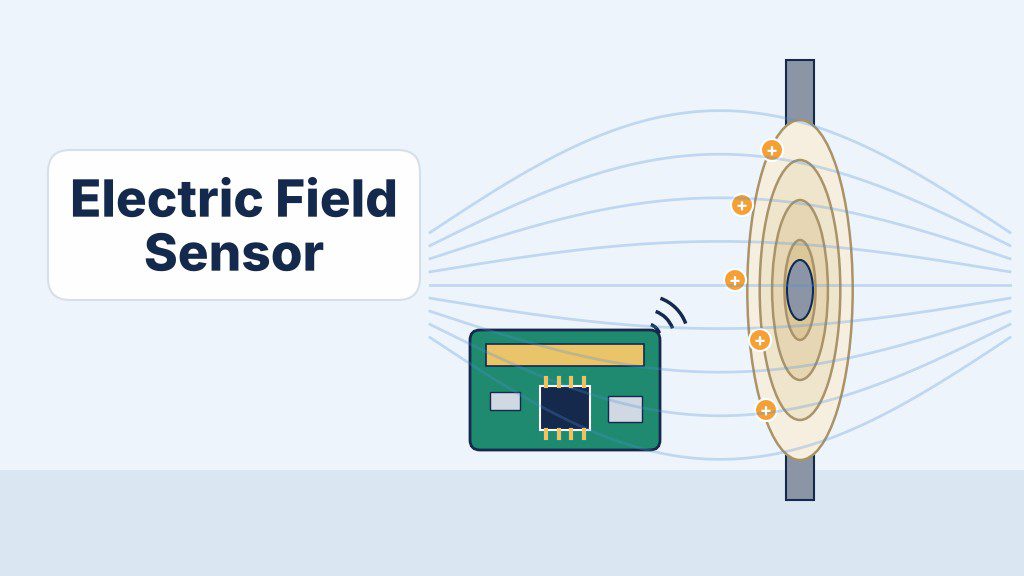
Rub a balloon on your hair, and it clings to the wall. Shuffle across a carpet, and a metal doorknob may bite your finger. Both tricks come from static charge. Static charge is, in short, electricity that stays put. The same effect also appears inside power grids, at far higher voltages. There, charge slowly settles on insulating parts and bends the electric field nearby. Because nobody can see that field, engineers rely on an electric field sensor. Most older tools, however, are bulky, wired or full of moving parts. So how do you watch static build up inside sealed, live equipment? One recent answer is a chip-sized design from a Tsinghua University study. This explainer therefore walks through the problem, the older tools and that newer fix.
For one thing, power grids increasingly move electricity as direct current at high voltages. According to the US Department of Energy, such lines waste less energy over long distances. Likewise, they can link grids that do not run in step. Direct current hides a quieter problem, though, inside the equipment itself. Its voltage keeps one direction, so stray charges keep drifting the same way. As a result, they pile up on insulating surfaces and struggle to leak away. Insulators are the solid parts that hold live conductors safely away from the grounded metal around them. Once charge sits there, it also distorts the field that designers carefully planned. In bad cases, that distortion ends in a flashover, a spark across the insulator. A 2026 review of insulator charging notes that makers often respond by enlarging the insulators. Bigger parts, of course, make the equipment larger and more expensive.
Explainer: What an Electric Field Actually Measures
An electric field, in essence, describes the push a charge feels at each point. Physicists measure it in volts per meter, written V/m. For example, 1,000 volts across a one-meter gap gives 1,000 V/m. Squeeze that voltage into one millimeter, and the field then jumps a thousandfold. That is why sharp edges and thin gaps worry high-voltage designers. Air itself gives up near 3 million V/m, as a college electromagnetics text explains. Beyond that limit, a spark jumps. Static fields are especially tricky because they barely change with time. In contrast, a changing field keeps nudging charges, so ordinary circuits can detect it. A steady field just sits there, so an electric field sensor must do something clever. Our earlier guide to electrostatic energy covers the basics of stored charge.
How an Electric Field Sensor Works Today
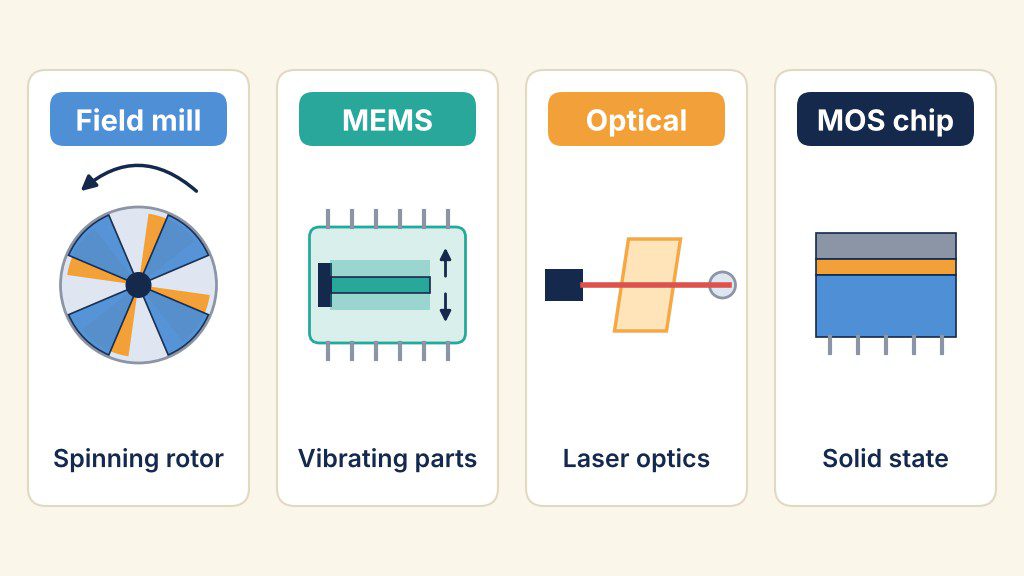
The classic electric field sensor for steady fields is the field mill. Inside it, a grounded rotor spins over a set of metal plates. The rotor alternately uncovers and then shields those plates from the field outside. When uncovered, the plates collect induced charge, and when shielded, they release it. As a result, a steady field becomes a pulsing signal that electronics can read. Weather teams, in particular, have trusted this trick for decades. For instance, a NASA technical report describes 31 field mills around Florida’s launch pads. Together, those mills help forecasters judge the lightning risk before a launch. Still, a spinning mill needs drive power and dislikes vibration. It is also hard to build into compact, sealed equipment.
Smaller Tools Bring New Trade-Offs
Engineers have therefore shrunk the idea onto silicon with MEMS technology. MEMS stands for microelectromechanical systems, which are tiny machines carved into chips. These sensors use vibrating shutters or resonating beams instead of a motor. Even so, the moving microstructures still raise reliability and packaging worries. Optical sensors take another route and read fields with light inside special crystals. Similarly, quantum sensors use atoms or diamond defects as tiny field probes. Both can be very sensitive, but they need external optics, careful tuning and extra readout equipment. For that reason, they are costly to scatter across a substation. Another snag applies to every electric field sensor, and it is the probe itself. A ground wire or long cable can disturb the very field under test. In other words, the measurement changes the thing it measures.
Fig. 1: Four Ways to Measure a Steady Field
A Chip-Based Electric Field Sensor That Measures Without Moving Parts
In November 2026, researchers at Tsinghua University in Beijing described a different approach. Xinting Liu, Shilin Wu, Jun Hu and colleagues built their electric field sensor around a MOS capacitor. MOS means metal-oxide-silicon, the same layered sandwich found inside computer chips. Their sensing element covers one square millimeter, far smaller than a rice grain. Its insulating oxide layer is only 100 nanometers thick. Nothing inside it spins or vibrates. Instead, the device responds by changing its capacitance. Capacitance is a component’s ability to store charge at a given voltage. Touchscreens rely on the same property, as our piece on how phones sense fingers explains. Because nothing moves during a measurement, there is no motor or shutter to drive. What is more, the whole module floats electrically, so it needs no ground wire.
Explainer: How a MOS Capacitor Senses a Field
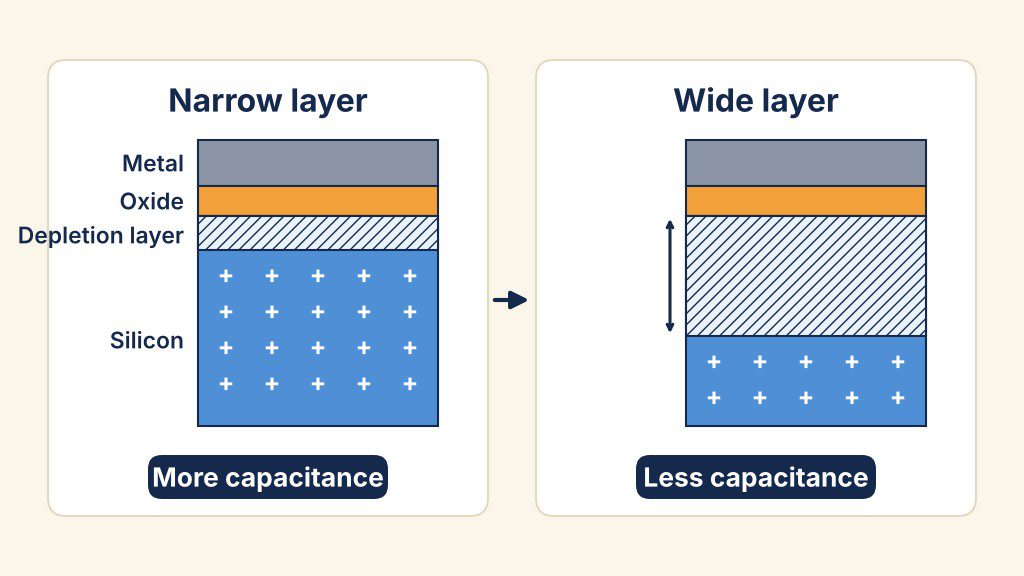
To illustrate, think of a capacitor as two metal plates facing each other. Move the plates apart, and the capacitor then stores less charge. A MOS capacitor can change that spacing without any moving parts. Its lower plate is silicon that holds mobile positive charges. When a voltage pushes those charges away from the oxide, an empty zone forms. Engineers call this zone the depletion layer, since free charges are depleted there. A wider depletion layer acts like a bigger gap, so capacitance drops. After that, add a small metal electrode that sits in the outside field. The field induces charge on that electrode, which behaves like a tiny voltage. Consequently, a stronger field reshapes the layer and shifts the capacitance. A bridge circuit, driven at 10 kilohertz, turns that shift into a readable signal.
Fig. 2: A Wider Depletion Layer Lowers Capacitance
What the Lab Tests Showed
How well does the idea work on the bench? After calibration between two metal plates, the sensor covered fields up to 1,000 kV/m in both directions. That is one million volts per meter. It could also resolve changes as small as 178 V/m. In addition, its output followed the field in an almost perfectly straight line. Over 400 up-and-down cycles lasting about 12 hours, drift still stayed below 1%. Likewise, a week under a constant field shifted the reading by under 1.5%. The complete wireless module fits on a board 36 by 24 millimeters. To test it, the team placed four units around a dish-shaped insulator. Together, they tracked charge arriving, fading and lingering, and showed where it entered. Finally, a scanning version resolved 180-micrometer features and mapped a power semiconductor’s surface.
Where Static Charge Monitoring Could Go Next
Why should anyone outside a lab care? Common lab methods mostly show charge only after the voltage is switched off. In contrast, embedded electric field sensors could report while the equipment runs. For now, makers of high-voltage gear can try such devices in lab testing. Within about five years, though, small wireless units could sit inside insulators and power modules. In the long run, sensor networks might support maintenance planned from data, not the calendar. That could matter for direct-current links and for electric-vehicle power electronics. Better sensing might also ease the pressure to oversize insulators. None of this is certain, of course, since the work remains a laboratory study. Our overview of smart grid technology shows where such monitoring fits.
Careers and Skills Behind Electric Field Sensing
This field blends power engineering, chip design and data skills. High-voltage and insulation engineers decide where charge is likely to gather. Sensor and semiconductor device engineers then design chips that can measure it. Reliability engineers test power electronics, while data engineers turn readings into warnings. The O*NET profile for electrical engineers also lists the tasks and skills involved. According to the US Bureau of Labor Statistics, electrical and electronics engineers earned a median $125,040. That figure is for May 2025, with 8% job growth projected through 2035. Note that these are US numbers, and pay differs between countries. With this in mind, consider electrical engineering, electronics, physics or embedded systems. Hands-on projects with microcontrollers and sensors make a strong starting point.
Limits Worth Keeping in Mind
Every promising electric field sensor comes with fine print, and this one does too. To begin with, all the results come from laboratory setups, not working substations. The design also suits only steady or slowly changing fields. Its main response fades above roughly 10 hertz, that is, ten cycles a second. Each unit also needs its own calibration. Temperature still nudges the output, although a compensation circuit helps. Specifically, that circuit cut temperature drift about seventeenfold in the team’s tests. A tiny reset relay also clears stray charge that would otherwise skew the zero point. The published tests ran for days, not the years that grid hardware must last.
On the whole, static charge will never vanish from high-voltage equipment. What can change is how early engineers notice it. Field mills proved that steady fields can be measured, but only with moving parts. MEMS, optical and quantum tools then shrank or sharpened the measurement. Now a plain chip structure hints at a simpler electric field sensor. If it survives real substations, hidden charge could become routine data. Until then, the balloon remains a fair reminder. Invisible fields are everywhere, so learning to measure them is worth your time. In short, the problem is old, yet the tools keep getting smaller. Students who enjoy both physics and electronics will find plenty to explore here.
References
Liu, X., Wu, S., Ye, Y., Jiang, X., Liang, F., Shen, X., Ye, W., Li, C., Zhang, B., Li, Q., He, J., & Hu, J. (2026). A miniaturized electrostatic field sensor based on MOS depletion-layer capacitance modulation. Nature Communications. https://doi.org/10.1038/s41467-026-79482-w
Tang, B., Xu, Y., Zhuo, R., Xiong, J., & Tang, J. (2026). Insulation design of gas–solid interface at HVDC condition-Part I: The research progress on surface charge accumulation and dissipation. Coatings, 16(2), 154. https://doi.org/10.3390/coatings16020154
Flinn, F. C., Roeder, W. P., Buchanan, M. D., McNamara, T. M., McAleenan, M., Winters, K. A., Fitzpatrick, M. E., & Huddleston, L. L. (2010). Lightning reporting at 45th Weather Squadron: Recent improvements. NASA Technical Reports Server. https://ntrs.nasa.gov/api/citations/20100038320/downloads/20100038320.pdf
The article builds from an everyday static shock to the engineering problem and explains field mills, micro-machined sensors and the depletion layer in terms a student can follow. It keeps the new chip-based sensor in proportion and states its limits, including laboratory-only testing and slow-field operation. A future update could add a worked example that links a capacitor's plate spacing to the charge it stores. For the complete methods and data, readers may wish to go to the source paper in Nature Communications.
Editorial note
ENTECH is running this explainer because hidden static charge is a growing concern as power grids add direct-current links and compact power electronics. The piece uses a recent Tsinghua University sensor study as one example of how engineers are trying to watch that charge from inside equipment. Students can follow how a textbook chip structure becomes a measuring tool, and where power, electronics and data careers meet. The sensor results come from laboratory tests, so readers are encouraged to consult the original paper for methods and full data.
Shreyas Kulkarni is a Chartered Electrical Engineer and renewable energy pioneer with over eight years of hands-on experience in the clean energy sector. He is the Co-Founder of UNICUS Energy, a leading provider of solar energy solutions in India, where he drives technical execution, system architecture, and clean tech deployment.
As an author for ENTECH Magazine, Shreyas focuses on making solar technology practical and understandable for students, engineers, and homeowners. His contributions include detailed guides on the inner workings of rooftop solar systems and deep dives into modern hardware advancements, such as lightweight solar panels and flexible photovoltaic materials.