Rooftop solar panels quietly charge phones, cool homes, and light streets every sunny day. Most of those panels use silicon, a material factories have refined for decades. Perovskite crystals offer a promising thin-film rival, but they stumble at larger sizes. Tiny lab cells now pass 28% efficiency, while bigger panels lose a large share. Now, a team in China reports a simple fix for perovskite solar mini-modules. In short, they briefly chill the wet film, so crystals grow more evenly. As a result, a 19.48 cm² mini-module reached a certified 23.9% efficiency. Buyi Yan, Jizhong Yao, and Dongchen Lan led the work. Their team spans Microquanta Semiconductor and Zhejiang University, both in Hangzhou. Partners include China Three Gorges Renewables in Beijing and an Australian photovoltaics center in Sydney. Together, they published the study in Nature Communications on October 29, 2026. Its DOI is 10.1038/s41467-026-78867-1 (Yan et al., 2026).
Why Perovskite Solar Mini-Modules Lose Power as They Grow
A solar cell turns sunlight into electricity, and a module links many cells together. In the lab, researchers usually test cells smaller than a fingernail. Those small cells look impressive because of their tiny, forgiving areas. Real panels, however, must cover large sheets of glass with one even film. When scientists scale up, small defects spread across the whole surface. For this reason, perovskite modules lose more efficiency than silicon panels during scale-up. Engineers call this drop the cell-to-module loss. A global efficiency table tracks the best cells and modules (Green et al., 2026). The gap between those two lists tells a clear story. Small perovskite cells sit near silicon, but perovskite modules still trail far behind. In other words, the material works, yet manufacturing it at size remains hard. Closing that gap, in fact, is central to practical panels, the authors write. So the team asked which part of the loss matters most.
Fill Factor: The Hidden Leak in Perovskite Solar Mini-Modules
Three numbers describe how well a solar cell performs. First, voltage measures the push behind the electric current. Second, current measures how many charges flow from the sunlight. On top of that, fill factor shows how much ideal power the device delivers. Think of fill factor as how full a cup gets before it spills. Using a fair-share math method, the team split the efficiency loss among those three numbers. Some current loss always comes from laser cuts that link cells in series. After setting that unavoidable loss aside, fill factor caused the biggest drop. In addition, fill factor fell steadily as devices grew across many published studies. That pattern points to one clear target for scale-up. Instead of chasing peak efficiency, the team focused on keeping fill factor high. Earlier ENTECH coverage of better perovskite crystals touched on similar film quality problems. Even so, this study traced the leak in finer detail.
The Science Explained: How a Quick Chill Builds Better Perovskite Films
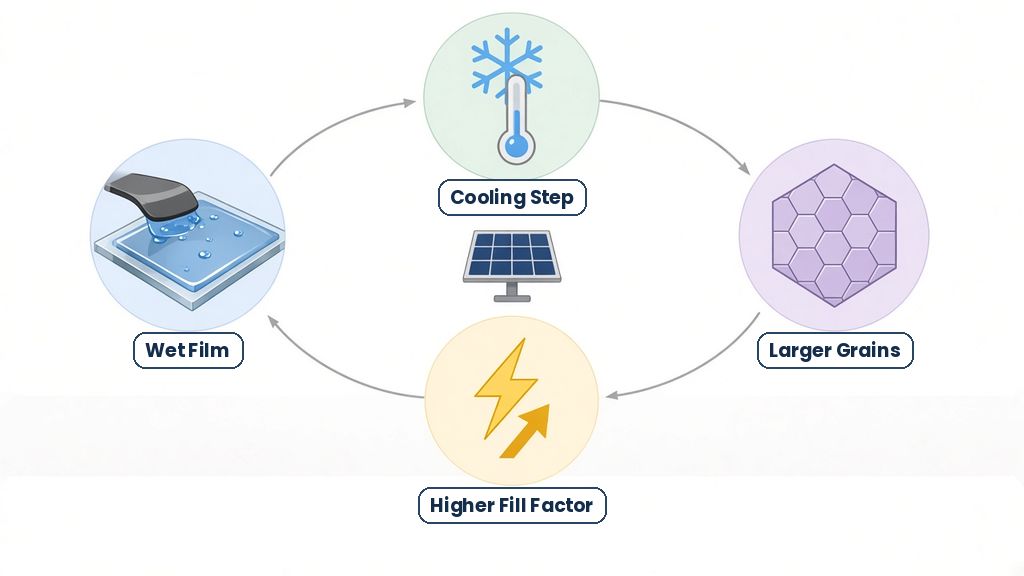
Perovskite films start as a wet liquid layer spread across glass. Next, factories usually pull a vacuum so that the solvent flashes away. During that drying, a temporary in-between phase forms before the final crystal. If that phase vanishes too fast, crystals grow unevenly and leave weak spots. For this reason, the team added one simple step, called cryo processing. They cooled the wet film for 15 seconds, down to 0 to 10 °C. Only then did the vacuum step begin. As a result of this chill, the in-between phase lasted longer. In turn, crystals had more time to settle into neat, even grains. Think of it like freezing cookie dough before baking, so shapes hold better. The U.S. Department of Energy (n.d.-a) explains how perovskite solar cells work. Similarly, the slower growth here gave the film fewer defects and smoother surfaces.
Fig. 1: How Cooling Helps Perovskite Films Grow
Smoother Films, Faster Electrons
Better crystals showed up clearly in the team’s measurements. First, the film’s light glow, called photoluminescence, grew much brighter. A brighter glow means fewer defects trap and waste the electric charges. In addition, surface roughness dropped from 35.0 to 21.2 nanometers. At the same time, electrons moved through the film more than twice as fast. Scientists also track a number called the ideality factor, which flags wasteful recombination. In this study, that factor fell from 1.29 to 1.15, closer to the perfect value. For comparison, a lower ideality factor means charges reach the wires instead of vanishing. Because of these changes, fill factor rose from about 80.0% to 84.5%. Most of that gain came from the lower ideality factor, not resistance. In other words, the chill mainly stopped charges from recombining inside the film. That single insight explains why the whole module improved.
What the Perovskite Solar Mini-Modules Achieved
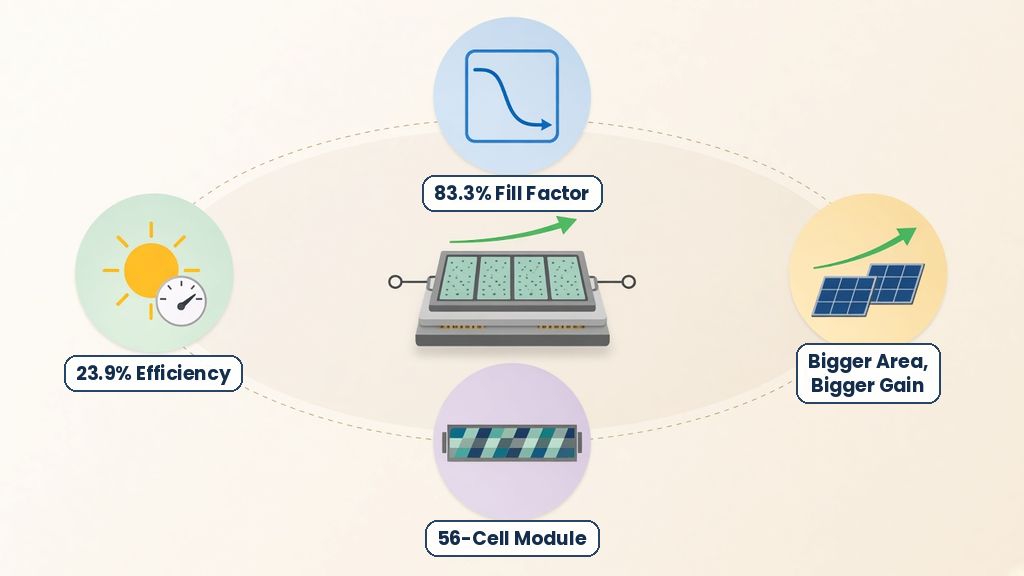
Next, the team built mini-modules with an aperture area of 19.48 cm². That is smaller than a playing card. Each one linked eight cells in series, and 97% of the area made power. Such a high share leaves very little wasted space. Lasers cut fine lines between cells so that current could flow onward. On the best device, the team also added an anti-reflection coating. The team then reported a certified steady-state efficiency of 23.9%. Its fill factor reached 83.3%, close to values for top silicon modules. The paper’s abstract calls this a record, yet its results section speaks more carefully. There, the authors place it among the highest-performing perovskite modules reported. For that reason, this article uses the cautious wording. Across 15 devices per group, the chilled modules also showed a narrower spread. In turn, steadier results matter greatly for any future factory line.
Fig. 2: Key Takeaways From the Mini-Module Study
Bigger Perovskite Solar Mini-Modules Gain More
Importantly, the fill factor gain grew as the devices got larger. That trend is exactly what manufacturers want from a scale-up method. On top of that, the same process produced a bigger module of 829.92 cm². It linked 56 cells across glass sheets measuring 30 by 40 centimeters. However, the detailed data for that large module sit in the supplementary files. So this article treats it as proof that the process scales, not as a result. At the same time, the chill helped devices age more slowly under light. In those tests, fill factor losses shrank more than threefold compared with control modules. For example, the ideality-linked fill factor loss fell from 11.8 to 5.3 points. Under ultraviolet light at 60 °C, chilled devices kept 80% of their efficiency longer. They held that level until a UV dose of nearly 150 kilowatt-hours. By contrast, control devices dropped below that mark before 100 kilowatt-hours.
Honest Limits of the Study
Still, these results come from small lab modules, not rooftop panels. The headline device covers only 19.48 cm², far smaller than a household panel. As well as that, the aging tests ran indoors under controlled light and heat. The paper reports UV doses rather than hours, so lifetimes stay unclear. Outdoor stability, therefore, remains unproven for this design. Rain, frost, and years of daily heat cycles could reveal new weak spots. In addition, the certification and large-module details appear only in supplementary files. Readers should keep both points in mind when they compare results. Even so, the study offers something useful beyond one efficiency number. It shows that keeping fill factor high is the real scale-up challenge. That lesson could guide many labs, not just this team. Earlier ENTECH stories on the perovskite energy revolution described similar hopes and hurdles. Overall, the honest takeaway is steady progress, not a finished product.
Business and Career Paths Around Perovskite Solar Mini-Modules
This study did not come from a university lab alone. Instead, two of three lead contacts work at Microquanta Semiconductor, a Hangzhou solar company. Zhejiang University supplied academic partners, while China Three Gorges Renewables joined from Beijing. That mix links lab science directly to solar manufacturing and power generation. For businesses, a process step that scales well can matter more than a lab record. In fact, the method used slot-die coating and laser scribing, both common in thin-film factories. As a result, a simple cooling step could fit existing coating lines. Of course, the paper does not report costs, so profits remain uncertain. The U.S. Department of Energy (n.d.-b) describes solar manufacturing as a key growth area. If stability improves, perovskite modules could someday compete with silicon at large scale. For now, companies need more outdoor data before they commit. Still, this kind of lab-to-factory teamwork shows where the field is heading.
Careers Around Perovskite Solar Mini-Modules
Teens who enjoy chemistry and hands-on building can find many roles here. For example, a photovoltaic process engineer tunes coating, drying, and cooling steps. A module reliability and test engineer runs light, heat, and UV aging tests. Thin-film materials scientists study crystals, defects, and surfaces with microscopes and lasers. In the same way, laser scribing and coating technicians keep production lines running smoothly. To prepare, focus on chemistry, physics, and algebra in high school. Later, college majors such as materials science or electrical engineering fit well. In addition, coding skills help, because engineers analyze large sets of test data. Science fairs, robotics clubs, and solar kit projects build useful hands-on experience. Our feature on perovskite solar panels offers more background for curious students. Above all, stay curious about why devices fail, not just how they work. That habit drives real progress in clean energy.
Conclusion
Perovskite solar cells already shine in the lab, yet bigger devices still lose power. In particular, this study pinpoints fill factor as the main leak during scale-up. To fix it, a 15-second chill before vacuum drying gave the film more even crystals. As a result, perovskite solar mini-modules reached a certified 23.9% efficiency and 83.3% fill factor. The fill factor gain also grew as devices got larger. On top of that, chilled devices aged more slowly under light and UV tests. Still, the headline device measures just 19.48 cm², and outdoor stability remains unproven. The large-module and certification details also sit in supplementary files. In short, the result marks careful progress, not a ready product. Even so, the message for engineers is clear and practical. Scaling, not peak efficiency, is now the main challenge for perovskite solar. Read the full study through its DOI (Yan et al., 2026). Then watch for outdoor tests, which will decide the next chapter.
References
Green, M. A., Dunlop, E. D., Yoshita, M., Kopidakis, N., Bothe, K., Siefer, G., & Jiang, J. Y. (2026). Solar cell efficiency tables: Version 68. Joule, 10(7), Article 102494. https://doi.org/10.1016/j.joule.2026.102494
Yan, B., Gong, R., Huang, Y., Gu, N., Li, R., Liu, D., Yan, K., Xu, X., Yang, Y. M., Yao, J., & Lan, D. (2026). Retarding efficiency loss upon scaling in perovskite photovoltaics as fill factor becomes the bottleneck. Nature Communications. Advance online publication. https://doi.org/10.1038/s41467-026-78867-1
I checked the brief against the Article in Press PDF. The key numbers match the paper: a certified steady-state efficiency of 23.9% and an FF of 83.3% on a 19.48 cm² eight-cell mini-module, an ideality factor that fell from 1.29 to 1.15, 15 devices per group in the efficiency comparison, an 829.92 cm² module with 56 cells, a more than threefold smaller FF-related aging loss, and a UV dose of nearly 150 kWh versus under 100 kWh before falling below 80%. The brief correctly avoids calling the 23.9% efficiency an outright record, since the Results text says “among the highest-performing.” Remaining limits are correctly flagged: the certification lab and large-module data are in supplementary files, and no stability duration in hours is given. Verdict: accurate; no corrections needed.
ENTECH runs this story because it moves perovskite solar research from small lab cells toward modules that can be built and sold. Solar maker Microquanta led the work with Zhejiang University and a China Three Gorges renewables company, so the industrial link is direct. For teens, it shows how materials chemistry, electrical measurements and process control decide whether a lab record becomes a product, and it points to roles in solar manufacturing, testing and thin-film engineering. The caveats matter: the certified record is on a 19.48 cm² mini-module, and long-term outdoor stability is still unproven. Takeaway: scaling up, not only peak efficiency, is now the main challenge for perovskite solar.
Shreyas Kulkarni is a Chartered Electrical Engineer and renewable energy pioneer with over eight years of hands-on experience in the clean energy sector. He is the Co-Founder of UNICUS Energy, a leading provider of solar energy solutions in India, where he drives technical execution, system architecture, and clean tech deployment.
As an author for ENTECH Magazine, Shreyas focuses on making solar technology practical and understandable for students, engineers, and homeowners. His contributions include detailed guides on the inner workings of rooftop solar systems and deep dives into modern hardware advancements, such as lightweight solar panels and flexible photovoltaic materials.