The pituitary gland is a small, pea-sized structure at the base of the brain, yet it plays a major role in controlling the body.
Understanding Pituitary Tumor Biology Through Transcription Factor Profiling
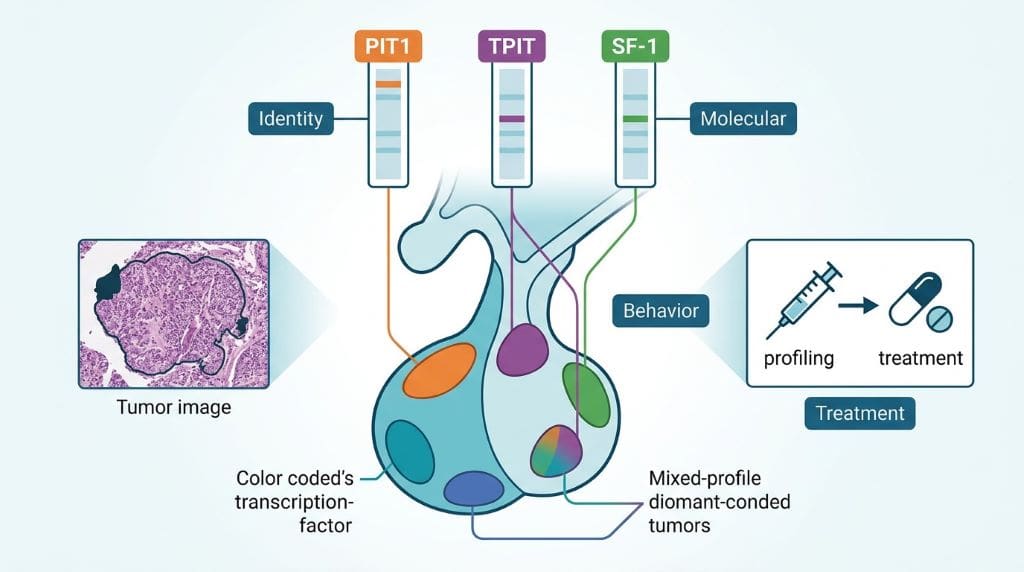
Transcription factor profiling is changing how we see pituitary tumors. Instead of guessing by shape alone, doctors now track key factors like PIT1, TPIT, and SF-1 to map tumor identity and behavior . In other words, each tumor leaves a molecular signature. Because of this, scientists can link gene activity with growth patterns and treatment response. For example, some tumors show mixed signals, while others follow a clear lineage path. As research moves forward, this approach makes diagnosis simpler and more precise. In turn, better profiling may lead to smarter and more personal treatments for patients.
TL;DR ‘Transcription Factor Profiling’
Transcription factor profiling helps doctors see tumor type more clearly. In this way, markers like PIT1, TPIT, and SF-1 guide simple tumor grouping. Because of this, scientists link gene signals with growth and risk. As a result, care becomes easier, faster, and more personal.
Key Points to Know
| Point | What It Means |
|---|---|
| What are PitNETs? | Growths in a small gland in your brain |
| Why care? | They mess with your body’s hormones |
| Jobs in this field | Doctors, scientists, and coders are needed |
| School subjects | Biology, chemistry, and math are key |
| New science | Gene studies help find better treatments |
What Is the Pituitary Gland?
Your brain has a small gland at its base. It is the size of a pea, yet it does big jobs. This gland makes hormones, which act like tiny messages. In this way, they tell your body what to do. They help you grow, sleep, and feel. Because of this, your body stays in balance. In addition, scientists use transcription factor profiling to study how this gland works and how its cells form. As a result, doctors can better understand changes in these cells.
What Are PitNETs?
PitNETs are tumors that grow in this small gland. Most are not cancer and do not spread. Even so, some can be hard to treat. These tumors are quite common; in fact, they are the second most common brain tumors and make up about 17% of cases. Because of this, many people are affected. In addition, scientists use transcription factor profiling to better understand these tumors and how they behave.
How Do They Hurt the Body?
Some tumors make too many hormones, and this can upset your body. In contrast, some tumors make no hormones and simply grow and press on the brain. Because of this, symptoms can differ from person to person. For example, prolactin tumors can cause milk flow and change periods. In addition, growth hormone tumors can make hands and feet grow too large. Also, ACTH tumors can lead to weight gain and high blood pressure. Meanwhile, null cell tumors do not make hormones at all. In this way, transcription factor profiling helps doctors sort these tumors by their cell type and behavior.
The Cool Science of Genes and Tumors
Scientists study the DNA inside tumors to learn more. In this way, they look for clues about how the tumors grow. Because of this, they can see why some tumors act more aggressively. In addition, this helps them find better ways to treat them.

What Causes These Tumors?
Most tumors happen by chance. About 90% are random. Only 5-10% run in families. Genes play a big role.
| Tumor Type | Gene Change | What Happens |
|---|---|---|
| Prolactin tumor | SF3B1 | Tumor grows fast |
| Growth hormone tumor | GNAS | Too much hormone made |
| ACTH tumor | USP8 | Body makes too much stress hormone |
| Null cell tumor | HIPPO path | Cells don’t grow right |
Scientists use this info. They can guess how a tumor will act. This helps pick the best treatment.
What Is Epigenetics?
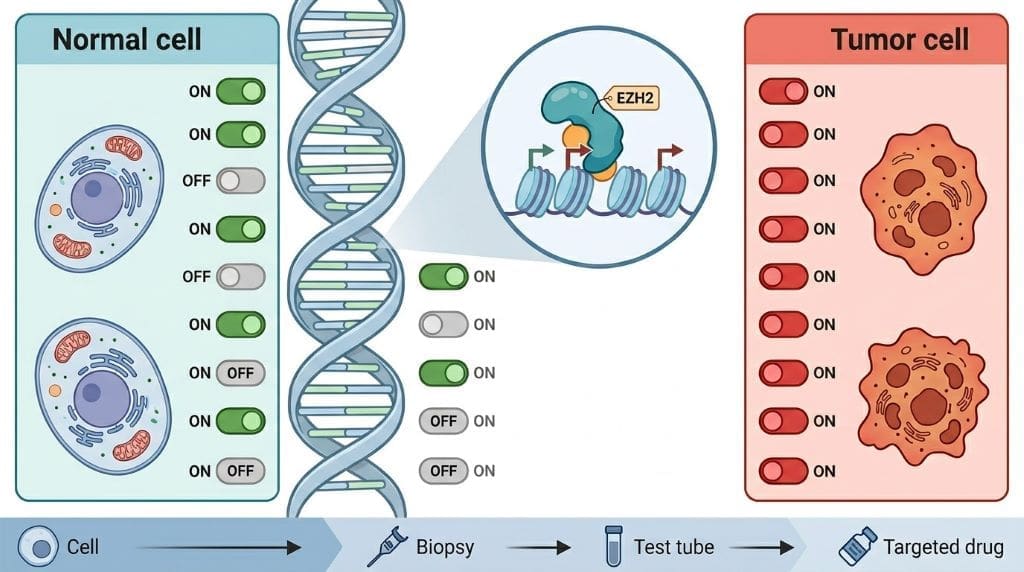
Genes can switch on or off, and this is called epigenetics. In this way, they act like simple light switches. Some stay on, while others stay off. Because of this, problems can start when the wrong genes stay active. In addition, a protein called EZH2 can become too high in some tumors. As a result, these tumors can grow fast and spread more easily.
New Drugs Being Tested
Doctors test new drugs in patients, and this is called a clinical trial. In this way, some drugs target specific genes found in tumors. Because of this, treatments can become more precise. In addition, transcription factor profiling helps match the right drug to the tumor type. For example, one drug shrank a tumor by 22%, while another made a tumor disappear. As a result, these findings give real hope.
Jobs in Pituitary Tumor Science.
Doctor Jobs
Brain surgeons remove tumors through the nose, and it works well. In this way, they use skill built over many years to save lives. In addition, hormone doctors treat patients with pills and check hormone levels often. Because of this, they can adjust doses and help people feel normal again. Meanwhile, pathologists study tumors under a microscope. They use transcription factor profiling to find the tumor type. As a result, their work guides the full treatment plan.
Science Jobs
Lab scientists study tumor DNA and find new gene changes. In this way, they work toward better cures, and many have a PhD. In addition, they use transcription factor profiling to understand how tumors form and behave. Meanwhile, genetic counselors talk with families and explain test results. Because of this, they help people make clear choices, and they often hold a master’s degree. Also, data coders use computers to study large data sets. As a result, they find patterns and help speed up research
How to Get Ready in High School
Start now. Pick the right classes. Build the right skills. Your future starts today.
Best Subjects to Take
Biology is a great place to start, as it shows how cells and DNA work. In this way, it builds the base for everything, including ideas like transcription factor profiling. In addition, chemistry explains how drugs act in the body through atoms and reactions. Because of this, you can see how treatments connect to health. Also, math helps you study data, and stats are key for research. As a result, strong math skills support good science work. Meanwhile, physics explains scans like MRI and CT. In this way, you can understand how these tools work.
Things You Can Do Now
- Take AP Biology if you can
- Learn to code in Python
- Join a science club
- Help out at a local hospital
- Read about brain tumors online
- Practice writing and speaking
Summer Ideas
Many colleges offer summer programs for high school students. In this way, you can work in real labs and gain hands-on experience. Because of this, your applications can stand out. In addition, free courses are easy to find online. Khan Academy is free, and Coursera offers many good options. You can learn genetics and even topics like transcription factor profiling at your own pace. Meanwhile, you can reach out to local scientists by email and ask to visit their labs. As a result, many may say yes, and a mentor can help guide your path.
What’s Next for This Field?
Science is moving fast, and new tools keep finding more gene changes. In this way, doctors learn more each year and improve care. Because of this, treatment may soon be personal—your tumor, your genes, your own plan. In addition, methods like transcription factor profiling help guide these choices. As a result, this field needs young minds and fresh ideas. You could be the one to find the next big cure..
Wrap-Up
PitNETs affect many people, and the science behind them is exciting. In this way, the field offers meaningful and rewarding work. Because of this, more help and fresh ideas are needed. In addition, you can start early by taking biology and chemistry in high school. Stay curious and keep asking questions. As a result, you can make a real difference, and your work may help save lives.
Frequently Asked Questions
What are Pituitary Neuroendocrine Tumors (PitNETs) and how are they classified?
Pituitary neuroendocrine tumors, formerly known as pituitary adenomas, are neoplasms arising from the anterior pituitary gland that exhibit significant biological diversity. The current World Health Organization classification has shifted toward a lineage-based system that utilizes specific transcription factors to identify cell types
Which molecular drivers are responsible for the development of these tumors?
The development of PitNETs is a complex process driven by the interplay of various signaling centers and tightly regulated transcription factors. Key factors such as PITX1 and PITX2 are essential for the initial formation of Rathke’s pouch, while LHX3 and LHX4 promote subsequent cell proliferation
Why do some pituitary tumors exhibit more aggressive behavior than others?
While many PitNETs are benign and slow-growing, a subset displays aggressive characteristics such as rapid invasiveness, treatment resistance, and high recurrence rates. These aggressive phenotypes are often linked to specific molecular signatures, including chromosomal instability and the overexpression of certain cell cycle regulators
Reference
Kidwell, R.L., Trippett, J. & Aghi, M.K. Molecular biology of pituitary neuroendocrine tumors. J Neurooncol 176, 197 (2026). https://doi.org/10.1007/s11060-026-05447-0
- Author
- Latest Posts

I completed my Master of Science from the University of Allahabad in 2017 with a strong academic background in life sciences and chemistry. My specialization included Molecular Biology, Microbiology, Genetics, Plant Breeding, Phycology, Paleobotany, and Bioinformatics, along with Organic Chemistry, Inorganic Chemistry, and Physical Chemistry. This multidisciplinary training provided me with a comprehensive understanding of biological systems and analytical scientific approaches.
After completing my postgraduate studies, I gained valuable professional experience in both the education and social development sectors. I worked at A.M. Oxford Public School, where I was actively involved in guiding students toward academic excellence. In this role, I focused on creating an engaging learning environment, encouraging critical thinking, and nurturing students’ curiosity for scientific learning. My experience as an educator strengthened my communication, mentoring, and classroom management skills.
In addition to my teaching experience, I worked with Jeevan Jagriti Foundation, where I contributed to community-based initiatives aimed at improving educational access and awareness among underprivileged sections of society. Through this work, I participated in programs designed to support social development and promote the value of education in marginalized communities.
These professional experiences helped me develop strong interpersonal, leadership, and organizational skills while reinforcing my commitment to education and community service.