The study shows that prion-based switching in DNA repair and recombination proteins controls mutation rates in a way that cells can pass to future generations and later reverse.
Prion Based Mutagenesis Alters Recombination Proteins For Adaptation
For many years, scientists believed that messenger RNA (mRNA) had one main job: carrying genetic instructions from DNA to the cell’s protein-making machinery. However, new research published in Cell shows that mRNA does much more. The study found that the 3′ untranslated region (3′ UTR) of mRNA helps newly made proteins fold into the correct shape. In addition, it helps them work properly. In other words, the 3′ UTR acts like a molecular chaperone. Prion Based Mutagenesis is another area that could be influenced by these findings. It guides protein formation. This discovery changes our understanding of how genes control protein function. Moreover, it may lead to new advances in disease research, protein biology, and RNA-based medicines.
Key Takeaways
- Scientists discovered that some mRNA 3′ untranslated regions (3′ UTRs) do much more than regulate mRNA stability and protein production.
- These highly conserved 3′ UTRs guide proteins into their correct shape while cells make them.
- More than 2,700 human mRNAs contain highly conserved 3′ UTRs. This shows that this mechanism exists across many species. Moreover, it has remained important throughout evolution.
- Most of these mRNAs produce proteins with long intrinsically disordered regions (IDRs). This highlights the important role of the 3′ UTR in protein folding.
- The 3′ UTR acts as an RNA chaperone. It guides proteins during their formation instead of changing protein levels or locations.
- During protein synthesis, the 3′ UTR interacts with the growing protein and directs it toward the correct shape.
- The 3′ UTR encourages helpful interactions between intrinsically disordered regions (IDRs).
- The 3′ UTR prevents unwanted interactions between IDRs and structured parts of the protein.
- The 3′ UTR reduces protein-folding errors during protein synthesis and helps proteins become stable and functional. The concept of mutagenesis based on prions helps expand this molecular understanding, particularly in the context of Prion Based Mutagenesis and protein formation.
Prion Switching as a Heritable Mutagenesis Mechanism
/
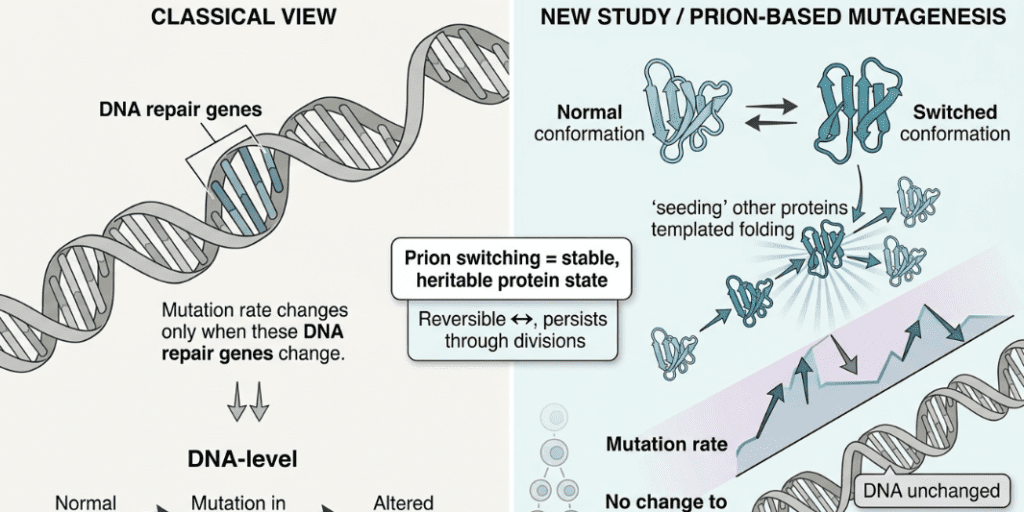
For many years, scientists believed that mutation rates depended only on genes that control DNA repair. They thought mutation rates changed only when these genes changed. However, a new study published in Cell reveals a different process. The researchers found that prion switching can temporarily increase or decrease mutation rates without changing the DNA itself. In the realm of mutagenesis, these findings support the importance of prion-based mechanisms.
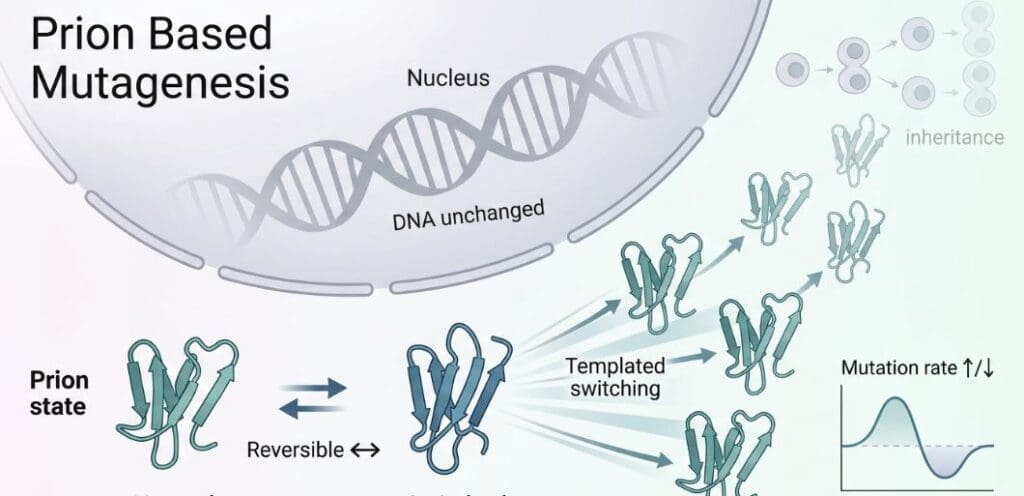
Prions are proteins that fold into a special shape and pass that shape to other copies of the same protein. This process creates stable, heritable changes in cell behavior without altering DNA. Unlike DNA mutations, prion states can switch back to their original form, although they can remain stable through many cell divisions. This reversible switching is a fundamental aspect of Prion Based Mutagenesis, connecting prion biology to the inheritance of genetic change.
Prion-Based Switching of DNA Repair and Recombination Proteins
- The researchers found that several proteins involved in DNA repair and homologous recombination can form prion-like structures, a phenomenon that highlights prion based pathways in mutagenesis.
- When these proteins enter their prion form, they change how they work and how they interact with other proteins.
- These changes affect the way cells maintain and repair their genomes.
- As a result, cells produce different numbers and types of mutations while still surviving DNA damage, linking prion states directly to mutagenesis mechanisms.
- This process acts as a reversible mutagenesis switch.
- During stressful conditions, the switch increases genetic diversity by raising mutation rates—a strategy rooted in the interplay between prion state changes and mutagenesis.
- More genetic diversity gives some cells a better chance of developing helpful mutations that improve survival, highlighting the adaptive benefits of prion-based mutagenesis in evolution.
- When conditions become favorable again, the proteins leave their prion state.
- The cells then return to their normal mutation rate and maintain genome stability, demonstrating the dynamic nature of prion-based mutagenesis control.
Conclusion
The study shows that prion-based switching in DNA repair and recombination proteins controls mutation rates in a way that cells can pass to future generations and later reverse. In summary, these findings build a strong case for the broad role of Prion Based Mutagenesis in cellular adaptation and heredity.
These proteins form self-templating structures that change how cells maintain and repair their genomes. As a result, cells create an epigenetic memory that increases genetic diversity without changing the DNA permanently—which is a hallmark of how Prion Based Mutagenesis sets itself apart from other mutation mechanisms.
This flexible system helps populations adapt quickly to environmental stress while protecting long-term genome stability; the flexibility of mutagenesis through prion-based switches ensures evolutionary resilience.
Frequently Asked Questions
What is prion-based switching in DNA repair proteins?
Prion-based switching occurs when DNA repair and recombination proteins change into a different self-templating shape. Cells can pass this protein state from one generation to the next. This change affects how cells maintain genome stability without altering the DNA sequence itself.
How does prion-based switching affect mutation rates?
When DNA repair proteins switch to a prion state, they change how they work and how they interact with other proteins. These changes affect how well cells repair DNA. As a result, cells produce different numbers and types of mutations. This increase in genetic diversity can help organisms adapt to changing or stressful environments.
Why is reversible mutagenesis beneficial for evolution?
Most mutations do not help an organism. Many mutations cause harm, while others have no effect. Therefore, a permanently high mutation rate can create serious problems. A reversible mutagenesis switch solves this problem by increasing genetic variation only during stressful conditions. When the stress ends, the switch returns mutation rates to normal and helps protect genome stability.
Reference
Van Elgort, A., Jakobson, C. M., Chen, Y. R., Byers, J. S., Futia, R. A., Lozanoski, T. M., Harvey, Z. H., Xie, J. L., Garcia, D. M., & Jarosz, D. F. (2026). Prion-based protein self-assembly tunes mutagenesis to enable rapid adaptation. Cell. Advance online publication. https://doi.org/10.1016/j.cell.2026.05.018 This reference details the central findings relevant to Prion Based Mutagenesis in modern genetics.
- Author
- Latest Posts

I completed my Master of Science from the University of Allahabad in 2017 with a strong academic background in life sciences and chemistry. My specialization included Molecular Biology, Microbiology, Genetics, Plant Breeding, Phycology, Paleobotany, and Bioinformatics, along with Organic Chemistry, Inorganic Chemistry, and Physical Chemistry. This multidisciplinary training provided me with a comprehensive understanding of biological systems and analytical scientific approaches.
After completing my postgraduate studies, I gained valuable professional experience in both the education and social development sectors. I worked at A.M. Oxford Public School, where I was actively involved in guiding students toward academic excellence. In this role, I focused on creating an engaging learning environment, encouraging critical thinking, and nurturing students’ curiosity for scientific learning. My experience as an educator strengthened my communication, mentoring, and classroom management skills.
In addition to my teaching experience, I worked with Jeevan Jagriti Foundation, where I contributed to community-based initiatives aimed at improving educational access and awareness among underprivileged sections of society. Through this work, I participated in programs designed to support social development and promote the value of education in marginalized communities.
These professional experiences helped me develop strong interpersonal, leadership, and organizational skills while reinforcing my commitment to education and community service.