Gibberellin Flower Development Improves Understanding of Squash Fertility
Gibberellin Flower Development Controls Female Squash Flower Growth
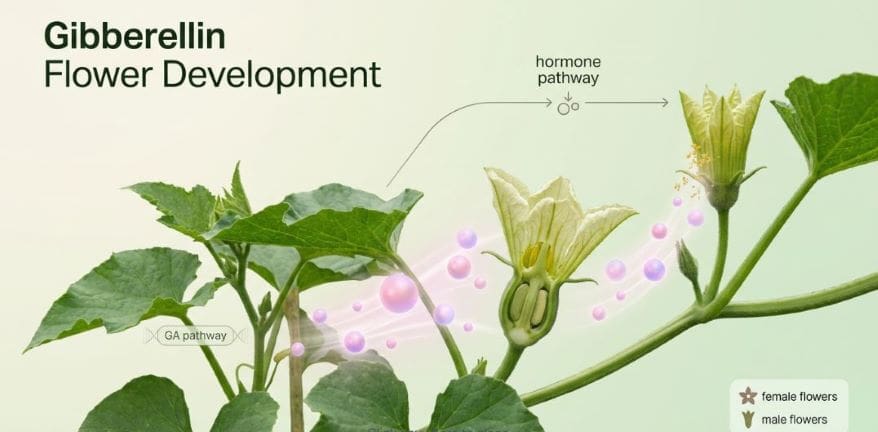
Plants use hormones to grow, flower, and make seeds. In squash (Cucurbita pepo), researchers found that a change in the ga3ox1b gene stops the plant from making enough gibberellin, an important growth hormone. Because of this, female flowers stay small, do not open, and cannot produce seeds. Male flowers, however, grow normally. The study also showed that gibberellin flower development works with other plant hormones, such as auxin, cytokinin, ethylene, abscisic acid, and jasmonic acid. These hormones work together to help female flowers grow and develop properly. This research helps scientists better understand how flowers form and reproduce. It may also help farmers and plant breeders grow healthier squash plants and improve crop yields in the future.
Key Takeaways
- Scientists studied the ga3ox1b gene in squash (Cucurbita pepo). This gene helps the plant make gibberellin, an important growth hormone.
- A mutation in ga3ox1b reduced the amount of active gibberellin in the plant.
- Plants with the mutation were shorter and showed poor growth.
- Female flowers were strongly affected. They stayed small, did not open, and were unable to produce seeds.
- Male flowers developed normally and remained fertile even when the mutation was present.
- Female flowers normally produce more gibberellin than male flowers, which helps them grow faster.
- Adding gibberellin to mutant plants restored normal growth and flower development.
Discovery of the ga3ox1b Mutation
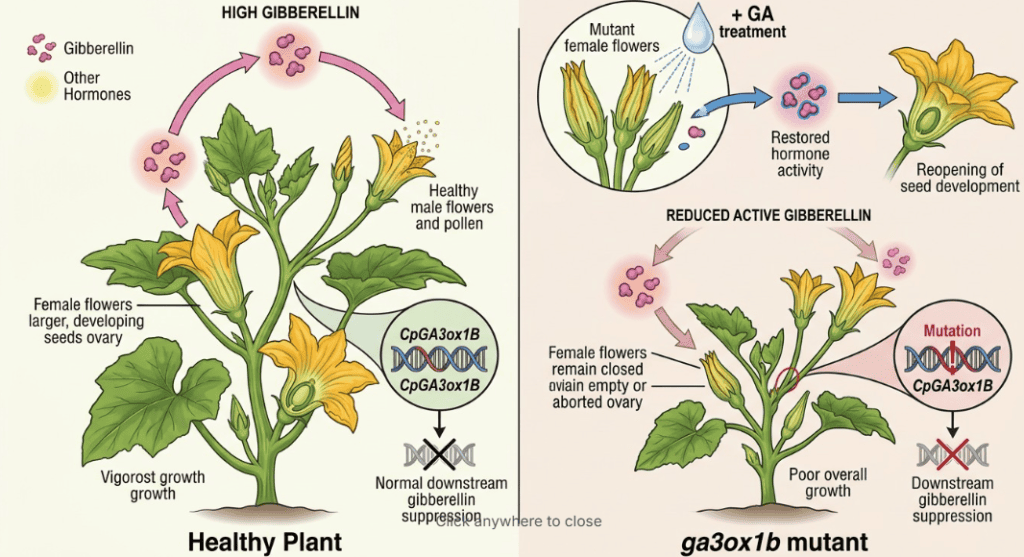
Scientists discovered a mutation in the CpGA3ox1B gene, a gene that helps squash plants make gibberellin, an important growth hormone. The mutation reduced the amount of active gibberellin in the plant. As a result, the plants became shorter and showed poor growth. The most striking effect was seen in female flowers. These flowers stayed small, did not open, and could not produce seeds. In contrast, male flowers grew and functioned normally. Researchers also found that healthy female flowers normally produce more gibberellin than male flowers, helping them grow faster and reach maturity. When mutant plants were treated with gibberellin, normal growth and flower development returned. This confirmed that the ga3ox1b mutation was responsible for the growth defects. The discovery revealed that gibberellin plays a key role in female flower development and works closely with other plant hormones to control flower growth and fertility.
Interactions Between Gibberellin, Ethylene, and Jasmonic Acid
Plant hormones work together to help flowers grow and develop. In this study, researchers found that gibberellin, ethylene, and jasmonic acid are closely connected. These hormones do not act on their own. Instead, they work together to support the normal growth of female flowers.
When the ga3ox1b mutation lowered gibberellin levels, changes also occurred in the genes linked to ethylene and jasmonic acid. This showed that the three hormones are part of the same growth system. A change in one hormone can affect the others.
Implications for Squash Breeding
- Researchers found that the ga3ox1b gene helps squash plants make gibberellin, an important growth hormone.
- When this gene did not work properly, plants produced less gibberellin, and female flowers stayed small, failed to open, and became sterile.
- Female flowers produce fruit, so breeders need healthy female flowers to achieve high crop yields.
- Researchers showed that gibberellin works with other hormones, including auxin, cytokinin, ethylene, abscisic acid, and jasmonic acid.
- Breeders can use this knowledge to improve flower growth and fertility in squash plants.
- Scientists restored normal growth and flower development by adding gibberellin to mutant plants.
Frequently Asked Questions
What is the ga3ox1b gene?
The ga3ox1b gene helps squash plants make gibberellin, a hormone that helps plants and flowers grow. Researchers found that this gene plays a key role in the growth and development of female flowers.
What happens when the ga3ox1b gene is mutated?
A change in the ga3ox1b gene reduces the amount of active gibberellin in the plant. Because of this, the plants grow shorter. Female flowers also remain small, do not open, and cannot produce seeds.
Why are female flowers affected more than male flowers?
Female flowers usually make more gibberellin than male flowers. They need this hormone to grow and develop well. When gibberellin levels become too low, female flowers do not develop properly. Male flowers, however, continue to grow normally.
Reference
Gautam, K., et al. (2026). The ga3ox1b mutation reveals the crosstalk between gibberellin and other phytohormones in controlling the growth and development of female flowers in Cucurbita pepo. Journal of Experimental Botany. Advance online publication. https://doi.org/10.1093/jxb/erag324
- Author
- Latest Posts

I completed my Master of Science from the University of Allahabad in 2017 with a strong academic background in life sciences and chemistry. My specialization included Molecular Biology, Microbiology, Genetics, Plant Breeding, Phycology, Paleobotany, and Bioinformatics, along with Organic Chemistry, Inorganic Chemistry, and Physical Chemistry. This multidisciplinary training provided me with a comprehensive understanding of biological systems and analytical scientific approaches.
After completing my postgraduate studies, I gained valuable professional experience in both the education and social development sectors. I worked at A.M. Oxford Public School, where I was actively involved in guiding students toward academic excellence. In this role, I focused on creating an engaging learning environment, encouraging critical thinking, and nurturing students’ curiosity for scientific learning. My experience as an educator strengthened my communication, mentoring, and classroom management skills.
In addition to my teaching experience, I worked with Jeevan Jagriti Foundation, where I contributed to community-based initiatives aimed at improving educational access and awareness among underprivileged sections of society. Through this work, I participated in programs designed to support social development and promote the value of education in marginalized communities.
These professional experiences helped me develop strong interpersonal, leadership, and organizational skills while reinforcing my commitment to education and community service.