AI data centers run hot, and their chips keep getting hotter. For this purpose, many operators now sink servers in liquid coolant. However, small spots on a chip can overheat within seconds. Now engineers at the University of Waterloo in Canada propose a cheaper fix. Their hybrid immersion cooling method pairs plain water with one boiling drop. In lab tests, a single drop cooled a simulated hotspot by up to 17 °C. Notably, that cooling took only 15 seconds from start to finish. The university announced the work on November 10, 2026, in an official news release. So how can one tiny drop make such a difference?
A processor rarely heats up evenly across its whole surface. Instead, heavy workloads can make small areas far hotter than the rest. As a result, these transient hotspots slow chips down and age them faster. They also make the hardware less reliable over time. AI workloads, in particular, can shift from light to heavy very quickly. In single-phase immersion, the coolant stays liquid as it absorbs heat. For that reason, it often reacts too slowly to a sudden spike. Two-phase immersion uses boiling instead, which removes heat far more strongly. On the other hand, it needs costly special fluids throughout the tank. It is also hard to switch on exactly where a hotspot appears.
Explainer: Why Boiling Removes So Much Heat
Heating a liquid normally raises its temperature step by step. At the boiling point, however, something different happens. The added energy breaks the liquid into vapor instead of warming it further. Scientists call this hidden energy the latent heat of vaporization. For example, turning one gram of water into steam takes about 2,260 joules. In other words, boiling soaks up heat while the temperature stays fixed. Moreover, the rising bubbles stir the nearby liquid like a tiny pump. That mixing, in effect, pulls fresh, cooler liquid toward the hot surface. Both effects together explain why boiling is such a strong cooling tool. For this reason, hybrid immersion cooling tries to harness boiling only where needed.
How Hybrid Immersion Cooling Works
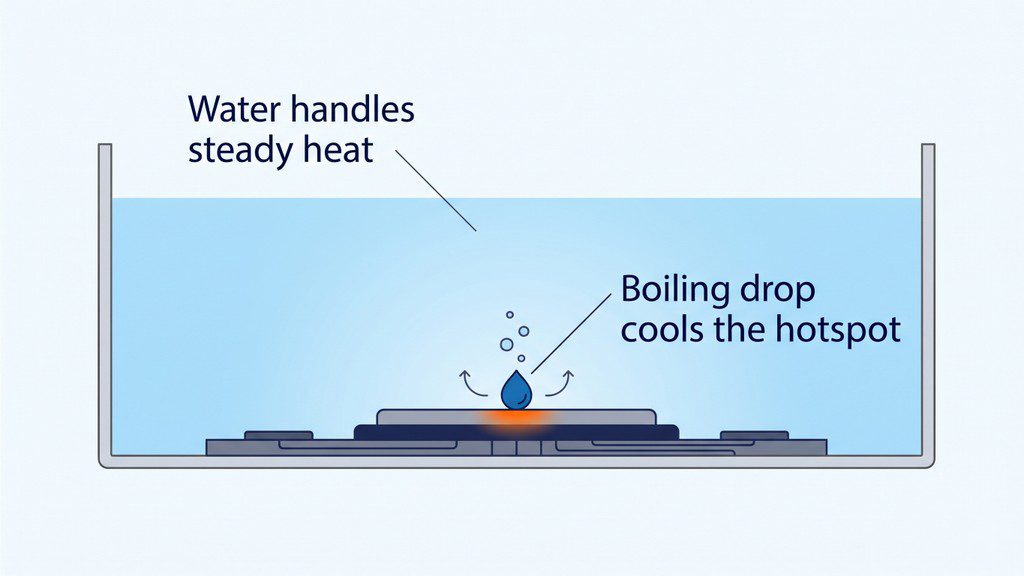
The Waterloo team describes its idea as a division of labor. To begin with, cheap deionized water fills the tank and handles steady heat. Then a single drop of electronics coolant sits right on the hotspot. This coolant boils at a much lower temperature than water does. In addition, it is heavier than water, so the two liquids do not mix. As a result, the drop stays put once it is placed on the hotspot. When the spot heats up, the drop boils and absorbs a burst of heat. At the same time, its bubbles stir the water so it carries heat away faster.
Fig. 1: Water Handles Steady Heat While a Boiling Drop Tackles the Hotspot
Choosing the Right Boiling Coolant Drop
The trick depends on picking a liquid with the right properties. First, it must boil well below water so that only the drop changes phase. Second, it must be denser than water so it sinks onto the chip. Third, it must not mix with water, or the drop would simply spread out. In this case, specialty electronics coolants meet all three demands. These fluids are expensive, so using only a few drops keeps costs down. Meanwhile, ordinary water does the bulk of the everyday cooling work. Consequently, hybrid immersion cooling needs far less of the costly fluid. That is why the team calls the approach both cheaper and more efficient.
A 17 °C Drop in 15 Seconds
In laboratory tests, the team heated a small area to mimic a chip hotspot. After that, they submerged this simulated hotspot in a tank of water. Then they placed a single coolant drop directly on top of it. As the drop boiled, the hotspot cooled by up to 17 °C within 15 seconds. According to the university, that is several times faster than conventional immersion. The paper’s abstract also notes that the team compared other immersion strategies. For instance, they varied the heat flux, the immersion depth and the drop size. Across these tests, the hybrid method showed rapid, targeted hotspot cooling. Even so, the exact gain depends on the test conditions.
How the Team Measured It
To begin with, the researchers watched temperatures with an infrared camera. This method, called infrared thermography, maps heat without touching the surface. At the same time, a high-speed camera filmed the bubbles as they formed. Because both cameras were synchronized, the team could link each bubble burst to cooling. In this way, they could see how boiling and stirring worked together. The team includes professor Sushanta Mitra, postdoc Tian-Yu Zhang and PhD student Arnav Banerjee. Mitra is a professor of mechanical and mechatronics engineering at Waterloo. He also leads the Waterloo Institute for Nanotechnology as its executive director. Overall, these tools gave a detailed view of hybrid immersion cooling at work.
Coated Drops That Boil on Cue
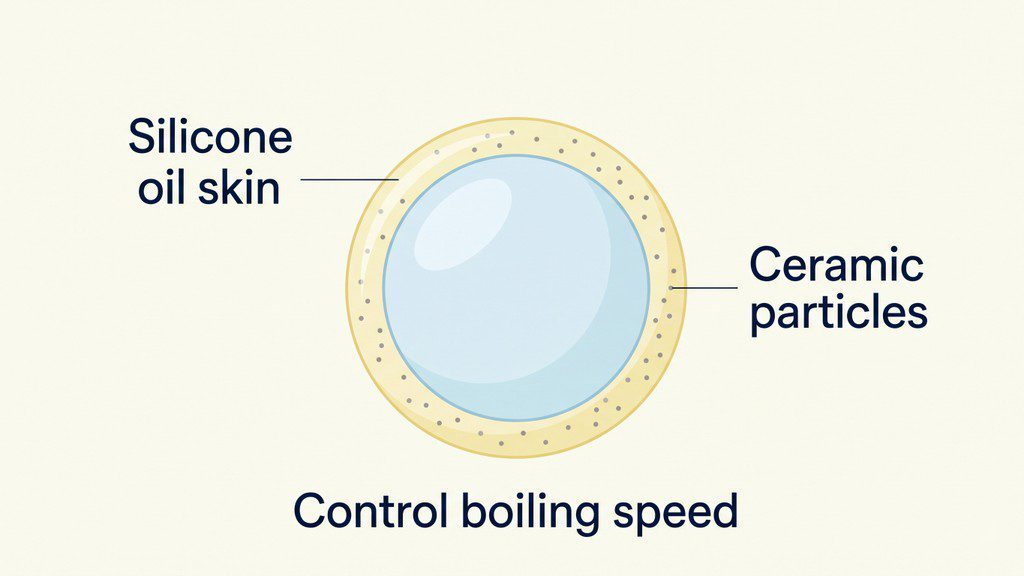
Next, the team built on its earlier work on wrapping one liquid inside another. Using a gravity-driven encapsulation method, they coated coolant drops in silicone oil. That thin oil skin changes how the drop behaves as it heats. In addition, the team mixed tiny heat-conducting ceramic particles into the coating. These particles help control how quickly each coated drop starts to boil. The abstract calls this programmable boiling through careful interface engineering. In other words, engineers could tune drops for different kinds of hotspots. This flexibility matters because hotspots vary from chip to chip.
Fig. 2: A Coated Drop Lets Engineers Tune When It Boils
From Lab Bench to Server Rack
The researchers imagine two ways to use the drops in real systems. In the first, coated drops would circulate freely through the water. They would then activate only when they reach a hotspot. In the second, sensors would instead detect a hotspot and deliver a drop. Both ideas, however, remain future concepts that have not been built. For now, the work is a lab demonstration on a simulated hotspot. Even so, it shows how targeted boiling could complement cheap water cooling. You can read the study in the Journal of Colloid and Interface Science.
Business Opportunities in Chip Hotspot Cooling
Cooling is a large and growing cost for AI computing. According to the International Energy Agency, data centers used about 415 TWh in 2024. That figure was roughly 1.5% of global electricity use. Moreover, the agency projects about 945 TWh by 2030. By comparison, cooling takes about 7% to over 30% of a data center’s power. With this in mind, cheaper hotspot cooling could attract immersion-cooling companies soon. Within five years, the method could be tested in immersion-cooled AI servers. The university also points to electric vehicles, batteries, high-powered lasers and LED lighting. Our guide to energy-efficient options for server rooms covers today’s main methods.
Careers and What to Study
Hybrid immersion cooling sits where fluids, materials and electronics meet. For example, thermal engineers design cooling systems for data centers and vehicles. Likewise, thermal-fluids researchers study boiling, bubbles and heat flow in labs. Electronics packaging engineers, in turn, protect chips from heat damage. According to the US Bureau of Labor Statistics, mechanical engineers earned a median $104,110. That figure is from May 2025, with 11% growth projected through 2035. These are US figures, and pay varies by country. For study, consider mechanical engineering, chemical engineering, materials science or nanotechnology. Our article on how engineers keep data centres running adds useful background.
Limits Worth Keeping in Mind
Note that this is a lab demonstration, not a test inside real servers. The hotspot was simulated, and the tank held water rather than working hardware. What is more, the 17 °C figure describes a local hotspot, not a whole server. The two delivery systems are still ideas that need to be designed and tested. Engineers will also need to know how often drops must be replaced. Of course, our team could read only the paper’s abstract, not its full text. Even so, the core idea is simple and uses low-cost water for most cooling. In the long run, hybrid immersion cooling could make AI hardware cooler and more reliable.
References
Zhang, T.-Y., Banerjee, A., & Mitra, S. K. (2026). A hybrid immersion cooling assisted by liquid-liquid encapsulation: A game changer for thermal management of transient hotspots. Journal of Colloid and Interface Science, 725, 141479. https://doi.org/10.1016/j.jcis.2026.141479
The article explains hotspots, latent heat and hybrid immersion cooling in clear, student-friendly terms. Its key figures match the university's release and the paper's abstract, including the 17 °C drop in 15 seconds. The limits section notes the simulated hotspot, the untested delivery concepts and that only the abstract was read. Readers who want the methods and data in full should check the original paper this story draws on.
Editorial note
ENTECH is running this story because cooling is one of the biggest engineering challenges behind the growth of AI data centers. The Waterloo study shows students how a basic idea from physics, the heat absorbed by boiling, can solve a modern problem. It also links heat transfer, materials and electronics in one clear example. The result comes from a lab test on a simulated hotspot, so real servers and delivery systems are still to come. For the full details, we suggest readers turn to the original open-access research paper.
I am a Physics graduate with a strong academic interest in statistical mechanics, complex systems, computational physics, and the study of collective behaviour in interacting systems. During my undergraduate studies, I developed an interest in understanding physical phenomena not only through theoretical concepts but also through computational modelling and simulation. As part of my academic work, I explored the Ising model using Monte Carlo simulations and studied the Active Ising Model to investigate collective behaviour, density variations, and phase transitions in active systems. These projects introduced me to computational approaches in physics and strengthened my interest in understanding how simple microscopic interactions can give rise to complex macroscopic behaviour. Alongside my academic interests, I am passionate about education and science communication. I have experience helping students and peers understand concepts in physics and mathematics, with an emphasis on intuitive explanations rather than simply memorising formulas. I enjoy connecting scientific ideas to everyday experiences and presenting complex topics in a way that is clear, engaging, and accessible. I am also interested in the role of technology in education and the development of digital learning resources. Through writing, teaching, and educational projects, I hope to contribute to making scientific knowledge more accessible to students and curious learners. My broader interests include non-equilibrium statistical mechanics, active matter, phase transitions, computational modelling, complex systems, and science education. Through my work, I aim to continue developing as a researcher while contributing to science communication and education.
Dr. Girish Sharad Barpande is an Associate Professor, aerospace researcher, and engineering design specialist with over 27 years of professional experience, including 24 years dedicated to academic excellence and student mentorship. He holds a Ph.D. in Mechanical Engineering with a specialized focus on Scramjet propulsion and high-speed aerodynamics from Savitribai Phule Pune University.
Dr. Barpande’s primary areas of expertise encompass Engineering Design, Design Thinking, Computational Fluid Dynamics (CFD), Tribology, and Total Quality Management (TQM). An active researcher with 11 international publications, his peer-reviewed works in reputable journals such as the SAE International Journal of Aerospace explore numerical simulations, scramjet combustor geometry, and fuel injection configurations for supersonic combustion systems.
A passionate champion of student-led innovation, Dr. Barpande founded and headed the renowned SUPRA SAEINDIA automotive design team at MIT in 2011, driving impressive records in national and international engineering competitions. As an author for ENTECH Magazine, he shares deep technical insights on aerospace dynamics, mechanical engineering design, and creative problem-solving in STEM.