Explore the groundbreaking in silico drug development tool accepted by the FDA to predict drug-induced liver injury effectively.
In Silico Drug Development Tool: The FDA Just Changed Drug Testing Forever
Estimated reading time: 5 minutes
Introduction: In silico drug development tool
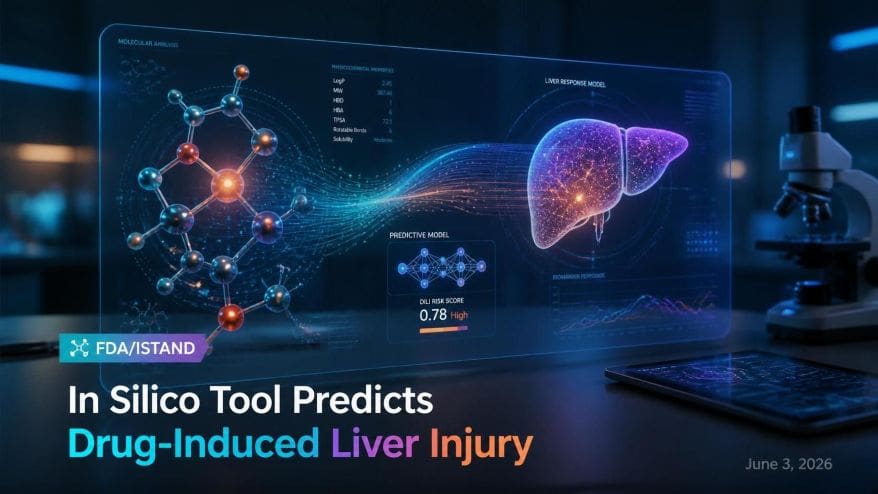
Imagine testing a medicine’s toxicity on a computer screen; for example, picture this happening before any living cell is touched. On June 3, 2026, the FDA made this vision real when, consequently, they accepted the first in silico drug-development tool. Specifically, this tool predicts drug-induced liver injury and, therefore, entered the ISTAND program through a Letter of Intent.
As a result, regulatory science is shifting fast. As future pharmacists, you need to understand this change. In silico methods use computer-based simulation for drug testing. By all means, this knowledge will shape your career.
Key Takeaways: In silico drug development
- What it does: Specifically, it uses machine learning to predict drug‑induced liver injury.
- Major milestone: On June 3, 2026, the FDA accepted the first in silico drug‑development tool into ISTAND.
- Why it matters: Consequently, harmful liver toxicities can be found earlier than with animal tests.
- Broader implication: Ultimately, this opens the door to wider use of validated in silico safety tools.
What Does In Silico Drug Development Tool Mean?
Breaking Down the Terminology
To begin with, let’s clarify the basic terms. Scientists use three main testing approaches. Each approach has a Latin name that describes its environment. At the same time, each serves a different purpose in drug development.
| Term | Meaning | Example |
|---|---|---|
| In vivo | Inside a living body | Animal testing |
| In vitro | Inside a test tube | Cell culture experiments |
| In silico | Inside a computer chip | AI-based toxicity prediction |
Also Read: Faster Devices, Smarter Careers: How FDA & CMS Are Rewriting the Future
The Core Problem: Drug-Induced Liver Injury (DILI)
The liver processes nearly every foreign chemical you ingest, which makes it especially vulnerable to toxic damage. Drug-induced liver injury (DILI) is a common reason drugs are withdrawn from the market. Because DILI often shows up late in clinical trials, predicting it early is critical.
Consider several drugs that were removed from the market; many failed because of unexpected hepatotoxicity (liver poisoning). Over time, these failures cost billions and harmed patients. Furthermore, they underscore the need for better early prediction methods.
The AI Solution
This tool uses machine learning to analyze chemical structures and predict hepatotoxicity early in drug development. It acts like a digital screening system, examining molecular patterns linked to liver damage. Consequently, it helps identify risky compounds sooner.
Also Read: Protein Intake Liver Cancer: A Survival Breakthrough
How the Silico Drug Development Tool Work?
- The algorithm receives a drug’s chemical structure.
- It compares this structure against known hepatotoxic compounds.
- It calculates a probability score for liver injury risk.
- Developers use this score to make early decisions.
Why Did the FDA Accept This Tool Under the ISTAND Program?
The Current Bottleneck in computer Aided Drug Development
Traditionally, animal models test drug safety before human trials. However, animals often miss human-specific liver toxicities. Consequently, dangerous side effects sometimes appear only during clinical trials. As a result, this creates enormous costs and patient risks.
| Issue | Impact |
|---|---|
| Animal model limitations | Miss human-specific toxicities |
| Late-stage failures | Cost billions in development |
| Patient harm | Unexpected adverse reactions |
The ISTAND Framework Explained
The FDA created the ISTAND program to evaluate novel testing methods. ISTAND stands for Innovative Science and Technology Approaches for New Drugs and supports tools outside existing qualification programs. Currently, the program is validating computer simulation as a legitimate safety tool.
The program covers several categories:
- Microphysiological systems
- Novel nonclinical assays
- Artificial intelligence-based algorithms
Strategic Benefits for the Pharmaceutical Industry
By using this program, scientists gain important advantages. They can significantly reduce animal testing and speed up drug pipelines by moving early toxicity screening to digital methods. Because of these benefits, more companies are likely to adopt in silico approaches.
Also Read: Food additives and GRAS: A Critical Look at the Hidden Ingredients
Frequently Asked Questions: In silico drug development tool
What is the ISTAND program?
To begin with, ISTAND stands for Innovative Science and Technology Approaches for New Drugs. In essence, it is an FDA pilot program. As a result, it helps evaluate new drug testing methods. At the same time, it covers tools like AI algorithms. All in all, it supports safer and faster drug development.
What does “in silico” mean in drug testing?
First of all, “in silico” means inside a computer. In contrast, “in vivo” means inside a living body. By comparison, “in vitro” means inside a test tube. With this in mind, in silico uses digital simulation for testing. In short, no animals or cells are needed for this method.
Why is drug-induced liver injury (DILI) so important?
Above all, the liver processes most chemicals you take. For this reason, it faces high toxicity risk. At any rate, DILI causes many drugs to fail late. As a matter of fact, this costs billions of dollars. In effect, early prediction saves lives and money.
Is this AI tool fully approved by the FDA?
At this point, the tool is not fully approved. To clarify, it is at the Letter of Intent stage. After that, it must pass two more phases. In due time, full qualification may happen. Until then, it remains under review and validation.
How will this change affect pharmacy students?
In the first place, digital skills will become essential. Together with traditional knowledge, you need data literacy. At the same time, regulatory science is changing fast. For this purpose, follow FDA updates closely. In conclusion, your career will blend pharmacy with technology.
Conclusion : In silico Drug Development Tool
By using this program, scientists gain important advantages. They can significantly reduce animal testing and speed up drug pipelines by moving early toxicity screening to digital methods. Because of these benefits, more companies are likely to adopt in silico approaches.
Additionally, to stay updated with the latest developments in STEM research, visit ENTECH Online. Basically, this is our digital magazine for science, technology, engineering, and mathematics. Further, at ENTECH Online, you’ll find a wealth of information.
References:
- U.S. Food and Drug Administration. (2026, June 3). FDA accepts first in silico drug development tool under ISTAND program to help predict drug-induced liver injury [CDER Statement]. https://www.fda.gov
- U.S. Food and Drug Administration. (n.d.). Innovative Science and Technology Approaches for New Drugs (ISTAND) pilot program. https://www.fda.gov/drugs/development-resources/innovative-science-and-technology-approaches-new-drugs-istand-pilot-program
- Author
- Latest Posts

Ramya Dobbala is a pharmacist and science communicator dedicated to bridging the gap between complex pharmaceutical research and public understanding. A 2024 B.Pharmacy graduate, Ramya has a strong foundational background in formulation science, having spearheaded research into the evaluation and formulation of anti-acne creams. Her work focused on optimizing topical delivery systems to enhance treatment efficacy and skin health.
Transitioning from the laboratory to the forefront of scientific discourse, she now leverages her technical expertise to translate intricate healthcare concepts into accessible, engaging content. As an author and communicator, Ramya is passionate about empowering audiences with evidence-based insights, particularly in the realms of dermatology and pharmaceutical innovation.



Really appreciate this article the fact that FDA accepted the first in silicon tool under through a letter of intent shows how regularly science is evolving early prediction of drugs induced liver injury will prevent late stage drug failures that cost billions