Advanced storage systems make the grid more reliable. As a result, they help protect cities from power fluctuations.
Stabilizing the Future Grid with Long-duration energy storage (LDES) Tech
Estimated reading time: 3 minutes
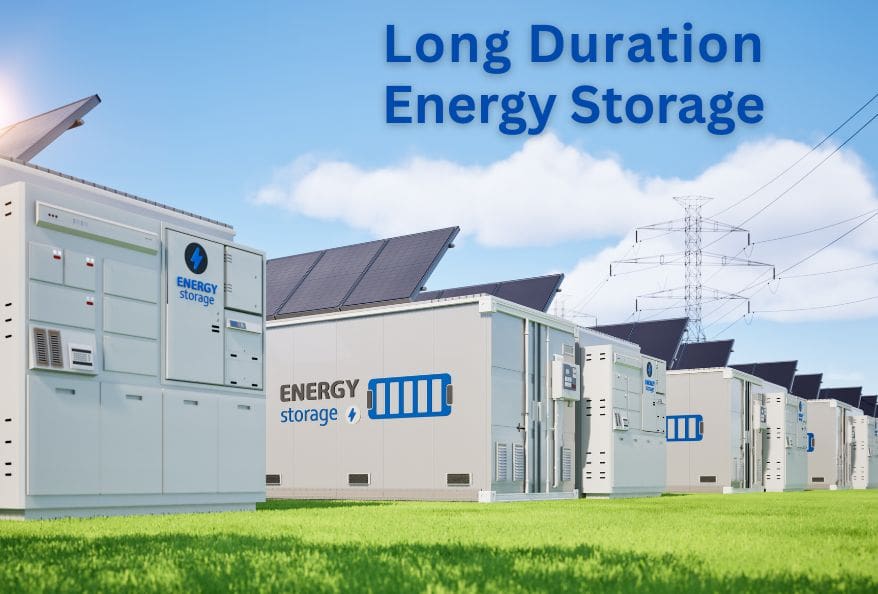
Across the world, scientists are developing Long-Duration Energy Storage (LDES). This technology helps stabilize modern power grids. It uses renewable energy and balances supply when demand changes. Through Redox Flow Batteries, it stores green electricity efficiently. Because of this, power supply stays steady even during low sunlight or wind. The system also uses vanadium and formic acid fuels, giving it long life. In short, LDES tech makes clean energy storage possible with less waste.
The Power of Advanced Long-duration energy Storage
Advanced storage systems make the grid more reliable. LDES batteries can store energy for many hours or even days. As a result, they help protect cities from power fluctuations. These systems are ideal for countries investing in renewable power. By storing excess solar and wind energy, they ensure supply remains strong when production drops. Because of their durability, they support carbon-neutral goals and make grids more sustainable.
Long-duration energy storage: The Team Behind the Research
This innovation comes from Southern University of Science and Technology (SUSTech) in Shenzhen, China. Meisheng Han and Tianshou Zhao led the study. They worked with experts including Kunxiong Zheng, Hengyuan Hu, and Jie Liu.
Their research, published in The Innovation Energy, explores electrochemical performance and mechanical design improvements in LDES systems. The group focuses on carbon neutrality, energy system stability, and long-term storage efficiency. Their work plays a key role in shaping the future of clean power.
ENTECH STEM Magazine has included this research in the Top 10 Environmental Sciences Discoveries and Innovations in 2025.
Storing Energy for Daily Use
LDES technology benefits daily life. It stores extra solar and wind energy during the day. Then, it releases power when demand rises at night. As a result, homes, factories, and hospitals receive continuous electricity. This system also reduces blackouts and provides stable voltage levels. It restores battery capacity with liquid fuels, reducing waste. Because of this, cities become greener, and energy use becomes cleaner. Overall, this technology makes power grids safer and more reliable.
A Growing Trillion-Dollar Market
The global LDES market is expanding fast. Analysts estimate it could reach trillions of dollars in value. However, it still faces technical and financial challenges. High membrane costs and stack optimization remain key areas for improvement. Even so, investment is increasing worldwide. Many companies see long-duration batteries as an essential part of the energy transition. With enhanced designs and lower costs, LDES will soon become a major part of the global power system.
Exciting Careers for New Students
Students today have great opportunities in energy storage. They can study mechanical engineering, chemistry, or materials science. Many focus on graphene electrodes and ion transport, improving battery efficiency. They also design flow battery stacks and explore reaction kinetics for faster storage. Graduates can work in clean energy labs, research institutes, or power companies. As green jobs grow, these future engineers will help stabilize grids and promote sustainable innovation.
The Simplicity of LDES Tech
Imagine a giant rechargeable water tank. The sun fills it with energy during the day. At night, it releases stored energy smoothly. Similarly, LDES systems hold clean power and release it when needed. They keep our lights on even when nature slows down—making the world brighter, cleaner, and more stable.
Additionally, to stay updated with the latest developments in STEM research, visit ENTECH Online. Basically, this is our digital magazine for science, technology, engineering, and mathematics. Also, at ENTECH Online, you’ll find a wealth of information.
Reference
Han, M., Zheng, K., Hu, H., Liu, J., Zou, Z., Yu, F., Mu, Y., Li, W., Wei, L., Zeng, L., & Zhao, T. (2025b). Long-duration energy-storage technologies: A stabilizer for new power systems. The Innovation Energy, 2(2), 100077. https://doi.org/10.59717/j.xinn-energy.2025.100077
- Author
- Latest Posts

Ashwini Kshirsagar holds a graduate degree in Chemistry and a postgraduate degree in Environmental Science from Shivaji University, Kolhapur. With a strong foundation in scientific principles and a creative flair, she blends her expertise in environmental science with skills in technical writing, graphic design, and video editing. Proficient in Adobe software, Ashwini excels at transforming complex scientific concepts into clear, engaging, and visually compelling content. Her unique ability to merge science and storytelling allows her to create impactful communication materials that are both informative and accessible to a wide audience.