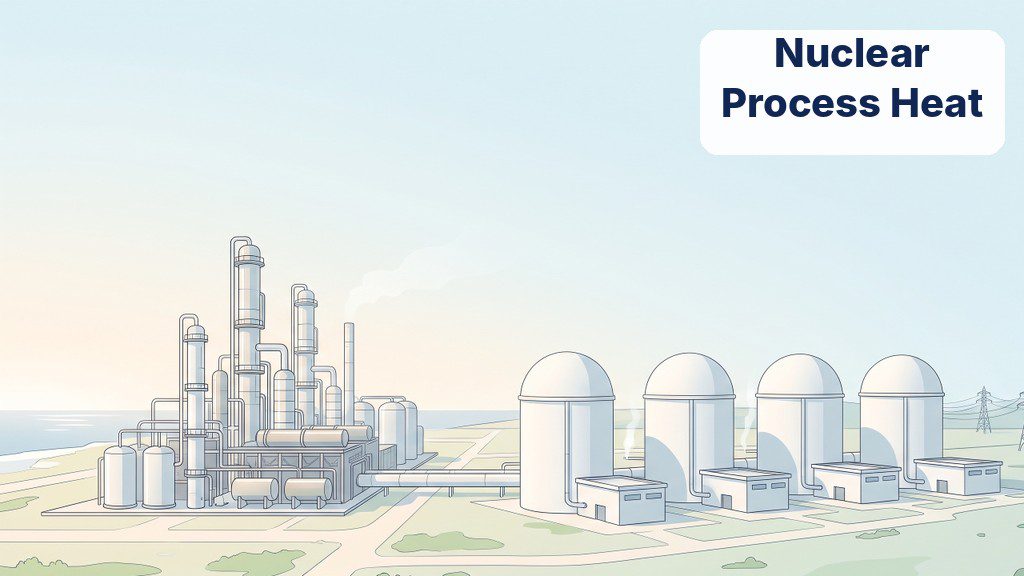
Chemical plants need two things in huge amounts: electricity and very hot steam. For the most part, that heat comes from burning natural gas. On November 9, 2026, however, the US Nuclear Regulatory Commission approved a different option. Specifically, it permitted the Long Mott Generating Station in Calhoun County, Texas. The plant would sit at Dow’s Seadrift Operations site and supply nuclear process heat directly. In fact, the US Department of Energy calls this a national first. Until now, no advanced nuclear facility had been authorized at a US industrial site.
The permit covers four X-energy Xe-100 small reactors built as one facility. Long Mott Energy, the project company, submitted the application in March 2025. To illustrate, each unit is designed for 80 electric or 200 thermal megawatts. Together, the four reactors could deliver up to 320 megawatts of electricity. By comparison, the full plant is rated at 800 megawatts of heat. According to the NRC, the station will mainly make high-temperature steam for Dow’s factory. Any extra electricity would then be exported to the local power grid. It could also meet the site’s steam needs for 60 years. Funding support comes from the department’s Advanced Reactor Demonstration Program.
Explainer: How Nuclear Process Heat Works
Most nuclear plants make steam only to spin turbines for electricity. Process heat is different, because factories use the heat itself. For example, chemical plants need steam to drive reactions, separate liquids and dry products. Generally, gas-fired boilers make that steam on site, releasing carbon dioxide. Nuclear process heat replaces the burning step with heat from splitting uranium atoms. A reactor warms a coolant, and the coolant then boils water into steam. Some of the steam heats the factory, while some can still make electricity. As a result, one plant can cover both needs of a large industrial site.
Inside a High-Temperature Gas-Cooled Reactor
The Xe-100 is a high-temperature gas-cooled reactor, which works rather differently from common reactors. Instead of water, helium gas carries heat away from the hot core. Helium does not become radioactive easily, and it stays a gas at high temperatures. For that reason, these reactors can deliver hotter steam than ordinary water-cooled plants. The NRC page lists a shared steam system that runs a Rankine cycle. That is the same steam-turbine cycle used in many coal and gas plants. What is more, the Energy Department says the design needs a much smaller footprint. By comparison, conventional light-water reactors usually occupy far larger sites.
Fig. 1: Tiny Coated Particles Pack Into a Graphite Fuel Pebble
Pebble Fuel With Its Own Shield
The fuel, called TRISO-X, comes as billiard-ball-sized pebbles rather than long fuel rods. Every pebble holds thousands of tiny coated particles inside graphite. Each TRISO particle is about the size of a poppy seed, says the department. At its centre sits a kernel of uranium, carbon and oxygen. Three layers of carbon and ceramic materials then wrap that kernel. In short, these layers are meant to keep radioactive products inside each particle. The NRC calls this approach a functional containment, together with the helium pressure boundary. Besides that, the fuel uses high-assay, low-enriched uranium, known as HALEU. This uranium contains between 5% and 20% of fissile uranium-235.
Four Regulatory Firsts at Once
The NRC says the permit marks several firsts for the agency. It is the first approval of a multimodule advanced reactor facility. Likewise, it marks the first approval of a pebble-bed reactor core. Moreover, it is the first design approved with online refueling. That means fresh pebbles can be added while the reactor keeps running. Finally, it is the first review of this reactor type under a newer framework. The NRC calls it the first such permit in nearly 60 years. However, the Energy Department describes the gap as more than 50 years. Either way, the last comparable approval came long before today’s students were born.
A Faster, Risk-Informed Review
The review followed the NRC’s risk-informed Licensing Modernization Project framework. Rather than fixed water-reactor rules, it weighs the actual risks of each design. To begin with, NRC staff finished the safety evaluation in October, a month early. Earlier, in May, the agency found no significant environmental impact from building the plant. As a result, the whole review stayed within its planned 18 months. The NRC chairman said this shows careful safety reviews can follow predictable timelines. This was also the third advanced reactor construction permit the NRC issued in 2026. All things considered, regulators appear ready to process new designs more quickly.
Why Factories Need Nuclear Process Heat
Heavy industries such as chemicals, steel and fuels burn huge amounts of gas for heat. Because of this, their emissions are harder to cut than power-plant emissions. Electric heaters can help, but high temperatures and steady supply are difficult to provide. Wind and solar power also rise and fall with the weather. On the other hand, nuclear process heat runs steadily, day and night. In addition, placing reactors right beside the factory avoids long steam pipelines. The Department of Energy says the project shows how advanced reactors could serve manufacturing directly. Even so, the plant must be built and proven first. Our article on the renewed interest in nuclear power explores the wider debate.
Fig. 2: Steam Goes to the Factory, Extra Power to the Grid
Fuel Supply and the Oak Ridge Plant
New reactors are only useful if enough suitable fuel exists. To that end, X-energy’s subsidiary TRISO-X is building a fuel plant called TX-1. It sits in Oak Ridge, Tennessee, and finished vertical construction in September 2026. According to the Department of Energy, it will make the pebbles for the Xe-100. It is also the first commercial-scale HALEU fuel fabrication facility approved by the NRC. Moreover, it is the first new US fuel facility licensed in over 50 years. Our story on the special uranium fuel advanced reactors need explains more.
Business Opportunities in Small Modular Reactors
In the near term, engineering firms and component makers can prepare for long-lead equipment orders. Within five years, building the Texas plant could create jobs in construction and quality assurance. Likewise, fuel fabrication in Oak Ridge could need trained technicians and engineers. If it works, chemical companies may consider nuclear process heat for other sites. In the long run, small reactors could start replacing some gas boilers in heavy industry. At the same time, some fossil-fuel heat jobs could shrink as that shift happens. Still, every step depends on the first plant delivering on time and on budget. For now, these are possibilities rather than signed orders.
Careers and What to Study
Nuclear process heat projects need many kinds of skilled people. For instance, nuclear engineers design reactor cores and analyse their safety. Licensing specialists, in turn, prepare the detailed documents that regulators review. Meanwhile, chemical plant engineers plan how steam and power reach each production unit. Quality assurance engineers, likewise, check that parts meet strict nuclear standards. According to the US Bureau of Labor Statistics, nuclear engineers earned a median $133,970. That figure is from May 2025, with about 800 openings expected each year. Of course, these are US figures, and pay differs between countries. For study, consider nuclear, mechanical or chemical engineering, or materials science. Our guide on becoming a nuclear engineer offers practical steps.
Limits Worth Keeping in Mind
Note that a construction permit allows building, but it does not allow operation. Before loading fuel, the company must win a separate NRC operating license. The Department of Energy also says the Xe-100 design still needs finalizing. Equally important, suppliers must be ready to deliver large, long-lead components. The project currently targets its first energy delivery in the early 2030s. Costs and the final schedule have not been confirmed in these official releases. Even so, the permit is a real regulatory milestone for nuclear process heat. In short, Texas will show whether small reactors can truly power a working factory.
US Nuclear Regulatory Commission. (2026, November 9). NRC issues first construction permit in nearly 60 years for high-temperature gas-cooled reactor (News Release No. 26-083). https://content.govdelivery.com/accounts/USNRC/bulletins/4323d99
The article explains process heat, helium cooling and TRISO pebble fuel in clear, student-friendly terms. Its figures match the DOE article and NRC release, including 80 megawatts of electricity or 200 of heat per unit and 320 megawatts in total. It notes that the NRC says nearly 60 years while DOE says more than 50, and it repeats no safety claims as fact. Readers who want the regulatory detail should check the original NRC release and project page.
Editorial note
ENTECH is running this Innovation because it is a real regulatory milestone, not a plan on paper. The NRC has authorized construction of four small reactors built to supply steam and power to a working chemical plant. It shows students that nuclear careers now reach into chemical engineering, fuel production and licensing, not only power stations. The permit does not allow operation, the design is still being finalized, and first energy is targeted only for the early 2030s. For full details, we suggest readers turn to the official DOE and NRC announcements.
Shreyas Kulkarni is a Chartered Electrical Engineer and renewable energy pioneer with over eight years of hands-on experience in the clean energy sector. He is the Co-Founder of UNICUS Energy, a leading provider of solar energy solutions in India, where he drives technical execution, system architecture, and clean tech deployment.
As an author for ENTECH Magazine, Shreyas focuses on making solar technology practical and understandable for students, engineers, and homeowners. His contributions include detailed guides on the inner workings of rooftop solar systems and deep dives into modern hardware advancements, such as lightweight solar panels and flexible photovoltaic materials.