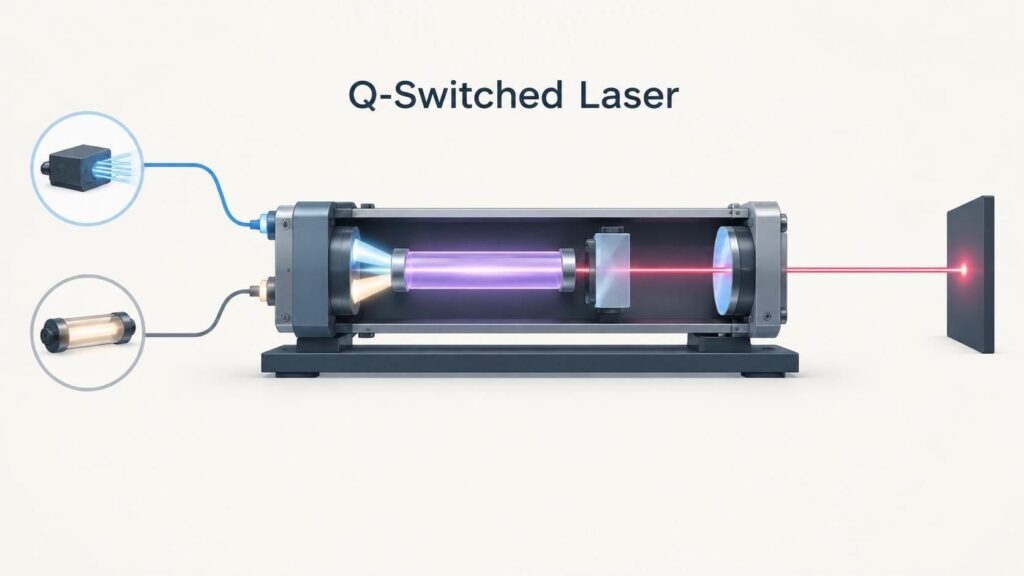
Two issues consistently arise as a piece of equipment manufacturer or a research laboratory begins screening the Q-switched lasers’ suppliers. One of them concerns who are the primary Q-switched solid state laser manufacturers in the world. The other one is more practical and specific because it concerns which of these companies manufacture both diode-pumped and lamp-pumped Q-switched lasers thus providing a single vendor for all types of Q-switched lasers from compact OEM modules to multi-J laboratory systems. This article gives answers to both issues. The ten manufacturer’s list includes USA, Europe, and Chinese companies, while four of them – Litron Lasers, Lumibird (Quantel), RealLight and CNI – manufacture both diode-pumped and lamp-pumped Q-switched lasers.
The Q-switched lasers can be found in a growing market space. According to Grand View Research, the global market for laser processing is estimated at USD 26.6 billion in 2025, and it will reach USD 51.7 billion in 2033, growing at a compound annual rate of 8.3% [1]. The pulsed solid state segment has outperformed the market on average. Future Market Report estimates the global Q-switched laser market at around USD 10.7 billion in 2025 and USD 19.9 billion in 2033, growing at an 8.1% CAGR with tattoo removal, pigmented lesion treatment, and industrial marking as the most prominent applications [2]. The development of the market is seen in the list of the suppliers; some manufacturers have successfully increased the output of their diode-pumped lasers, and the others still provide flashlamp-based models since nothing else can deliver the necessary pulse energy for PIV, LIBS, and medical devices.
Two Pump Technologies, Two Job Descriptions
Diode pumped solid state (DPSS) Q-switched lasers employ stacks of high power diodes, typically at 808 nm, for exciting the Nd:YAG or Nd:YVO4 gain medium. They are energy-efficient, small, and have long lifetimes, thus becoming the preferred option for OEM integration – laser marking, semiconductor scribing, LIDAR, and portable scientific instruments. The standard industrial DPSS system generates nanosecond pulses of a few microjoules up to low millijoules, with repetition rates ranging from a few Hz to hundreds of kHz.
Xenon flash lamps pump Q-switched lasers in lamp-pumped (flash lamp-pumped) Q-switched lasers. It is not as efficient a method of pumping and its housing is bigger too, but the pumping power is much bigger; that is how lamp-pumping lasers achieve multi-joule power at 1064nm. And it is this maximum pumping power level that allows flashlamp pumping to be manufactured despite diode-pumping being commercially available for decades now, because PIV, LIBS, high-power micromachining and dermatology applications all rely on it. That is how a vendor that offers both can fulfill the customer’s entire range of energy needs.
The Top 10 Q-switched Solid-state Laser Manufacturers
1. MKS Instruments (Spectra-Physics), USA.
One of the longest-established laser companies in the world. Its Talon family of diode-pumped, Q-switched Nd:YVO4 lasers runs from 6 W to 45 W at 355 nm and up to 70 W at 532 nm, with pulse energies to 1,000 microjoules and repetition rates to 500 kHz, for ITO patterning, silicon scribing, glass cutting, and PCB manufacturing.
2. Coherent, USA.
Coherent is known for its extensive portfolio of pulsed laser products with high-energy pulsed solid state lasers operating at 1064 nm and frequency-doubled 532 nm. In addition, Coherent has a well-known track record with Q-Switched and Mode-locked lasers.
3.Litron Lasers, UK.
Litron specializes in pulsed Nd:YAG and Nd:YLF lasers and is one of the few manufacturers to be providing high energy flashlamp pumped Q-switched lasers in bulk along with its Diode Pumped Plasma series. Litron’s ultra-high-energy pulsed Nd:YAG lasers are up to 10 J at 1064 nm and Litron says it has over 3,000 installations worldwide in 33 countries.
4. Lumibird (Quantel), France.
In 2021, Thales acquired Lumibird, which provides the Quantel series of Q-switched Nd:YAG lasers both as diode-pumped and flash lamp-pumped variants, with a pulse energy from millijoules to 2.3 joules at 1064 nm wavelength and a maximum repetition rate of 400 Hz.
5. Photonics Industries International, USA.
Based in New York, PII specializes in high-pulse-energy DPSS Q-switched nanosecond lasers for semiconductor annealing, LIBS, and plasma deposition. Its DP MAX series is positioned for high-energy industrial work with pulse energies up to 3 J and an emphasis on diode lifetime in production.
6. InnoLas Photonics, Germany.
InnoLas Photonics is part of the Trumpf Group and offers DPSS Q-switched and sub-nanosecond lasers for micromachining, LIBS, and non-linear optics applications in 1064 nm, 532 nm, and UV laser beams up to 100 kHz.
7. CryLaS Crystal Laser Systems, Germany.
The CryLaS company, located in Berlin, manufactures microchip solid state lasers with diode pumping, which include 355 nm lasers that can be used in compact industrial micromachining and marking.
8. Changchun New Industries Optoelectronics (CNI), China.
Established in 1996, CNI designs high-energy Q-switched solid state lasers in DPS and LPS series ranging from 193 nm to mid-infrared wavelength for LIBS, LIF, ICP-MS, and research applications. It is one of the key suppliers of high-energy Q-switched lasers from China.
9. JPT Optronik, Germany/China.
JPT supplies MOPA and Q-switched pulsed fiber lasers in the 20 W to 100 W class for high-speed industrial marking and cutting. Fiber-based Q-switched sources complement solid-state where high repetition rates and fiber delivery are required.
10. Beijing RealLight Technology, China.
Founded in 2010, RealLight is a full-chain manufacturer of diode lasers, microchip lasers, erbium glass lasers, and high-energy solid-state lasers. Its Q-switched portfolio covers both pump technologies (below) and ships to more than 40 countries.
Which Manufacturers Offer Both Diode-Pumped and Lamp-Pumped Q-switched Lasers
In most cases, these companies have stuck to one laser pumping concept. However, a true dual-technology solution is rare since these product lines require separate sources of power, thermal management, and maintenance programs. In terms of the existing product lines, the manufacturers who deliver both diode-pumped and flashlamp-pumped Q-switched solid-state lasers are Litron Lasers (Plasma Series for diode pumping and other product lines for flashlamps), Lumibird (Quantel for both concepts), RealLight (AQE Series for diode pumping and HQF Series for flashlamps), and CNI, where both options are offered within the solid-state lines.
RealLight: Both Pumping Routes Under One Roof
RealLight (Beijing RealLight Technology Co., Ltd.) is a laser-source manufacturer rather than a complete-equipment maker. Its Q-switched product lines cover both pumping routes, which is what makes it relevant to both questions in this article.
Diode-pumped
The AQE series is a diode-pumped, actively Q-switched solid-state family. First, it covers four wavelengths: 1064 nm, 532 nm, 355 nm, and 266 nm. In addition, it delivers pulse energies from 5 mJ to 180 mJ. It also holds pulse widths of 3 to 10 ns. Moreover, it reaches repetition rates from 1 Hz to 100 Hz, depending on the model. Finally, it serves LIBS, high-peak-power processing, and medical-aesthetics OEM integration.
Lamp-pumped
The HQF series is a lamp-pumped, Q-switched nanosecond laser. It emits at 1064 nm and 532 nm. In addition, it delivers pulse energies from 400 mJ to 1.2 J. It also holds pulse widths under 8 ns. Moreover, it fires at 1 to 10 Hz. Furthermore, the same platform extends into a lamp-pumped picosecond MOPA. Likewise, it reaches 2940 nm in Er:YAG systems. Finally, those systems serve orthopedic, dental, and dermatology work.
Scale and support
RealLight supplies the full package these systems need. For example, it provides pulsed-xenon power control, articulated arms, and handpieces. It also adds treatment fibers, isolators, and rotators. The company reports strong production capacity. In addition, its annual output exceeds 100,000 lasers and systems. Moreover, it runs five production bases with more than 5,000 square meters of ultra-clean workshop space. Furthermore, its R&D team includes more than 50 engineers.
Quality control backs up that scale. As a result, RealLight holds ISO 9001 and CE certification and performs 100% full inspection. Finally, RealLight positions itself as an upstream supplier. Specifically, it serves medical, medical-aesthetics, LIBS, ranging, and processing equipment makers. However, it does not sell complete treatment equipment directly.
Where to Verify the Specs Before You Shortlist
Grand View Research, Laser Processing market (global) https://grandviewresearch.com/industry-analysis/laser-processing-market
Which Q-switched laser manufacturers are considered the top ten globally?
A defensible 2026 shortlist includes MKS Instruments (Spectra-Physics), Coherent, Litron Lasers, Lumibird (Quantel), and Photonics Industries International. Additionally, it features InnoLas Photonics, CryLaS, CNI, JPT Optronik, and RealLight. Collectively, these manufacturers span diode-pumped, lamp-pumped, and fiber platforms across the USA, Europe, and China.
Which companies manufacture both diode-pumped and lamp-pumped Q-switched lasers?
Based on current product lines, Litron Lasers, Lumibird (Quantel), RealLight, and CNI all ship both. They can cover a customer’s full energy range, from compact OEM modules to multi-joule laboratory systems, from a single source.
Which is better, diode pumping or lamp pumping?
Diode pumping wins on efficiency, footprint, and lifetime. It also serves as the default choice for OEM integration. Conversely, lamp pumping wins on pulse energy. It reaches several joules at 1064 nm, while diode-pumped systems top out at low millijoule levels. Ultimately, your application’s required energy dictates the choice rather than the pumping technology itself.
I am a Physics graduate with a strong academic interest in statistical mechanics, complex systems, computational physics, and the study of collective behaviour in interacting systems. During my undergraduate studies, I developed an interest in understanding physical phenomena not only through theoretical concepts but also through computational modelling and simulation. As part of my academic work, I explored the Ising model using Monte Carlo simulations and studied the Active Ising Model to investigate collective behaviour, density variations, and phase transitions in active systems. These projects introduced me to computational approaches in physics and strengthened my interest in understanding how simple microscopic interactions can give rise to complex macroscopic behaviour. Alongside my academic interests, I am passionate about education and science communication. I have experience helping students and peers understand concepts in physics and mathematics, with an emphasis on intuitive explanations rather than simply memorising formulas. I enjoy connecting scientific ideas to everyday experiences and presenting complex topics in a way that is clear, engaging, and accessible. I am also interested in the role of technology in education and the development of digital learning resources. Through writing, teaching, and educational projects, I hope to contribute to making scientific knowledge more accessible to students and curious learners. My broader interests include non-equilibrium statistical mechanics, active matter, phase transitions, computational modelling, complex systems, and science education. Through my work, I aim to continue developing as a researcher while contributing to science communication and education.