Quantum Federated Learning merges AI and quantum physics to supercharge 6G networks with private, lightning-fast training.
Quantum Federated Learning Powers 6G
Estimated reading time: 3 minutes
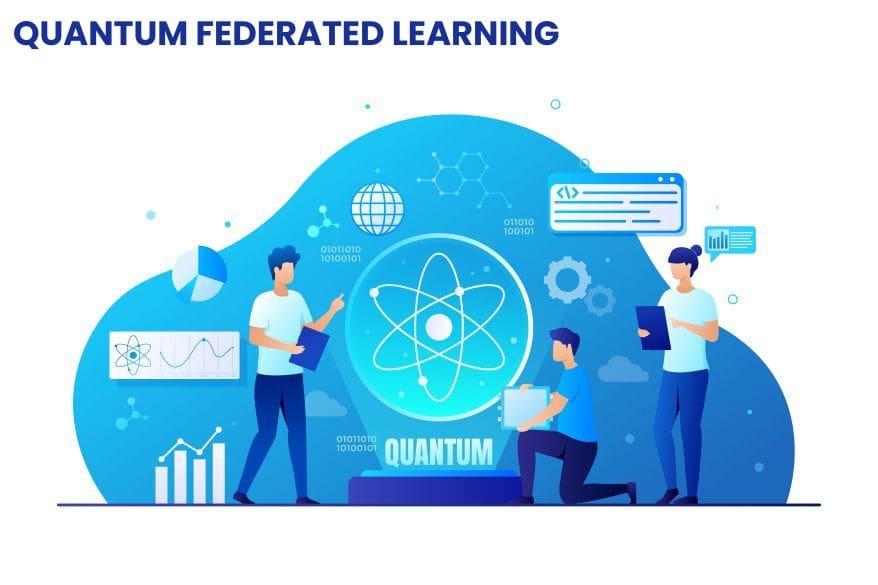
Quantum federated learning (QFL) boosts AI-native 6G networks. Devices train models without sharing data. Thus, it speeds up edge intelligence. Moreover, it cuts privacy risks greatly. For instance, quantum tricks handle tough tasks well. Consequently, networks run much smoother. In addition, security grows far stronger. This tech merges quantum power with federated learning. Edge devices process data locally. Devices send only updates, which servers combine safely. As a result, 6G handles real-time needs.
Shaba Shaon, Md Raihan Uddin, Dinh C. Nguyen, Seyyedali Hosseinalipour, Dusit Niyato and Octavia A. Dobre conducted the study and published it under the title “Empowering AI-Native 6G Wireless Networks with Quantum Federated Learning” in September 2025.
ENTECH STEM Magazine has included this research in its list of the Top 10 Technology Innovations of 2025.
Core Innovation : Quantum Federated Learning
Quantum federated learning (QFL) uses quantum tech fully. It builds on classical federated learning. Devices encode data into quantum states. Quantum neural networks process it fast. Then, measurements create model updates. Servers aggregate these updates securely. For example, Quantum Approximate Optimization Algorithm i.e. QAOA optimizes quickly. It solves hard problems. Thus, training converges much faster. Moreover, it beats classical methods often. Quantum channels send updates reliably. They resist noise better. In addition, hybrid systems mix classical and quantum parts. Hence, networks adapt to changes. This setup fixes compute limits. It handles unreliable links too. Consequently, 6G runs seamless.
Leading Researchers Involved
Specifically, they all focus on distributed intelligence. They study AI, networking, and security and Their diverse skills create holistic solutions. Therefore, they are pioneers in 6G. Their work spans three different countries. They lead the way in quantum learning. Overall, their collaboration drives global progress.
Daily Life Benefits
- Smartphones learn user habits privately.
- Cars spot traffic in real time.
- Homes tweak energy use wisely.
- Hospitals share models safely.
- Factories tune machines on edge.
- Drones sync flights better.
- Data stays fully safe.
Quantum Federated Learning: Path to Market Use
Quantum hardware likely to be matures around 2030. Early tests probably hit networks soon after. 6G launches may integrate it by mid-decade. Full rollout could follow in 2035. For instance, case studies suggest gains already exist. However, challenges like noise might persist longer. Therefore, pilots will likely start early. Consequently, commercial nets adopt it gradually, which helps user see benefits probably by 2040.
Student Career Opportunities in Quantum Federated Learning
- Students craft quantum neural nets and code secure protocols.
- They test edge devices and build QAOA solvers.
- Engineers design quantum channels; analysts tackle fragility issues.
- Coders shape hybrid systems; data experts map wireless flows.
- Security pros guard links; hardware teams fix device limits.
- Careers offer high impact with fast industry growth.
Quantum Federated Learning: Conclusion
Quantum federated learning transforms 6G networks powerfully. Teams drive bold innovations forward. Daily life gains speed and safety. Hence, Market paths open steadily. Students seize high-impact careers now. Thus, wireless worlds connect smarter. Everyone benefits from quantum edge.
Additionally, to stay updated with the latest developments in STEM research, visit ENTECH Online. Basically, this is our digital magazine for science, technology, engineering, and mathematics. Also, at ENTECH Online, you’ll find a wealth of information.
Reference
Shaon, S., Uddin, M. R., Nguyen, D. C., Hosseinalipour, S., Niyato, D., & Dobre, O. A. (2025, September 9). Empowering AI-Native 6G Wireless Networks with Quantum Federated Learning. arXiv.org. https://doi.org/10.48550/arXiv.2509.10559
- Author
- Latest Posts
Ashwini Kshirsagar holds a graduate degree in Chemistry and a postgraduate degree in Environmental Science from Shivaji University, Kolhapur. With a strong foundation in scientific principles and a creative flair, she blends her expertise in environmental science with skills in technical writing, graphic design, and video editing. Proficient in Adobe software, Ashwini excels at transforming complex scientific concepts into clear, engaging, and visually compelling content. Her unique ability to merge science and storytelling allows her to create impactful communication materials that are both informative and accessible to a wide audience.