What is cholesterol? Discover its role in your body, the difference between LDL and HDL, and how it affects your health.
Cholesterol Explained: What It Is, Types, and Its Effects on Your Health
Estimated reading time: 8 minutes
What is cholesterol? It is a waxy, fat-like substance. Your body makes it naturally. You also get it from food. Cholesterol is not all bad. In fact, you need it to live. Your cells use it for structure. Your body uses it to make hormones. What is cholesterol doing in your blood? Too much of it causes problems. It builds up in arteries. It blocks blood flow. This leads to heart attacks. After all, it is a matter of balance. Let me explain the full story.
Key Takeaways
- Cholesterol is a waxy fat your liver makes.
- Two types exist: LDL (bad) and HDL (good).
- High cholesterol has no symptoms but causes silent damage.
- Diet and genetics both affect your levels.
- Testing is the only way to know your numbers.
What Is Cholesterol? A Simple Definition
It is a lipid molecule. It travels in your blood. The liver produces about 80% of it. The other 20% comes from food. To enumerate the roles, cholesterol builds cell membranes. It helps make vitamin D It creates bile acids for digestion It produces sex hormones such as estrogen and testosterone.
Seeing that you need cholesterol, why is it dangerous? The problem is too much cholesterol. When levels get high, the excess does not stay dissolved. It sticks to artery walls. This is plaque. Plaque narrows your arteries. It reduces blood flow. What’s more, plaque can rupture and cause clots.
At the present time, about 38% of American adults have high cholesterol (CDC, 2024a). To put it differently, nearly two in five people are at risk. By comparison, many of them feel perfectly healthy. This is why screening matters.
The Molecular Structure
Cholesterol is a steroid molecule. It has a four-ring carbon structure. This structure makes it rigid and stable. It fits perfectly into cell membranes. It keeps membranes fluid but not too fluid. Analogous to a brick in a wall, provides support. At any rate, you do not need to remember the chemistry. What matters is the quantity in your blood.
The Two Types: Good vs. Bad Cholesterol
It cannot travel alone. It is fat, and blood is water-based. So the body packages cholesterol into carriers. These carriers are called lipoproteins. To illustrate, think of lipoproteins as taxis. LDL is the bad taxi. It drops cholesterol off in your tissues. HDL is the good taxi. It picks up extra and takes it to the liver for disposal.
In light of this difference, doctors measure both types.
LDL Cholesterol (The Bad Kind)
LDL stands for low-density lipoprotein. It carries about 60-70% of total cholesterol. When LDL is high, deposits in arteries. This is the beginning of heart disease. For the most part, doctors want your LDL under 100 mg/dL. At first, high LDL causes no symptoms. Sooner or later, it leads to plaque buildup. The narrower the artery, the harder the heart works.
HDL Cholesterol (The Good Kind)
HDL stands for high-density lipoprotein. It acts like a garbage truck It collects excess cholesterol It brings it back to the liver Higher HDL is generally better. Aim for over 60 mg/dL.
While this may be true, extremely high HDL (above 100) may be harmful. In general, focus on keeping LDL low and HDL high.
Where Does Cholesterol Come From?
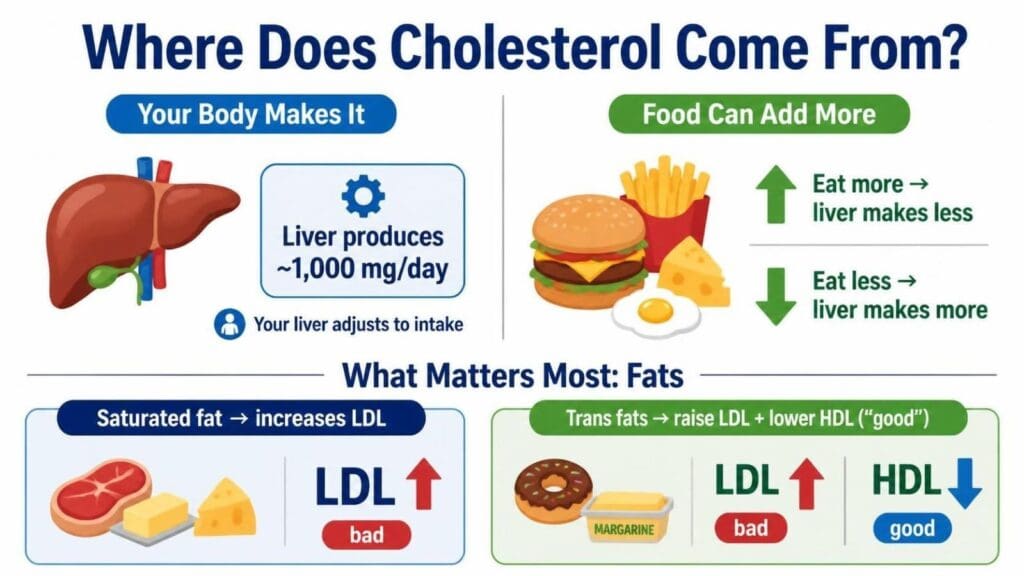
Your body makes it. For example, your liver produces about 1,000 mg each day, and food you eat can add more. Before making it, your liver adjusts based on what you consume. If you eat more, the liver usually makes less. If you eat less, it often makes more. That’s why food impact is less important than saturated fat. To explain it simply, saturated fat can push your liver to make more LDL (“bad” cholesterol). Also, trans fats are even worse because they raise LDL and lower HDL (“good” cholesterol).
At this point, here are the main dietary sources:
- Red meat (beef, pork, lamb)
- Full-fat dairy (butter, cheese, cream)
- Processed meats (sausage, bacon, hot dogs)
- Fried foods
- Baked goods made with butter or shortening
What’s more, genetics play a big role. Some people have a condition called familial hypercholesterolemia. Their livers cannot remove LDL properly. This condition affects 1 in 250 people (CDC, 2024c).
Why High Cholesterol Is Dangerous
It builds up silently over decades. Consider the case of a 45-year-old man who eats a standard American diet. By age 50, he may have about 30% plaque in his coronary arteries—yet he has no idea.
In fact, high cholesterol can lead to atherosclerosis, which is the hardening of the arteries. As plaque accumulates, the passage for blood narrows. Therefore, the heart may not get enough oxygen, which can cause chest pain (angina). Moreover, if a plaque rupture occurs, a clot can form and block blood flow completely—resulting in a heart attack.
Similarly, high cholesterol can affect the brain. For example, clots can travel to brain arteries and cause a stroke. In addition, it can impact leg arteries, leading to peripheral artery disease.
How Do You Know If You Have High Cholesterol?
It is a simple blood test. It is called a lipid panel. You usually need to fast for 9-12 hours before the test. The test measures four things:
- Total cholesterol
- LDL (bad)
- HDL (good)
- Triglycerides (another type of fat)
At any rate, the results come as numbers. For most adults, total cholesterol should be under 200 mg/dL. LDL should be under 100 mg/dL. HDL should be over 60 mg/dL. Triglycerides should be under 150 mg/dL.
As has been noted, these targets vary by person. Your doctor may set stricter goals. If you have diabetes or heart disease, targets are lower.
In contrast, some people have low cholesterol. Low is also a concern. It can cause bleeding risks or hormone problems. Balance is key.
Who Should Get Tested?
The CDC recommends testing every 4-6 years for adults over 20 (CDC, 2024b). Children should be tested once between ages 9 and 11. People with risk factors need more frequent testing.
To list the risk factors:
- Family history of heart disease or high cholesterol
- Diabetes
- High blood pressure
- Smoking
- Obesity
- Age (men over 45, women over 55)
If you have any of these, get tested annually.
The Latest Surveillance Data
What is happening to the population? The CDC tracks this through national surveys. Recent data shows a worrying trend (CDC, 2024b). Between 1999 and 2013, high rates dropped. At this time, progress has stalled.
To point out, only 54% of people with high levels are getting treatment. Of those treated, only 33% have their condition controlled. This means millions of people are not protected.
Analogous to the CDC, the European CDC (ECDC) tracks similar data. Cardiovascular disease remains the leading cause of death in Europe (ECDC, 2024). Prevention efforts are not working fast enough.
At last, workplace wellness programs can help. OSHA recommends heart health programs at work (OSHA, 2024). Regular screenings in the workplace can catch problems early.
How to Lower High Cholesterol
What is cholesterol management? It starts with lifestyle changes. To rephrase it, you can control your numbers.
To illustrate, start with diet. Reduce saturated fat. Eat more fiber. Oats, beans, and apples are good choices. Plant sterols block cholesterol absorption. You find them in fortified foods.
What’s more, exercise helps. Aim for 150 minutes of moderate activity each week. Walking, cycling, or swimming all work. Exercise raises HDL and lowers triglycerides.
At the same time, manage your weight. Losing 5-10% of body weight can lower LDL by 5-10%.
Provided that lifestyle is not enough, medication helps. Statins are the first choice. They block the liver from making cholesterol. They reduce heart attack risk by up to 30%.
Other medications include:
- Ezetimibe (blocks cholesterol absorption)
- PCSK9 inhibitors (injectable, very effective)
- Bile acid resins
Conclusion
Cholesterol is a necessary substance. Still, balance is everything. Too much LDL can cause silent damage over time. The good news is you can control it. Get tested, eat well, and move more. If needed, take medication. Ultimately, your heart depends on it.
Frequently Asked Questions
What is cholesterol in simple terms?
Cholesterol is a waxy fat your body needs. However, too much can build up in your arteries. Therefore, keeping it balanced helps keep blood flowing smoothly and supports heart health.
Can I eat eggs with high cholesterol?
For most people, dietary cholesterol matters less than saturated fat. In addition, an egg a day is generally safe for many. However, if you have health conditions, consider personalized guidance.
Does stress cause high cholesterol?
Stress can indirectly raise cholesterol. For example, it may increase unhealthy habits like poor diet or reduced activity. Therefore, managing stress and lifestyle may help support healthier cholesterol levels.
Are statins safe?
For most people, statins are considered safe and effective. Moreover, doctors monitor side effects and adjust doses if needed. However, if you’re pregnant or have liver issues, discuss options first.
How often should I get tested?
For most adults, cholesterol testing every 4–6 years is a good starting point. However, if you have risk factors or family history, testing more often may be recommended.
References
- Duan, Y., Gong, K., Xu, S., Zhang, F., Meng, X., & Han, J. (2022). Regulation of cholesterol homeostasis in health and diseases: From mechanisms to targeted therapeutics. https://www.nature.com/articles/s41392-022-01125-5
- Duan, Y., Gong, K., Xu, S., Zhang, F., Meng, X., & Han, J. (2022). Regulation of cholesterol homeostasis in health and diseases: From mechanisms to targeted therapeutics. https://pmc.ncbi.nlm.nih.gov/articles/PMC9344793/
- Luo, J., Yang, H., & Song, B. L. (2024). Cholesterol metabolism: Physiological regulation and diseases. https://pmc.ncbi.nlm.nih.gov/articles/PMC10893558/
- Zhang, X., et al. (2025). Cholesterol metabolism: Molecular mechanisms, biological functions, diseases, and therapeutic targets. https://pmc.ncbi.nlm.nih.gov/articles/PMC12508344/
Editorial Note: This article was written by Ramya Dobbala and reviewed for editorial accuracy by our editorial team. It has not yet undergone independent review by a professional.
- Author
- Latest Posts

Ramya Dobbala is a pharmacist and science communicator dedicated to bridging the gap between complex pharmaceutical research and public understanding. A 2024 B.Pharmacy graduate, Ramya has a strong foundational background in formulation science, having spearheaded research into the evaluation and formulation of anti-acne creams. Her work focused on optimizing topical delivery systems to enhance treatment efficacy and skin health.
Transitioning from the laboratory to the forefront of scientific discourse, she now leverages her technical expertise to translate intricate healthcare concepts into accessible, engaging content. As an author and communicator, Ramya is passionate about empowering audiences with evidence-based insights, particularly in the realms of dermatology and pharmaceutical innovation.