Bolivia’s Carreras Pampa an extraordinary paleontological site containing over 16,600 dinosaur footprints from the Upper Cretaceous era.
Discover the World’s Largest Dinosaur Tracksite: Carreras Pampa, Bolivia with 16,000+ Fossil Footprints
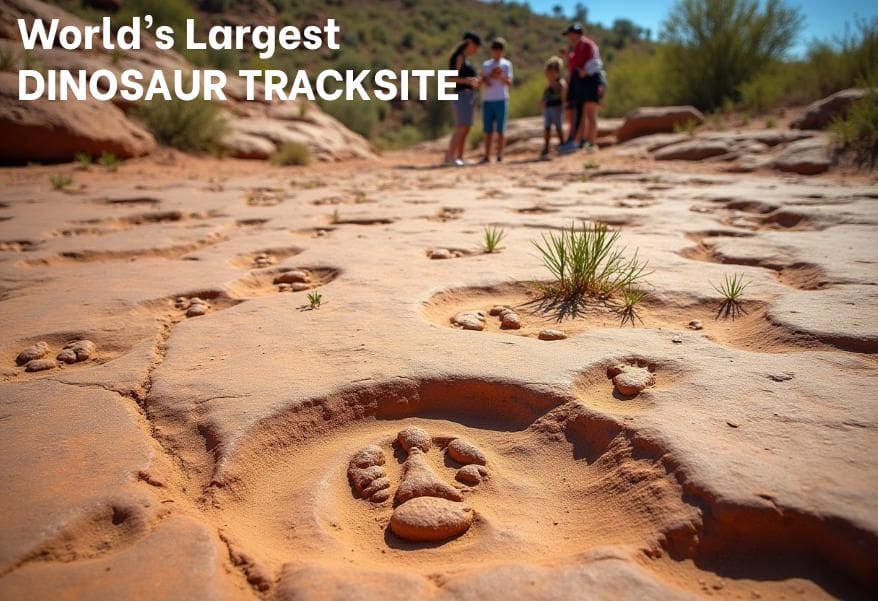
The Carreras Pampa tracksite in Torotoro National Park, Bolivia, known as the World’s Largest Dinosaur Tracksite, holds the largest collection of dinosaur footprints in the world. This location provides a unique look into dinosaur behaviour and environment during the Upper Cretaceous period. With over 16,600 theropod tracks and numerous swim and tail traces, it reveals fascinating insights into these ancient creatures.
Discovering The Largest Dinosaur Tracksite
At Carreras Pampa, scientists have documented 1,321 theropod trackways along with 289 solitary tracks. These tracks vary greatly in size and type, indicating a diverse group of dinosaurs roamed the area. The team identified eight different preservation styles and eleven morphotypes for walking tracks, plus three distinct swim track types.
The wide range of sizes shows dinosaurs from tiny juveniles to huge adults passed through this tracking surface. The tracks tell us about movement speeds, gaits, and interactions among the animals. Moreover, scientists noticed many tracks with tail marks and signs of swimming behaviors—rare clues that help us understand how these dinosaurs moved near water.
Biodiversity Insights from Bolivian Dinosaur Tracks
Bolivia’s rich fossil sites include many dinosaur track locations spanning from the Triassic to the Cretaceous periods. Still, scientific studies were limited until recent years. The Carreras Pampa site stands out because it offers a detailed snapshot of dinosaur life on one large bedding surface covering about 7,500 square meters.
This concentration allows researchers to study entire populations instead of just isolated footprints. For example:
- Titanosaurid and theropod trackways, common at various Bolivian sites, suggest herding or social behavior.
- A variety of avian tracks, found alongside theropod footprints, hint at diverse ancient bird species sharing these environments.
- Diverse preservation states, such as shallow to deep impressions within single trackways show changing ground conditions during recording times.
The exceptionally high number of tracks reveals complex behaviors we rarely observe elsewhere, said Esperante. This discovery gives us unprecedented insight into dinosaur life just before their extinction.
A Rich History of Bolivian Dinosaur Tracksites
Bolivia’s record includes Triassic through Cretaceous sites documenting various dinosaurs such as sauropods, ankylosaurs, and theropods like those at Carreras Pampa.
This discovery builds upon important studies at places like Cal Orcko wall near Sucre famous for thousands more dinosaur tracks visible on vertical surfaces.
Scientific Study on Carreras Pampa Tracksite (Source)
The comprehensive study published by Esperante et al., details more than 16 thousand footprints discovered across nine separate sites inside Torotoro National Park’s sedimentary layers dating back to the Maastrichtian stage (Late Cretaceous). It emphasizes how this kind of evidence deepens our understanding beyond skeletal fossils by revealing real-time behaviors including stops, turns, swimming actions like paddle strokes displayed by some dinosaurs.
Additionally, to stay updated with the latest developments in STEM research, visit ENTECH Online. Basically, this is our digital magazine for science, technology, engineering, and mathematics. Also, at ENTECH Online, you’ll find a wealth of information.
Reference
- Silvestri, Á. B. L. (2025). Morphotypes, preservation, and taphonomy of dinosaur footprints, tail traces, and swim tracks in the largest tracksite in the world: Carreras Pampa (Upper Cretaceous), Torotoro National Park, Bolivia. PLoS ONE, 20(12), e0335973. https://doi.org/10.1371/journal.pone.0335973
- Author
- Latest Posts

Ashwini Kshirsagar holds a graduate degree in Chemistry and a postgraduate degree in Environmental Science from Shivaji University, Kolhapur. With a strong foundation in scientific principles and a creative flair, she blends her expertise in environmental science with skills in technical writing, graphic design, and video editing. Proficient in Adobe software, Ashwini excels at transforming complex scientific concepts into clear, engaging, and visually compelling content. Her unique ability to merge science and storytelling allows her to create impactful communication materials that are both informative and accessible to a wide audience.