Memory Recall May Shift Second by Second, New Neuron Study Says
Your Brain’s Memory Opens in a Split Second — But Not All at Once
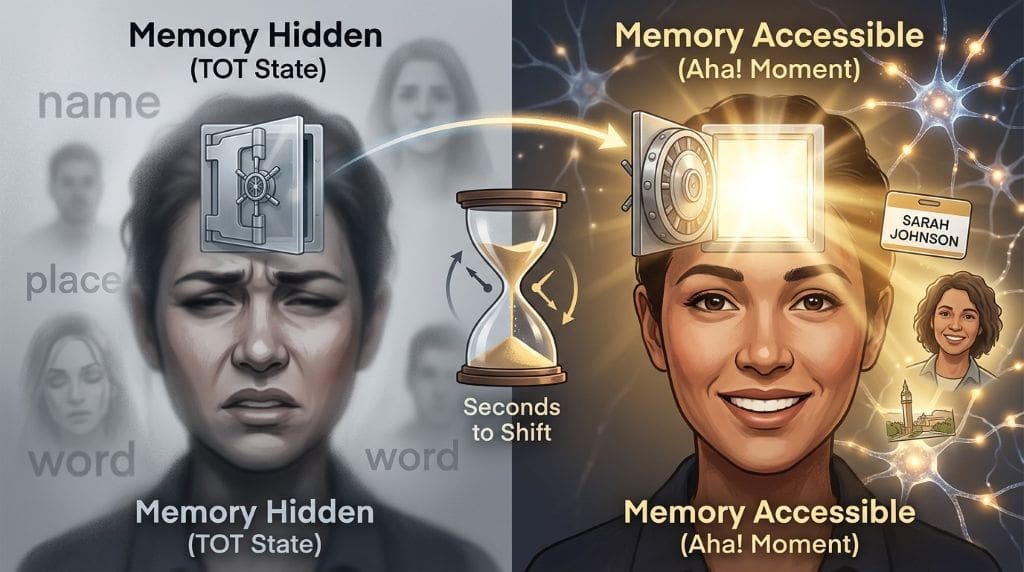
You reach for your morning coffee. Your brain instantly pulls up its location. Yet the color of the mug comes in a heartbeat later. A new study in Neuron shows why. During the study, scientists recorded brain signals millisecond by millisecond. As a matter of fact, they watched memories unfold in real time. Basically, the brain prioritizes what you need. Because, it serves the most useful detail first. Other details wait in line. This process is dynamic. Memory recall is not a single flash. Contrarily, it is a rapid sequence of steps. Your brain is a master of temporal efficiency. In fact, this discovery changes how we understand thinking.
Key Takeaways of Memory Recall
- Memory recall unfolds in a staged, temporal order.
- The brain prioritizes goal-relevant information first.
- Unimportant details arrive later during retrieval.
- This process prevents mental overload.
- The finding could reshape cognitive rehabilitation.
The Split-Second Order of Memory Recall
Every memory feels instant. In reality, it is a choreographed sequence. Researchers tracked brain activity with millisecond precision. They used magnetoencephalography (MEG). This tool captures rapid neural signals. Participants retrieved simple object features. They recalled an item’s location or its color. The brain did not dump all information at once.
At first, the task-relevant detail appeared. This was the spatial location of the object. After that, secondary features surfaced. The memory of the item’s color came later. This delay was small. It happened within a fraction of a second. Yet the order was consistent. Your brain serves what you need sooner. Unnecessary details wait their turn.
Why Location Comes First in Memory Recall
Why does spatial memory win the race? The study points to evolutionary logic. Knowing an object’s position is critical. You need to grab the cup. You do not need to admire its shade. Prior to taking action, the brain solves the spatial puzzle. This priority shields you from hesitation. To illustrate, imagine a driver braking for a deer. The brain instantly retrieves the brake pedal’s spot. The texture of the pedal is irrelevant. This hierarchy is a survival tool.
- The brain fetches the location of a threat first.
- The aesthetic features of the threat arrive later.
How Scientists Watched a Memory Surface
This list shows the temporal hierarchy. The brain staggers access to prevent a cognitive traffic jam. A smooth output is the result. At the same time, this staging reveals a fundamental truth. Your memory is not a photograph. It is more like a prioritized checklist.
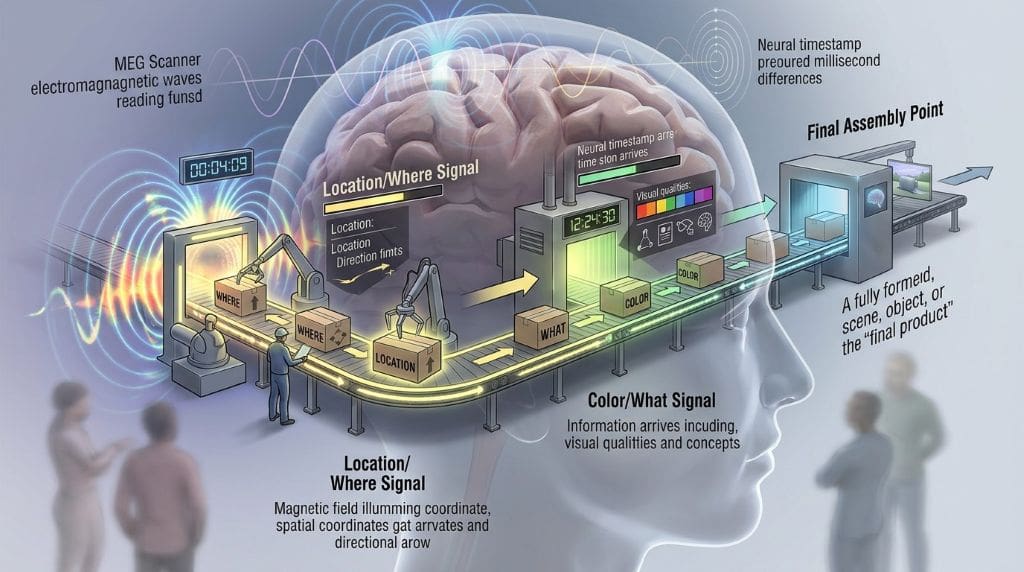
The team used a decoding algorithm. They trained a computer to read brain patterns. The MEG scanner recorded magnetic fields from neurons. As a result, they could see concepts form. They tracked “where” versus “what” signals. The location signal peaked first. What’s more, the color signal appeared reliably later. This was not random noise. It was a structured sequence.
This method avoids subjective reports. Participants did not guess their own timing. The brain revealed its schedule directly. So to speak, the researchers read the neural time stamp. With this in mind, we can see memory as an assembly line. Different parts arrive at distinct stations. The final product is a complete thought.
The Role of Goal-Directed Attention in Memory Recall
Your current goal shapes the order. The study involved a visual cue. Sometimes the task asked for the object’s location. Other times, it asked for the color. The brain adapted its search strategy. It flexibly reordered the retrieval stream. For the purpose of survival, this is deeply efficient. Your brain does not replay everything. It jumps to the answer.
In effect, attention acts as a neural pointer. It reaches into the memory trace. It pulls the critical thread out first. All things considered, this protects your working memory. You avoid processing irrelevant clutter. This explains that feeling of sudden confusion during memory recall. You find a key detail easily. A small secondary detail often escapes you. That detail was not prioritized.
- Goal-relevant signals get a head start.
- Irrelevant signals are processed slower.
This dynamic is goal-dependent. The brain is not a rigid machine. It is an adaptive search engine. This fact may help us design better learning tools. By emphasizing key goals, we speed up factual access.
Why This Timing Matters for Daily Life
Undeniably, memory lapses frustrate us. Often, the memory is not lost. In fact, the brain just stalled on an irrelevant bit. Particularly, you blank on a name. Till, you remember the person’s job instantly. This is because the job was the relevant anchor. Thus, the name was a secondary tag. Certainly, understanding this temporal lag reduces stress. Especially, you are not losing your mental edge. Basically, your brain is sorting by importance.
This mechanism explains tip-of-the-tongue states. Firstly, you feel the memory is close. Then, the semantic category is clear. The specific label is lagging behind. It is still in the pipeline. It simply arrives later or decays faster. At the present time, we can interpret these glitches with kindness. Actually, they are sequencing errors, not failures.
Implications for Cognitive Health Clinics
Clinicians can use this knowledge. Memory testing often looks at accuracy during memory recall. Response time precision is equally vital. A patient might recall an object’s name. Yet the speed of the spatial memory may have degraded. This temporal analysis offers a new biomarker. It is a subtle sign of aging or pathology.
So long as we measure the sequence, we gain insight. A breakdown in the order suggests frontal lobe issues. This region controls the prioritization during memory recall. In either case, early detection becomes possible. We can design games to boost sequencing speed. These exercises would train the goal-directed pointer. This is a fresh path for rehabilitation.
The Future of Neural Decoding Technology
This research validates MEG as a core tool. It captures the fleeting architecture of thought. Future devices may be simpler. Wearable brain sensors could monitor recall speed. They could warn of mental fatigue. In similar fashion, they could optimize learning schedules. Your device would know your brain’s prime time. It would serve critical training when you are sharpest.
However, this is not mind-reading. The algorithms decode simple sensory features. Complex autobiographical memory is messy. In spite of that, the principle holds. Retrieval is a time-stamped reconstruction. False memories may occur when timing breaks. A detail meant to arrive late arrives early. This misplacement corrupts the story. This sheds light on eyewitness unreliability.
A New Understanding of Consciousness
To put it another way, awareness is a temporal composite. The smooth movie of life is an illusion. In fact, tt comprises frames of varied content. Memory recall stitches these frames together. The sensation of unity comes from this stitching. When the timing is off, reality flickers. Some psychiatric conditions involve such fragmentation. To that end, understanding timing may unlock treatments.
All in all, the brain is a master timekeeper. It juggles the past to serve the present. This efficiency defines intelligence. Artificial systems often flood outputs all at once. That is a waste. Mimicking the brain’s staggered recall could create smarter AI. The robot would first check spatial risk. It would then check cosmetic details. The result is safer autonomy.
References
Morishita, Yoshikazu, et al. “Infraslow Histaminergic Dynamics Govern Priming States to Gate Moment-to-Moment Memory Accessibility.” Neuron, June 2026, p. S0896627326004113. DOI.org (Crossref), https://doi.org/10.1016/j.neuron.2026.05.019
FAQs on Moment-to-Moment Memory Recall
What is the main discovery of the study?
The study shows that memory retrieval is sequential. Actually, the brain prioritizes spatial or task-relevant information first.
Does this mean I will forget colors?
No. To rephrase it, the color memory still arrives. It just follows a slight temporal delay.
How did the scientists measure this timing?
They used magnetoencephalography (MEG). Basically, this non-invasive scanner tracks neural magnetic fields in real time.
Can I train my brain to recall faster?
Yes. Focusing sharply on a single retrieval goal speeds up that specific access stream. Additionally, practice reduces the internal noise.
Is this related to the loss of short-term memory?
At times, yes. A sequencing breakdown can mimic memory loss. Certainly, the data might be there, just poorly timed.
- Author
- Latest Posts

I am Bhagyashree Khaire, a Bachelor of Pharmacy graduate with a strong curiosity for science, biology, and the way research helps improve healthcare. My background in pharmacy has given me a foundation in pharmaceutical concepts, biological processes, and drug-related knowledge, which motivates me to explore scientific topics and share them through writing.I enjoy reading, researching, and writing about topics related to biology, pharmacology, healthcare, and pharmaceutical sciences. I believe that scientific information should not only be accurate but also easy to understand, and I aim to present complex concepts in a simple and meaningful way for readers.
During my research work, I conducted secondary market research on Rutin and its pharmacological activities, where I explored available scientific literature, biological effects, therapeutic potential, and research insights related to this natural flavonoid compound. This experience helped me strengthen my skills in scientific research, literature analysis, and communicating technical information effectively.
I am passionate about building my journey in science correspondence and scientific writing by creating informative, research-based articles that connect scientific knowledge with people. I am interested in opportunities related to healthcare content, pharmaceutical writing, research communication, and science-based storytelling.
With a continuous learning mindset and a passion for science, I aim to contribute valuable insights through my writing and grow as a science communicator.