Learn how Cortical Labs developed the world's first biological computer with living neurons, transforming technology as we know it.
Biological Computer You Can Code — Inside the Cortical Cloud
Estimated reading time: 8 minutes
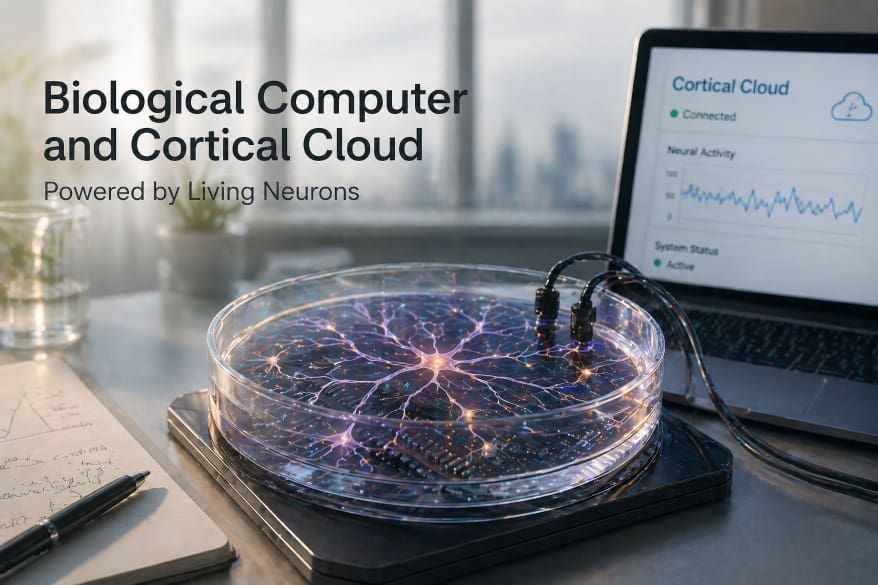
What if your computer ran on real brain cells — not chips? In fact, that is no longer science fiction. An Australian company called Cortical Labs has built the world’s first biological computer using living human neurons. On top of that, a new 2026 paper from their team shows how anyone can now code on these neurons in real time. At first, this sounds unbelievable. But the science is peer-reviewed, published, and open access. In short, we may be looking at the biggest shift in computing since the silicon chip. And you can access it from your laptop right now through their Cortical Cloud.
Key Takeaways
Before we go further, here is what the research shows:
- Cortical Labs built the world’s first commercial biological computer, called the CL1.
- The CL1 grows real human neurons from stem cells on a silicon chip.
- A new 2026 paper introduces the CL API — a coding interface for these neurons.
- The CL API works in real time with sub-millisecond response speed.
- Anyone can use it through a simple Python interface — no hardware expertise needed.
- The Cortical Cloud lets researchers access these neurons from anywhere in the world.
- The whole system uses under 1 kilowatt of power — far less than standard AI.
- Brain cells in the CL1 already learned to play the video game Doom.
What Is a Biological Computer — and Why Does It Matter?
In general, traditional computers run on silicon chips. These chips process data using electrical signals at fixed speeds. A biological computer works differently. In fact, it uses real, living neurons to process information. Seeing that neurons are the building blocks of the human brain, they bring something silicon cannot copy — the ability to learn and rewire on the fly.
Cortical Labs is an Australian biotech company based in Melbourne. At first, they focused on basic neuroscience. After that, they made global headlines in 2022. They placed 800,000 human and mouse neurons on a chip. Then they trained that network to play Pong. The world took notice.
What Is the CL1 Biological Computer?
To put it differently, the CL1 is Cortical Labs’ flagship biological computer product. Neurons grow inside a liquid solution full of nutrients. This keeps them healthy and active. They then grow across a silicon chip. As a result, that chip sends and receives electrical pulses into the neural structure.
Here is what makes the CL1 so different from standard computers:
- It uses real human neurons grown from stem cells.
- The neurons live on a silicon chip inside a sealed bio-reactor.
- A system called biOS — Biological Intelligence Operating System — runs their environment.
- The biOS creates a simulated world for the neurons to interact with.
- Users deploy code directly to the neurons to run experiments.
- The CL1 is the world’s first code-deployable biological computer.
The CL1 made its public debut in March 2025. It joins human brain cells to a silicon chip. To illustrate, the chip reads their signals and responds in real time. At the present time, you can buy one for $35,000. You can also access it remotely through the Cortical Cloud.
How Does the CL API Let You Code on a Biological Computer?
This is where the 2026 paper comes in. Prior to this, working with living neural networks needed deep hardware knowledge. In other words, only specialist labs with the right tools could do it. The new CL API changes that completely (Hogan et al., 2026).
So, what does the CL API actually do? In short, it gives you a simple way to send signals into living neurons. It also reads what the neurons send back. All of this happens in real time. In fact, the response speed is under one millisecond. What’s more, users write all of this in Python — the same language taught in most schools. The CL API handles all the complex timing in the background. As a result, you do not need to know anything about hardware. You just write your code and run it.
The CL API gives users real-time, sub-millisecond access to biological neural networks via a simple Python interface. It handles all the complex hardware timing automatically — so researchers can focus on the science, not the setup. — Hogan et al., arXiv, 2026
How Does the Biological Computer Respond in Real Time?
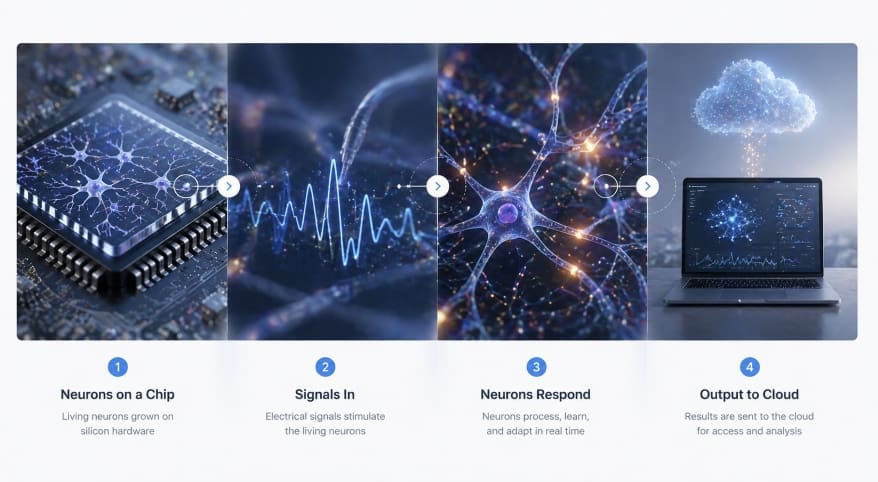
To explain briefly, closed-loop means the system reads neural activity and fires back instantly. Here is how that works, step by step:
- First, the biOS sends electrical signals into the neuron culture.
- After that, the neurons fire back in response.
- Then, the CL API reads those firing patterns in real time.
- In turn, it sends new signals based on what the neurons just did.
- All in all, this full loop happens in under one millisecond.
In like manner, this is how your own brain works — constant signals going back and forth. As a result, the CL1 with the CL API copies real brain communication more closely than any silicon system can.
Table 1: Biological Computer vs. Traditional Silicon AI
| Feature | Biological Computer (CL1) | Traditional AI (GPU Cluster) |
|---|---|---|
| Processing units | Living human neurons | Silicon transistors |
| Energy use | Under 1 kilowatt per rack | Multi-megawatt demand |
| Learning style | Intuitive, minimal data | Massive datasets required |
| Adaptability | Self-rewiring, dynamic | Fixed after training |
| Response speed | Sub-millisecond | Milliseconds to seconds |
| Access method | CL API + Cortical Cloud | Cloud GPU services |
| Cost to access | ~$300/week (cloud) | Varies — often very high |
Source: Hogan et al., 2026; Cortical Labs (corticallabs.com)
What Is the Cortical Cloud — and Can Anyone Use It?
Above all, one of the most exciting parts of this story is the Cortical Cloud. Not everyone can afford a $35,000 biological computer. Seeing that most researchers, students, and startups do not have a wet lab, Cortical Labs built a cloud solution for them.
With the Cortical Cloud, developers can build on the CL1 from anywhere in the world. What’s more, their biological computers use less energy than standard AI systems. In effect, this is wetware-as-a-service — renting real neurons by the week.
Here is what the Cortical Cloud offers:
- Remote access to CL1 units from any device.
- No lab equipment or wet lab space needed.
- Code runs directly on real living neurons.
- Real-time data streams back to your screen.
- Cloud access costs about $300 per week.
- By early 2026, the Cortical Cloud ran multiple server stacks. Each stack holds up to 30 CL1 modules.
You can visit Cortical Labs directly at corticallabs.com and access the Cortical Cloud platform at cloud.corticallabs.com. With this in mind, understanding how cloud computing works in modern science gives a useful foundation for why this kind of remote-access model is such a big step forward.
Table 2: What Can You Do on the Cortical Cloud?
| Use Case | Who It’s For | Possible Outcome |
|---|---|---|
| Drug testing on neurons | Pharma researchers | Safer, faster drug trials |
| AI research | Computer scientists | More efficient learning systems |
| Brain disease modelling | Neuroscientists | Better understanding of disorders |
| Education and experiments | University students | Hands-on neuroscience research |
| Neurocomputing projects | Startups and developers | New computing applications |
| Ethics-safe animal testing | Biology labs | Reduce animal use in research |
Source: Cortical Labs (corticallabs.com); Hogan et al., 2026
Why Could a Biological Computer Change the Future of AI?
All things considered, the CL API and the CL1 together represent something genuinely new. Brett Kagan, Chief Scientific Officer at Cortical Labs, says: “We believe actual intelligence is biological.”
In fact, the energy numbers tell a clear story. Standard GPU clusters for AI use massive amounts of power. In contrast, the CL1 rack runs on under 1 kilowatt. To put it differently, that is a tiny fraction of what a normal AI system needs.
In short, this matters for three big reasons:
- Energy — biological computers use a tiny fraction of the power AI uses.
- Efficiency — neurons learn fast with very little data.
- Ethics — the CL1 cuts the need for animal testing in research.
With this in mind, understanding what synthetic biological intelligence means for AI’s future puts all of this in perspective. After all, this is not just a faster computer. In fact, it is a completely different kind of machine.
For a deeper understanding of biological computers, check out our related articles on live computers and biocomputing, which explain the science behind programmable living systems and synthetic biological intelligence.
Frequently Asked Questions (FAQs)
What is a biological computer and how does it work?
A biological computer uses living neurons — not silicon chips — to process information. Cortical Labs’ CL1 grows human neurons from stem cells on a silicon chip. The biOS operating system creates a simulated environment for the neurons. Users then send electrical signals in, and the neurons respond. All in all, that two-way exchange is the computing process.
What is the CL API and who can use it?
The CL API is a Python-based programming interface for Cortical Labs’ biological neural networks. The 2026 paper by Hogan et al. introduced it as a way for non-specialist programmers to run real-time experiments on living neurons. In effect, if you know basic Python, you can use it.
What is the Cortical Cloud?
The Cortical Cloud is Cortical Labs’ remote-access platform. It lets anyone experiment on real CL1 biological computers from anywhere in the world — no lab required. At roughly $300 per week, it opens biological computing to students, startups, and researchers who cannot buy the $35,000 unit outright.
Can biological computers really replace traditional AI?
Not yet — but they offer clear advantages in some areas. For instance, they use far less energy, learn faster with less data, and adapt in ways silicon chips cannot. At this point, they are best suited for research, drug testing, and neurocomputing experiments. But the field is moving fast.
References
Hogan, D., Doherty, A., Khoo, B. K., Zhou, J., Salib, R., Stewart, J., Lawson, K., Loeffler, A., & Kagan, B. (2026). CL API: Real-time closed-loop interactions with biological neural networks. arXiv. https://doi.org/10.48550/arXiv.2602.11632
- Author
- Latest Posts

Ayushi Shukla is a biotechnologist and science communicator specializing in the intersection of genomic data and public health. Previously, she served as a Core Member and R&D Lead at the HealthTech venture Eat Wisely Bro, where she spearheaded research initiatives and translated emerging medical data into product strategy. She holds an M.Sc. in Biotechnology from the TERI School of Advanced Studies, where her research at The Energy and Resources Institute (TERI), New Delhi, focused on Environmental Biotechnology and Bioremediation.
As a Research Scholar at TERI, Ayushi developed a plant growth-promoting bacterial consortium for high-salinity agricultural conditions, managing daily laboratory procedures and molecular workflows. Her technical portfolio on GitHub demonstrates her dry lab expertise, featuring end-to-end bioinfomatics pipelines for RNA-Seq analysis, Phylogenetic modeling, and a functional prototype for Mycobacterium tuberculosis Genomic Surveillance & Dashboard.
Her clinical foundation includes advanced training in Somatic NGS and Precision Oncology from the Cancer Research Centre at Tata Memorial Centre, and a professional certification in Good Clinical Practice (GLP) from the NIDA Clinical Trials Network. Ayushi bridges the gap between raw genomic data and student-friendly narratives to help the next generation of scientist understand the transformative power of modern biology.