Learn how biotin tumor research reveals how cancer uses Vitamin B7 to survive and ways STEM experts can stop it.
Biotin and Tumor Growth: What Vitamin B7 Research Shows About Cancer Biology

Estimated reading time: 8 minutes
A new functional-genetics study in Molecular Cell shows that vitamin B7 (biotin) can act as a survival switch that lets tumor cells keep producing energy when glutamine — their preferred fuel — is cut off. Here is what the discovery of Biotin And Cancer reveals about cancer metabolism, and why it could lead to smarter combination therapies.
Key Takeaways: Biotin And Cancer
- Many tumors depend on external glutamine to keep their energy-producing cycles running — a state known as glutamine addiction.
- Using CRISPR-Cas9-based screening, researchers found that biotin (vitamin B7) helps cells bypass glutamine dependence.
- Biotin powers pyruvate carboxylase (PC), an enzyme that lets a cell build its own fuel when glutamine is unavailable.
- The tumor suppressor FBXW7 controls this escape hatch: when FBXW7 is lost and c-MYC rises, cells lose the biotin route and become permanently lock into glutamine addiction — a targetable vulnerability.
- Future therapies may pair glutamine blockade with biotin/pyruvate-carboxylase-pathway inhibition to close the escape route and prevent resistance.
What Is Glutamine Addiction?
Cancer is not just a disease of uncontrolled division — it is also a disease of altered metabolism. Tumor cells multiply quickly, so they need large amounts of energy and raw building blocks. A well-studied feature of this rewiring is glutamine addiction: the reliance of many tumors on the amino acid glutamine, taken up from the environment, to keep the tricarboxylic acid (TCA) cycle — the cell’s energy hub — supplied with intermediates.
Glutamine is not only a fuel. Cells convert it to glutamate and then to α-ketoglutarate, which enters the TCA cycle (a process called anaplerosis). Glutamine also supports the cell’s antioxidant defenses (through glutathione) and supplies nitrogen for nucleotides and amino acids. Because so many metabolic roads pass through glutamine, blocking its uptake or breakdown has been testes as a way to “starve” tumors.
The problem: some cancer cells survive the blockade. Even when glutamine is remove or its metabolism is inhibited, a subset of cells keeps growing. Until now, the mechanism behind this resilience was largely unknown. The new study explains it — and identifies both the nutrient and the gene that control the escape route.
The Study: A Systematic Search for Escape Routes
Researchers at the University of Lausanne (Strefeler, Baker, Chollet & Jourdain) used a technique called functional nutrient-genetic profiling. The team combined two tools:
CRISPR-Cas9 screening, which lets scientists switch off individual genes one at a time across the entire genome, and
controls nutrient environments, in which cells were grown with and without glutamine.
The goal was straightforward: identify which genes — and which nutrients — allow a cell to survive when glutamine is taken away. The screen tested a wide panel of vitamins and small molecules, and one candidate stood out dramatically: biotin, also known as vitamin B7.
The Discovery: Biotin Unlocks a Metabolic Backup Plan
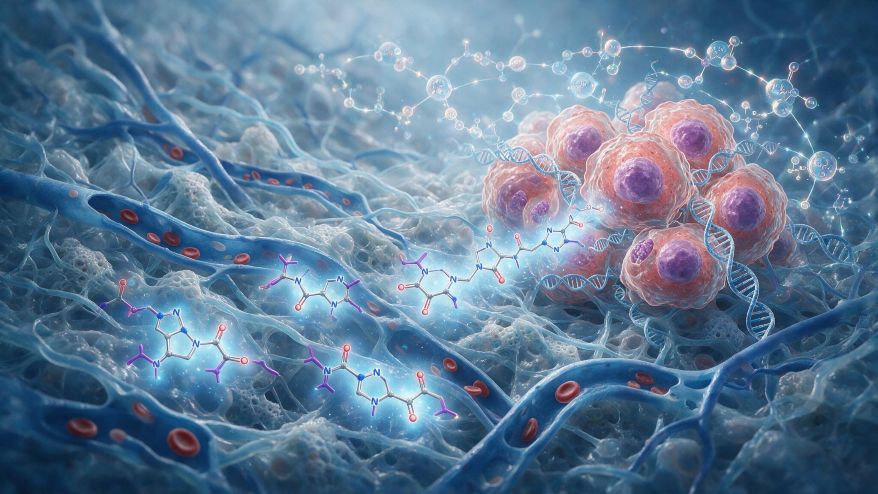
Biotin is a water-soluble B vitamin best known for its role in healthy hair, skin, and nails. At the molecular level, it is a cofactor: a helper molecule that enzymes need to function. Biotin is requires by a small family of carboxylases, enzymes that attach carbon dioxide to other molecules. One of these is pyruvate carboxylase (PC), which converts pyruvate — the end product of sugar breakdown — into oxaloacetate.
Why does that matter? Oxaloacetate is a TCA-cycle intermediate. When glutamine is scarce, a cell that can make oxaloacetate from pyruvate can manufacture its own fuel instead of depending on outside supply. In short, biotin-enabled PC is the “back door” that lets cells keep the energy cycle running during glutamine starvation.
Healthy human cells use the very same vitamin and enzyme for normal energy metabolism — the study is not about a toxic substance, but about how cancer co-opts a routine metabolic switch for survival. The finding also illustrates why enzyme-level detail matters: the survival pathway was invisible until the team looked carefully at which nutrients rescue glutamine-deprived cells.
The FBXW7–c-MYC Switch: Why Some Tumors Can Escape and Others Cannot
The screen produced a second major finding: the escape route is not available to every tumor. A protein called FBXW7 acts as the gatekeeper.
FBXW7 is a well-known tumor suppressor. It is part of a molecular machine (an E3 ubiquitin ligase complex) that tags other proteins for destruction. One of its most important targets is c-MYC, a powerful growth-promoting transcription factor. When FBXW7 is working normally, it keeps c-MYC levels low.
The study shows how this matters for metabolism:
FBXW7 intact, c-MYC low: the cell retains “metabolic flexibility.” The pyruvate carboxylase gene stays active, and the biotin-dependent backup pathway is available. If glutamine disappears, these cells can switch fuels and survive.
FBXW7 lost or mutated, c-MYC high: high c-MYC suppresses the PC promoter (the genetic switch that turns on pyruvate carboxylase). The cell loses its backup generator and becomes strictly dependent on glutamine — truly “addicted.”
This is clinically significant because FBXW7 is mutated or deleted in a wide range of human cancers, including colorectal, gastric, endometrial, and certain leukemias. The study therefore divides tumors into two metabolically distinct classes: those that can escape glutamine blockade (FBXW7-intact, biotin/PC available) and those that cannot (FBXW7-deficient, locked into addiction).
What This Means for Cancer Treatment: Biotin And Cancer
The findings suggest concrete, testable treatment strategies:
Smarter patient selection (biomarkers)
FBXW7 status — and pyruvate carboxylase expression — could predict which tumors will respond to glutamine-targeting drugs. FBXW7-deficient, c-MYC-high tumors are already “pre-addicted” and may be the most sensitive to glutaminase inhibitors, a drug class now in clinical development.
Closing the escape hatch (combination therapy)
For FBXW7-intact tumors, blocking glutamine alone may simply force them onto the biotin/PC backup path. Combining glutamine blockade with inhibition of the biotin utilization pathway (for example, pyruvate carboxylase, or the enzymes that load biotin onto carboxylases) could prevent resistance — the “lock the back door” strategy.
Also Read: Biochemistry for Beginners
New drug targets
Pyruvate carboxylase inhibitors and related metabolic tools are active research areas. Because PC is also important in healthy tissues (such as the liver’s glucose-production machinery), selective, tumor-context targeting will be essential — a major open question for medicinal chemists.
It is important to be precise about scope: this is mechanistic, cell-based research. It does not yet prove that any drug works in people. But it provides a molecular map for where to look.
A Practical Caution: Biotin Supplements and Blood Tests
Because biotin is a widely sold supplement (often taken at high doses for hair, skin, and nails), the study invites an obvious question: should cancer patients change their biotin intake?
The honest answer: this study does not answer that question. The experiments were perform in cultured cells, and dietary biotin levels in patients are a different matter entirely. No one should start or stop any supplement based on this research, and supplement decisions during cancer treatment belong in a conversation with an oncologist.
There is, however, one well-documented, directly relevant caution: high-dose biotin interferes with many common laboratory blood tests. Biotin is uses in the chemistry of certain immunoassays (troponin, thyroid hormones, and others), and high biotin levels in the blood can produce falsely high or falsely low results. The U.S. Food and Drug Administration has issued a safety communication warning that biotin can cause incorrect test results, and recommends that patients tell their clinicians about biotin use before blood draws. This is practical advice any patient can act on today.
Frequently Asked Questions
Does biotin cause or cure cancer?
No. Biotin is an essential vitamin, and this study does not show that biotin causes cancer — nor that it treats it. It shows that, in cell cultures, cancer cells can use biotin to power a fuel-making enzyme when glutamine is unavailable. Whether dietary biotin matters for human tumors is unknown and requires further research.
Should cancer patients stop taking biotin?
Do not change any supplement routine based on this article. High-dose biotin is known to interfere with certain laboratory blood tests, so patients should tell their care team about any biotin they take before blood work — and discuss all supplements with their oncologist.
What is glutamine addiction?
A metabolic state in which a tumor depends heavily on external glutamine to supply the TCA cycle and support growth. It makes the tumor vulnerable to drugs that block glutamine uptake or breakdown — unless the cell has an escape route like the biotin/pyruvate-carboxylase pathway.
What is pyruvate carboxylase (PC)?
A biotin-dependent enzyme that converts pyruvate into oxaloacetate, replenishing TCA-cycle intermediates. It is the molecular “backup generator” that helps cells survive without glutamine.
What is FBXW7?
A tumor-suppressor protein that marks other proteins — most notably the growth driver c-MYC — for destruction. Its loss in cancers leads to c-MYC accumulation and metabolic inflexibility (glutamine addiction).
When will this become a treatment?
Not soon. The discovery must be validate in animal models and then in clinical trials. Its most immediate value is guiding which tumors to treat with glutamine-targeting drugs and how to combine those drugs to block resistance.
References
- Strefeler, A., Baker, Z. N., Chollet, S., & Jourdain, A. A. (2026). Functional nutrient-genetic profiling reveals biotin and FBXW7 are essential to bypass glutamine addiction. Molecular Cell, 86(4), 1–15. https://doi.org/10.1016/j.molcel.2026.02.002
- FDA Safety Communication: Biotin can interfere with laboratory tests, causing incorrect results (2017, updated 2019). https://www.fda.gov/medical-devices/safety-communications/biotin-interference-tests-fda-warns-can-cause-incorrect-test-results
- Author
- Latest Posts

Lubna Nabi is a zoologist, science communicator, and life sciences specialist with a Master’s degree in Zoology and research focus in Limnology (the study of inland aquatic ecosystems). She combines hands-on laboratory experience with an interdisciplinary approach to biological and environmental research, bridging academic science with public literacy.
With a strong foundation in aquatic biology, laboratory techniques, and scientific outreach, Lubna excels at translating complex medical, biological, and ecological research into engaging, educational content. Her work focuses on fostering scientific curiosity, advancing environmental awareness, and promoting lifelong learning through clear, creative science communication.
- Author
- Latest Posts

I am an inspirational writer and emerging science blogger with a deep-rooted passion for understanding and sharing the wonders of the world around us. My journey began with a Bachelor of Science in Chemistry from AKI’s Poona College of Arts, Commerce and Science, where I developed not only a strong foundation in scientific principles but also a mindset that values curiosity, observation, and critical thinking. Studying chemistry has taught me to approach problems with logic, to look beyond the obvious, and to see patterns where others might only see complexity. These experiences have shaped the way I perceive life and influence the way I express my thoughts, both scientifically and creatively.
I have always believed that knowledge is only as powerful as the way it is shared. This belief has guided me to create content that bridges the gap between science and everyday life. I aim to simplify complex scientific ideas so they become approachable, relatable, and engaging for everyone—whether someone has a formal background in science or is simply curious about the world. Science, in my view, is not confined to textbooks and laboratories; it is a way of thinking, understanding, and connecting with the world around us. By making science accessible, I hope to inspire curiosity, ignite learning, and encourage people to see the beauty and relevance of scientific discovery in their daily lives.
Alongside my love for science, I am deeply passionate about motivational writing. I believe words carry the power to transform perspectives, encourage self-reflection, and inspire action. By combining analytical thinking with creativity, I create content that is intellectually stimulating yet emotionally resonant. Whether I am breaking down a chemical concept, exploring a scientific phenomenon, or crafting motivational narratives, my goal is to communicate ideas in a way that is clear, meaningful, and impactful.
Through my work, I strive to empower my readers – not just by helping them understand the science around them, but by inspiring them to grow, learn, and realize their full potential. Every article, post, or story I write reflects my commitment to turning knowledge into inspiration. I want to spark curiosity, encourage self-improvement, and show that learning and personal growth are deeply connected. For me, writing is not just a craft; it is a way to touch minds, connect hearts, and make ideas come alive in a way that truly resonates.