Understand gas exchange in alveoli: how oxygen enters blood while carbon dioxide is expelled during breathing.
Gas Exchange in Alveoli: How the Lungs Work
Estimated reading time: 5 minutes
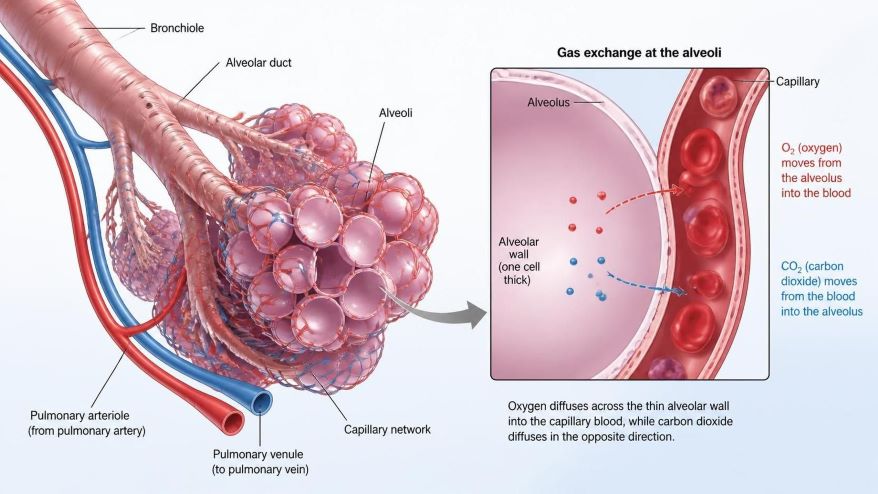
Gas exchange in alveoli is simple. Air fills tiny sacs called alveoli in your lungs. Oxygen moves from the air into nearby blood. At the same time, waste gas, carbon dioxide, moves from the blood into the air in the alveoli. Then you breathe out, removing that waste. This swap of oxygen and carbon dioxide is gas exchange in the alveoli. It helps your body work.
Key Takeaways: Gas Exchange in the Lungs
- Thin Walls: Alveoli have very thin walls. This lets gases pass through fast.
- Large Surface Area: Many tiny sacs provide a large surface area for gas to move across.
- Rich Blood Supply: Capillaries wrap around each sac, keeping blood close.
- Simple Diffusion: Oxygen moves from the air into the blood. Carbon dioxide moves from the blood into the air.
- Concentration Gradient: High oxygen in the sac pushes it into the blood. High blood carbon dioxide pushes it into the sac.
- Hemoglobin Help: Hemoglobin in red blood cells grabs oxygen and carries it to the body.
- Fast and Efficient: All these parts make gas exchange in alveoli quick and simple for your body.
Alveoli Structure: Gas Exchange in the Lungs
Alveoli are tiny sacs in your lungs. They have very thin walls. A close net of tiny blood vessels hugs them. This setup makes gas exchange in alveoli fast and straightforward. Oxygen moves from the air in the sac directly into the blood. Carbon dioxide goes the other way. It leaves the blood and enters the air. Then you breathe it out. This simple, thin design helps you get oxygen without delay.
How Gas Exchange Occurs by Diffusion
First, gas exchange in alveoli happens by diffusion. This is a simple process. Oxygen is high in the air inside the alveoli but low in the blood. Thus, oxygen moves from the air into the blood. Next, carbon dioxide is high in the blood but low in the air. Thus, it moves from the blood into the alveoli. Finally, you breathe out that waste gas. As a result, gas exchange in the alveoli keeps your body working well.
Oxygen and Carbon Dioxide Gradients
First, a gradient is a simple difference. In the lungs, oxygen is high inside the air sacs but low in the blood. This difference makes oxygen move into the blood. Next, carbon dioxide is high in the blood but low inside the air sacs. So, that gas moves from the blood into the air sacs. Then, you breathe it out. As a result, these gradients drive gas exchange in alveoli. They make it fast and easy for your body to get oxygen and remove waste.
Capillaries in Alveoli
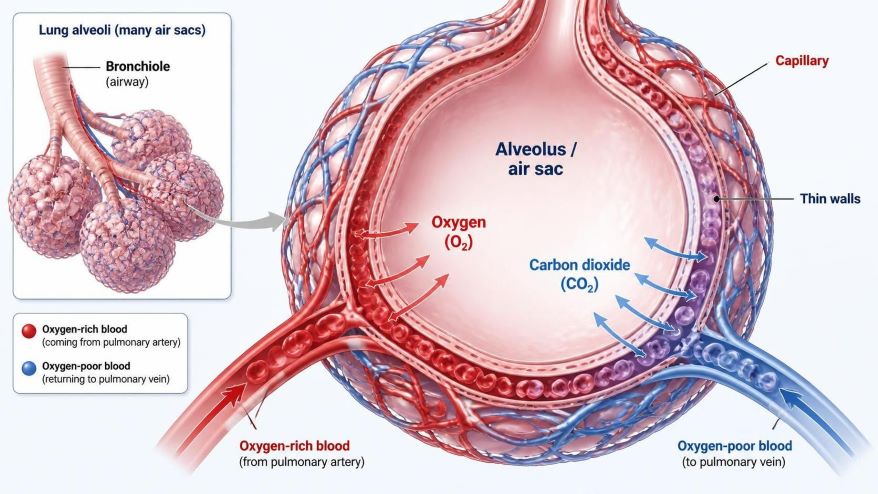
Capillaries are very tiny blood vessels. They wrap around each air sac in your lungs. Their walls are extremely thin. This lets gases pass through with ease. First, oxygen moves from the air sac into the blood inside the capillary. Next, carbon dioxide moves from the blood into the air sac. As a result, gas exchange in alveoli happens quickly. In short, these tiny vessels make gas exchange in the alveoli simple and fast, allowing your body to get the oxygen it needs.
How Alveoli and Hemoglobin Support Efficient Gas Exchange
First, hemoglobin is a special part of your red blood cells. It grabs oxygen tightly. This helps move oxygen from your lungs to your whole body. Next, the alveoli have a very large surface area. They are like many tiny balloons all packed together. This large area lets a lot of gas move at once. As a result, hemoglobin and the alveoli’s large surface area work together to make gas exchange in the alveoli fast and effective. In short, gas exchange in the alveoli supplies your body with the oxygen it needs without delay.
Frequently Asked Questions: Gas Exchange in the Lungs
What is gas exchange in alveoli?
Gas exchange in alveoli is a simple swap. It happens in tiny air sacs in your lungs. First, oxygen moves from the air into your blood. Next, carbon dioxide moves from your blood into the air. Then, you breathe out that waste. This whole process is called gas exchange in alveoli. It gives your body the oxygen it needs and removes waste gas.
Where does gas exchange occur?
Gas exchange occurs in tiny sacs deep inside your lungs. These sacs are called alveoli. They look like bunches of grapes. Thin walls and small blood vessels make the job easy. First, oxygen enters the blood. Then, carbon dioxide leaves the blood. This swap is called gas exchange in alveoli. It happens fast because the walls are very thin
How does oxygen enter the blood?
Oxygen enters the blood through a simple process. First, you breathe air into tiny sacs called alveoli. Oxygen is high in these sacs but low in the blood. So, oxygen moves from the sacs into nearby blood vessels. This move happens by diffusion. Thin walls make it fast and easy. This whole swap is part of gas exchange in alveoli
References:
- Dong, J., Yang, Y., & Zhu, Y. (2022). Recent advances in the understanding of alveolar flow. Biomicrofluidics, 16(2), 021502. https://doi.org/10.1063/5.0084415
- Knudsen, L., Ochs, M. The micromechanics of lung alveoli: structure and function of surfactant and tissue components. Histochem Cell Biol 150, 661–676 (2018). https://doi.org/10.1007/s00418-018-1747-9
- Author
- Latest Posts

I completed my Master of Science from the University of Allahabad in 2017 with a strong academic background in life sciences and chemistry. My specialization included Molecular Biology, Microbiology, Genetics, Plant Breeding, Phycology, Paleobotany, and Bioinformatics, along with Organic Chemistry, Inorganic Chemistry, and Physical Chemistry. This multidisciplinary training provided me with a comprehensive understanding of biological systems and analytical scientific approaches.
After completing my postgraduate studies, I gained valuable professional experience in both the education and social development sectors. I worked at A.M. Oxford Public School, where I was actively involved in guiding students toward academic excellence. In this role, I focused on creating an engaging learning environment, encouraging critical thinking, and nurturing students’ curiosity for scientific learning. My experience as an educator strengthened my communication, mentoring, and classroom management skills.
In addition to my teaching experience, I worked with Jeevan Jagriti Foundation, where I contributed to community-based initiatives aimed at improving educational access and awareness among underprivileged sections of society. Through this work, I participated in programs designed to support social development and promote the value of education in marginalized communities.
These professional experiences helped me develop strong interpersonal, leadership, and organizational skills while reinforcing my commitment to education and community service.