This study adds to that knowledge. It looks at important biological processes and explains why they matter. The findings help us better understand nature and its value to science and society.
Heterospecific Pollen Transfer Influences Polemonium Reproductive Success
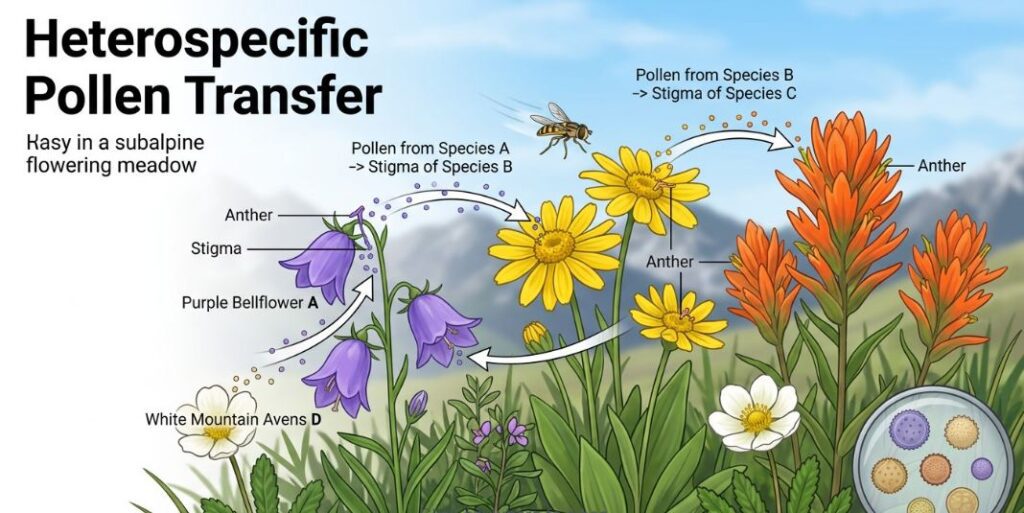
Nature has many amazing ways to survive and grow. One interesting process is heterospecific pollen transfer, which influences how plants adapt to their surroundings. Plants, animals, and other living things can adapt to changes around them. These natural systems help them stay alive in different environments.
Scientists study these processes to learn how life works. Their discoveries can help improve farming, biotechnology, environmental protection, and human health. They can also lead to new ideas for solving global problems.
This study adds to that knowledge. It looks at important biological processes and explains why they matter. The findings help us better understand nature and its value to science and society.
Key Takeaways
- The study looked at heterospecific pollen transfer (HP). This happens when pollen from one plant lands on the stigma of a different plant species.
- Researchers studied Polemonium brandegeei and nearby flowering plants that bloomed at the same time.
- They checked how often these plants received pollen from other plant species.
- The results showed that foreign pollen transfer was very common among plants that flowered together; furthermore, this pattern persisted across the studied communities. Consequently, co-flowering species frequently exchanged pollen, indicating widespread interspecific pollen movement..
- This finding showed that many plant species are linked through shared pollinators.
- The effects of foreign pollen were not the same for all plants.
- Some species were affected more than others.
- The impact depended on flower traits and the mix of plant species in the community.
Collection of Open-Pollinated Stigmas and Pollen Transfer Networks
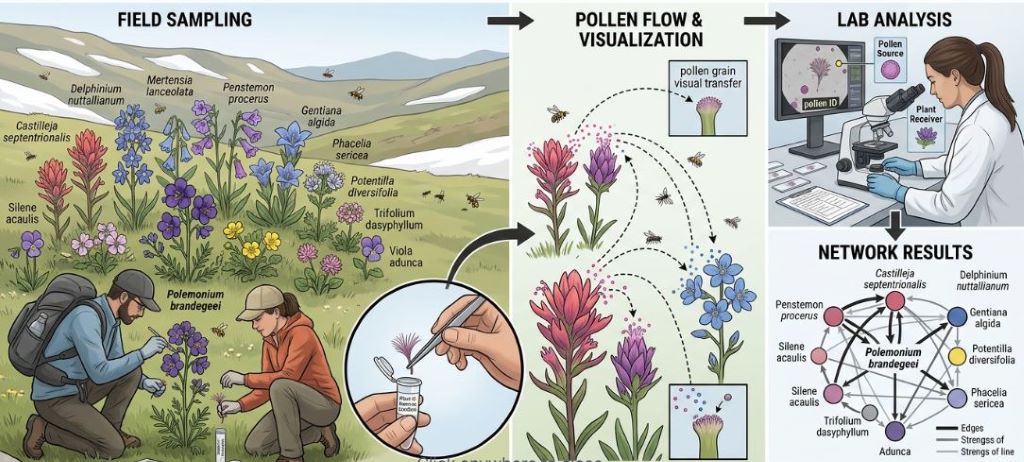
For heterospecific pollen transfer, First-the researchers collected stigmas from 11 common flowering plant species growing near Polemonium brandegeei in two subalpine plant communities. Next, they allowed natural pollinators, such as bees and other insects, to visit the flowers freely. As these pollinators moved between flowers, they carried and deposited pollen on the stigmas.
Consequently, the stigmas recorded the pollen they received from different plant species. Then, the researchers examined the pollen samples to identify both the source of the pollen and the plant that received it. Using these data, they traced pollen movement among species and created pollen transfer networks. Finally, this method helped them understand how pollination links plants within the community.
Patterns of Heterospecific Pollen transfer (HP) Receipt and Donation Across Species
Researchers studied pollen transfer among 11 flowering plant species. They found that heterospecific pollen transfer (HP), or pollen moving between different species, was very common.
Every plant species both received and gave pollen to other species. This result showed that pollen often moved among different plants in these subalpine communities.
The researchers also found that many pollen exchanges occurred between plants that were not closely related. This finding suggests that many species shared the same pollinators.
Overall, the study showed that pollination created strong links among many plant species within the community.
Hand Pollinations Testing How Donor–Recipient Relatedness Affected Consequences of HP Receipt for Polemonium brandegeei
- Researchers carried out hand-pollination experiments to study how heterospecific pollen transfer (HP) affected the reproduction of Polemonium brandegeei.
- They used pollen from different plant species that varied in how closely they were related to P. brandegeei.
- This approach helped the researchers test whether closely related species had stronger effects than more distant species.
- They applied mixed pollen to the stigmas. Each mixture contained pollen from P. brandegeei and pollen from another co-flowering species.
- The results showed that the effects of foreign pollen depended on how closely the donor species was related to P. brandegeei.
- Pollen from closely related species caused more problems for normal reproduction.
- In contrast, pollen from distantly related species had weaker effects.
- Overall, the study showed that closely related plants can interfere more strongly with successful reproduction when they share pollinators.
Conclusion
This study shows that many native plants share pollinators when they flower at the same time. Bees and other insects often visit several plant species during a single trip. As a result, pollen frequently moves from one plant species to another.
Because of this movement, foreign pollen often lands on plant stigmas. This process creates links among different plant species in the community.
Pollinator sharing can also benefit plants. When several species attract the same pollinators, flowers may receive more visits. As a result, plants may produce more seeds and reproduce more successfully.
Overall, the study shows that pollinator sharing is common among co-flowering native plants and can help support healthy plant communities.
Frequently Asked Questions
What is heterospecific pollen (HP) transfer?
Heterospecific pollen transfer happens when a pollinator carries pollen from one plant species and places it on the stigma of another species. This process is common in areas where many plant species flower at the same time. Because these plants often share the same pollinators, pollen frequently moves between different species.
How common was heterospecific pollen transfer in the studied subalpine communities?
The study found that all 11 common flowering plant species either received pollen from other species or gave pollen to them. This result shows that pollen moved widely among different plant species. As a result, pollen exchange was a common part of these subalpine plant communities.
Did heterospecific pollen negatively affect plant reproduction?
For most plant species, the amount of heterospecific pollen was low. This foreign pollen did not greatly affect the germination of pollen from the same species. In some species, flowers that received more foreign pollen also received more pollen from their own species. This pattern suggests that sharing pollinators may provide benefits. As a result, plants may receive more total pollen and improve their chances of successful reproduction.
Reference
Bruninga-Socolar, B., Aigner, P. A., Brosi, B. J., & Koski, M. H. (2026). Prevalence and consequences of heterospecific pollen receipt in the subalpine plant communities of Polemonium brandegeei. Botany, 104, 1–15. https://doi.org/10.1139/cjb-2025-0037
- Author
- Latest Posts

I completed my Master of Science from the University of Allahabad in 2017 with a strong academic background in life sciences and chemistry. My specialization included Molecular Biology, Microbiology, Genetics, Plant Breeding, Phycology, Paleobotany, and Bioinformatics, along with Organic Chemistry, Inorganic Chemistry, and Physical Chemistry. This multidisciplinary training provided me with a comprehensive understanding of biological systems and analytical scientific approaches.
After completing my postgraduate studies, I gained valuable professional experience in both the education and social development sectors. I worked at A.M. Oxford Public School, where I was actively involved in guiding students toward academic excellence. In this role, I focused on creating an engaging learning environment, encouraging critical thinking, and nurturing students’ curiosity for scientific learning. My experience as an educator strengthened my communication, mentoring, and classroom management skills.
In addition to my teaching experience, I worked with Jeevan Jagriti Foundation, where I contributed to community-based initiatives aimed at improving educational access and awareness among underprivileged sections of society. Through this work, I participated in programs designed to support social development and promote the value of education in marginalized communities.
These professional experiences helped me develop strong interpersonal, leadership, and organizational skills while reinforcing my commitment to education and community service.