New Plant Species Enhances Understanding of Flora
New Plant Species Discovery Expands Botanical Knowledge
Scientists have studied plants for hundreds of years. Even so, they still find new plant species. Every new discovery helps us learn more about nature. It shows how plants grow, change, and support life in different ecosystems. It also reminds us that many plants are still unknown.
Taxonomic research helps scientists find, identify, and name new species. This work is important because it provides the basic knowledge needed for conservation and future research. The recent study published in Kew Bulletin is a good example. It reveals new plant species and shows why scientists must document them quickly. Many plants could disappear because of habitat loss and climate change before they are even discovered.
Key Takeaways
- Scientists discovered a new plant species.
The researchers described a new species called Aristolochia argilophila from Brunei Darussalam. They also found that plants once grouped as A. foveolata in Borneo are actually three different species: A. papillifolia, A. transtillifera, and A. argilophila. - The true A. foveolata does not grow in Borneo.
The study shows that A. foveolata should be removed from the Flora of Borneo. The real A. foveolata grows in the Philippines. It is different from the plants found in Borneo. - Flowers are better than leaves for identifying species.
Leaf shape changes a lot, so it is not a reliable way to identify these plants. Flower features, such as the flower angle, small glands, and tiny hairs, clearly separate the three species. - Flower measurements proved the species are different.
The flower analysis clearly separated all three species. Leaf measurements showed a lot of overlap. This means flowers are much more useful than leaves for identifying species in this group. - The new species needs protection.
Aristolochia argilophila grows only in Brunei Darussalam. It lives in a small area and faces threats from urban growth, fires, and land clearing. Because of this, the researchers classified it as Vulnerable (VU) under the IUCN Red List criteria.
Taxonomic Classification and Botanical Background
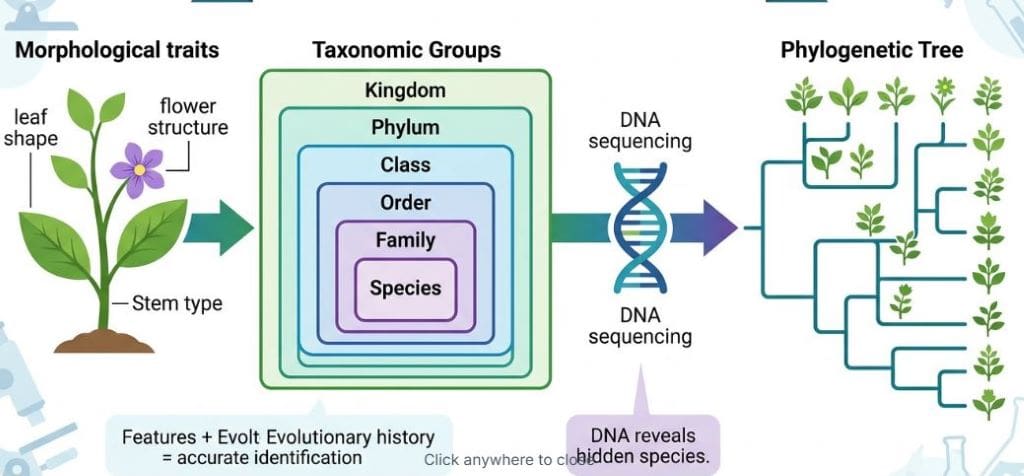
Taxonomic classification is the way scientists identify, name, and group living things. They place organisms into groups based on their shared features and evolutionary history. In botany, this system helps scientists tell plant species apart, study how they evolved, and record plant diversity.
Today, scientists use both plant features and DNA to classify plants. This makes plant identification more accurate and helps show how different species are related. New DNA sequencing methods have made this work even better. They help scientists find hidden species and solve classification problems that were hard to understand before.
Methods Used for Species Identification
Scientists identify species by using several methods. First, they study the organism’s shape and features. They compare these features with published descriptions and reference specimens. They look at traits such as size, body shape, color, leaves, flowers, or other visible features. These traits help them tell one species from another.
Scientists also use microscopes to study small details. This helps them separate species that look almost the same. They examine tiny surface features, internal parts, reproductive structures, and other fine details that cannot be seen easily in the field. These careful studies make species identification more accurate.
Conclusion and Conservation Priorities
The study concludes that this species is important and should be carefully recorded. Scientists should confirm its identity by using standard botanical methods and keep clear records of its key features. This information will help future research and improve plant classification.
The study also stresses the need to protect the species’ habitat. Habitat loss is one of the biggest threats to rare plants. Protecting natural areas is the best way to help the species survive.
Scientists should carry out more field surveys. These surveys can show where the species grows, how many plants remain, and whether new plants are growing. This information helps researchers decide if the species is common, rare, or at risk. It also helps them plan the best conservation actions.
The study also supports ex situ conservation. This means protecting the species outside its natural habitat. Scientists can store seeds, grow plants in botanical gardens, preserve herbarium specimens, or save plant tissue. These methods provide extra protection for species with small populations, limited ranges, or broken habitats.
Frequently Asked Questions
Why is taxonomic classification important in botany?
Taxonomic classification helps scientists name, identify, and group plant species. It makes research easier, supports conservation, and helps track plant diversity.
How do researchers determine whether a plant represents a new species?
Researchers compare a plant’s shape, features, and location with those of related species. They also use DNA data when it is available. This helps them find traits that make each species unique.
What are the key diagnostic features used in plant taxonomy?
Scientists look at key features such as leaves, flowers, fruits, seeds, and reproductive parts. These features help them identify and tell species apart.
Reference
Frank, D., Jaafar, S., Pandai, A., Abdullah, M. F., Sukri, R., & Mustapeng, A. M. A. (2026). Aristolochia argilophila (Piperales: Aristolochiaceae), a new species from Brunei Darussalam, with notes on the taxa Aristolochia foveolata Merr. and Aristolochia transtillifera Ding Hou. Kew Bulletin. https://doi.org/10.1007/s12225-025-10361-1
- Author
- Latest Posts

I completed my Master of Science from the University of Allahabad in 2017 with a strong academic background in life sciences and chemistry. My specialization included Molecular Biology, Microbiology, Genetics, Plant Breeding, Phycology, Paleobotany, and Bioinformatics, along with Organic Chemistry, Inorganic Chemistry, and Physical Chemistry. This multidisciplinary training provided me with a comprehensive understanding of biological systems and analytical scientific approaches.
After completing my postgraduate studies, I gained valuable professional experience in both the education and social development sectors. I worked at A.M. Oxford Public School, where I was actively involved in guiding students toward academic excellence. In this role, I focused on creating an engaging learning environment, encouraging critical thinking, and nurturing students’ curiosity for scientific learning. My experience as an educator strengthened my communication, mentoring, and classroom management skills.
In addition to my teaching experience, I worked with Jeevan Jagriti Foundation, where I contributed to community-based initiatives aimed at improving educational access and awareness among underprivileged sections of society. Through this work, I participated in programs designed to support social development and promote the value of education in marginalized communities.
These professional experiences helped me develop strong interpersonal, leadership, and organizational skills while reinforcing my commitment to education and community service.