With applications in medicine, finance, cybersecurity, and AI, this role stands among the most important jobs of the future.
The Coolest Tech Jobs You Haven’t Heard Of: Quantum Algorithm Developer
Estimated reading time: 5 minutes
Some jobs sound like they are pulled straight from science fiction. The Quantum Algorithm Developer career is one of them. These specialists design algorithms for quantum computers—machines far more powerful than classical computers for solving certain problems. They tackle challenges that traditional devices could never complete in a lifetime. This field is not just thrilling, but also highly rewarding, as it may transform industries from cybersecurity to drug discovery.
What Does a Quantum Algorithm Developer Do?
At its core, a quantum algorithm developer creates instructions for computers that run on the principles of quantum mechanics. Unlike normal code, these algorithms use quantum bits, or qubits, which can exist in multiple states at once.
Their work often involves:
- Writing quantum algorithms to speed up complex calculations.
- Testing algorithms on hardware from pioneers like IBM, Google, or Rigetti.
- Working on breakthroughs for medicine, logistics, or finance.
- Finding new ways to secure sensitive data with quantum cryptography.
In other words, they design the “brain” of the next generation of computers.
Why Is This Job So Cool?
This career does not just involve programming—it’s programming for the future of computing. Classical computers struggle with problems that grow too big, like modeling molecules or optimizing huge systems. Quantum computers can handle them more efficiently.
It’s cool because:
- You push the limits of what’s computationally possible.
- You pioneer in cybersecurity, healthcare, and AI.
- You work in a niche, cutting-edge field with high salaries.
As Richard Feynman, the Nobel Prize–winning physicist, once said, “Nature isn’t classical… and if you want to make a simulation of nature, you’d better make it quantum mechanical.” This perfectly explains why quantum algorithm developers exist.
How Does Quantum Computing Work?
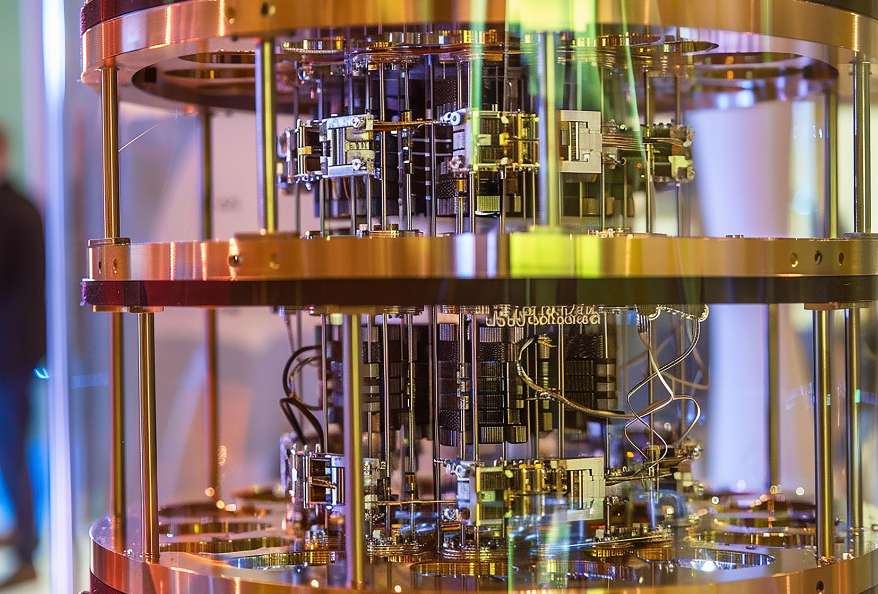
To understand the job, think about how computers store information. A classical computer uses bits—zeros and ones. A quantum computer uses qubits that can be both zero and one at the same time because of superposition.
Quantum algorithm developers design steps to exploit:
- Superposition: Qubits representing multiple possibilities simultaneously.
- Entanglement: Qubits linked so one’s state affects another instantly.
- Quantum interference: Controlling probabilities to get the right answer.
This means a quantum algorithm can run massive parallel calculations, solving some problems far faster than traditional machines.
Also Read: Quantum Leap: Future of Quantum Computing
Career Path to Becoming a Quantum Algorithm Developer
Students who want this job usually begin with a strong foundation in:
- Physics (especially quantum mechanics).
- Mathematics (linear algebra and probability).
- Computer Science (algorithms, coding, and optimization).
Later, they may pursue graduate-level studies in Quantum Information Science or Quantum Engineering. Hands-on training is increasingly available through online platforms that allow programming on real quantum machines, such as IBM Quantum Experience or Microsoft Azure Quantum.
Skills That Matter for Quantum Algorithm Developers
The role combines deep theoretical knowledge with strong coding skills.
Technical skills:
- Proficiency in Python and toolkits like Qiskit or Cirq.
- Understanding of quantum physics principles.
- Expertise in mathematical modeling.
- Familiarity with optimization problems and cryptography.
Soft skills:
- Patience and logical thinking.
- Problem-solving across multi-disciplinary teams.
- Lifelong learning since the technology is evolving rapidly.
This blend of skills makes the job both difficult and fascinating.
Also Read: Quantum Physics Education in Schools
Where Do Quantum Algorithm Developers Work?

This job is not limited to labs anymore. Global players are investing heavily in quantum computing.
- Tech Giants: IBM, Google, Microsoft, and Amazon.
- Pharmaceutical firms: Finding new drugs with advanced molecular modeling.
- Banks & Finance: Faster risk analysis and fraud detection systems.
- Cybersecurity firms: Designing secure post-quantum encryption methods.
Wherever industries face problems too big for classical computers, you will find quantum developers shaping the future.
Future Growth in Quantum Computing Careers
The demand for quantum algorithm developers is expected to grow rapidly. According to a 2024 McKinsey report, the global quantum computing market could reach nearly $100 billion by 2035. This growth means long-term opportunities for students entering the field today.
With governments and tech giants pouring billions into research, the need for experts to design smart quantum algorithms will keep soaring.
Quantum Algorithm Developer: Should Students Choose This Career?
This path is ideal for students who love math, physics, and coding. The field requires intellectual curiosity and problem-solving ability. The challenges can be tough, but the rewards—both financial and intellectual—are enormous.
For parents, this career offers job security in a niche, expanding industry. These roles often come with above-average pay and global opportunities. Supporting students who want to explore quantum computing means backing a career with huge growth potential.
Conclusion
The quantum algorithm developer is a career at the edge of what technology can achieve. These experts design complex algorithms that help solve problems classical computers simply cannot. With applications in medicine, finance, cybersecurity, and AI, this role stands among the most important jobs of the future.
For students, it’s not just a career in coding—it’s a chance to help build the future of computing itself.
Additionally, to stay updated with the latest developments in STEM research, visit ENTECH Online. Basically, this is our digital magazine for science, technology, engineering, and mathematics. Further, at ENTECH Online, you’ll find a wealth of information.
References:
- J, A., Adedoyin, A., Ambrosiano, J., Anisimov, P., Casper, W., Chennupati, G., Coffrin, C., Djidjev, H., Gunter, D., Karra, S., Lemons, N., Lin, S., Malyzhenkov, A., Mascarenas, D., Mniszewski, S., Nadiga, B., O’malley, D., Oyen, D., Pakin, S., . . . Lokhov, A. Y. (2022). Quantum Algorithm Implementations for Beginners. ACM Transactions on Quantum Computing, 3(4), 1–92. https://doi.org/10.1145/3517340
- Delgado-Granados, L. H., Krogmeier, T. J., Sager-Smith, L. M., Avdic, I., Hu, Z., Sajjan, M., Abbasi, M., Smart, S. E., Narang, P., Kais, S., Schlimgen, A. W., Head-Marsden, K., & Mazziotti, D. A. (2024). Quantum algorithms and applications for open quantum systems. arXiv (Cornell University). https://doi.org/10.48550/arxiv.2406.05219
- Author
- Latest Posts

Deven Nandapurkar is a Software Engineer, Project Lead; working at the strategic intersection of software engineering, productivity science, and emerging technologies. Driven by a core philosophy of “building things worth building,” he leads cross-functional teams and drives end-to-end technical strategy—from early-stage conceptualization through production-grade deployment.
A Computer Engineering graduate from Pune University, Deven brings a sharp systems-thinking approach to technical leadership, honed by years of managing high-stakes engineering projects and leading teams to top placements in national and international hackathons, including the NASA Space Apps Challenge and the Peerlist GenAI Hackathon.
Deven explores how human cognition and emerging technology converge. He regularly writes about cognitive performance optimization, attention management, AI integration, and the evolving dynamics of the modern workforce – offering actionable frameworks for professionals seeking to maximize their productivity and thrive alongside intelligent systems.
- Author
- Latest Posts

As a dedicated Computer Science Lerner, Samruddhi thrives on innovation and leadership, having led teams to victory in 6 national hackathons. Skilled in AI-powered chatbots, scalable web architecture, REST and FAST APIs. Proficient in TensorFlow, Python, Django. She is passionate about developing AI-driven solutions that push the boundaries of technology. Samruddhi is a versatile software enthusiast with a passion for innovative solutions and a track record of impactful projects in web development, machine learning and data science.


