Learn how robots as companions are transforming loneliness into connection through supportive and engaging behaviors.
Your Future Best Friend Might Need Batteries: How “Robots as Companions” is Changing Everything

Estimated reading time: 8 minutes
Picture this. You come home from a tough day. Then, your phone is buzzing. Also, your homework is waiting. Albeit, you feel a bit lonely. But your companion is there. Especially, It asks about your day. Also, it suggests a quick gratitude exercise. Besides, it reminds you of your strengths. However, this companion is not a person. Indeed, it is a social robot. Surely, science fiction is now reality. Specifically, robots are stepping out of factories. Particularly, they are entering our homes and hearts. In addition, they are becoming partners for our mental well-being. In a word, this is the new frontier of technology and human connection.
Key Takeaways
- Robots are being successfully used as companion coaches to improve psychological well-being through evidence-based exercises.
- Design matters – robots that act like supportive peers (companion-like) can build stronger bonds than those that act like instructors (coach-like).
- This field combines computer science, psychology, as well as engineering to create machines that understand and support human emotions.
- Career paths are diverse, ranging from robotics engineering to human-robot interaction design and AI ethics.
From Sci-Fi to Science: The Rise of Robotic Companions
Robots used to be about heavy industry. In fact, they built cars. Also, they assembled gadgets. Indeed, their world was one of precision and logic. On the contrary, the human world is messy and emotional. In due time, scientists asked a bold question. Can robots operate in our social world? Surprisingly, the answer is a resounding yes. As a result, we now have social robots. Obviously, their primary function is interaction. For the same reason, they provide companionship, offer support, and can even deliver therapy.

A landmark study by Jeong et al. (2022) proves this point. For this purpose, researchers placed robot companions in people’s homes. Accordingly, these robots delivered positive psychology interventions. The exercises included practicing gratitude and recognizing strengths. One group had a “coach-like” robot. For this purpose, it acted as an expert instructor. Another group had a “companion-like” robot. In this case, it acted like a supportive peer learning alongside the user. In summary, the companion-like robot was more effective. It built a better therapeutic alliance. Participants felt a stronger bond. This bond led to greater improvements in their well-being (Jeong et al., 2022). This shows a critical insight. For companionship, behavior is key. A machine that shares and listens can feel more trustworthy than one that just teaches.
Table 1: Coach vs. Companion Robot Behaviors
| Behavior Type | Coach-Like Robot | Companion-Like Robot |
| Self-Disclosure | Uses generic examples. | Shares its own “experiences” related to the topic. |
| Role | Positioned as an expert instructor. | Positioned as a peer learning with you. |
| Language | Gives direct instructions and homework. | Gently suggests trying activities together. |
How Do These Robots Actually Work? The Tech Behind the Touch
Building a robotic companion is highly interdisciplinary. It is not just about coding. In fact, it is about understanding people. For this purpose, the system needs to perceive, process, and respond.
First, the robot must sense the world. Obviously, it uses cameras and microphones for this purpose. Indeed, these are its eyes and ears. Equally important ia advanced software which allows for face recognition. It can also detect voice tones. Thus, this helps the robot identify its user. It can also gauge basic emotional cues.

Second, it must process this information. This is where artificial intelligence (AI) shines. Especially, natural Language Processing (NLP) allows the robot to understand spoken words. Besides, machine learning algorithms help it choose an appropriate response. Additionally, the robot accesses a database of therapeutic content. This content is based on proven psychology exercises (Jeong et al., 2022).
Third, it must respond in a meaningful way. Particularly, this involves speech synthesis for talking. It also involves physical movement. A tilt of the head can show listening. Indeed, a simple gesture can express empathy. All these parts must work together seamlessly. The goal is to create a natural interaction. SPecifically, this makes the human feel heard and understood.
Why Would Anyone Trust a Robot with Their Feelings?
This is a fair and common question. Humans are social creatures. We crave connection with other living beings. So, why confide in a machine? Research points to several compelling reasons.
Firstly, robots can be non-judgmental. You can tell them anything. There is no fear of gossip or social shame. Studies show people often disclose more to virtual agents than humans (Lucas et al., 2014). This creates a safe space for practice. For someone with social anxiety, a robot can be a low-pressure first step.
Secondly, they are consistently available. They do not get tired, busy, or impatient. They can provide support at 2 PM or 2 AM. This reliability is crucial for building a habit, like daily mindfulness practice.
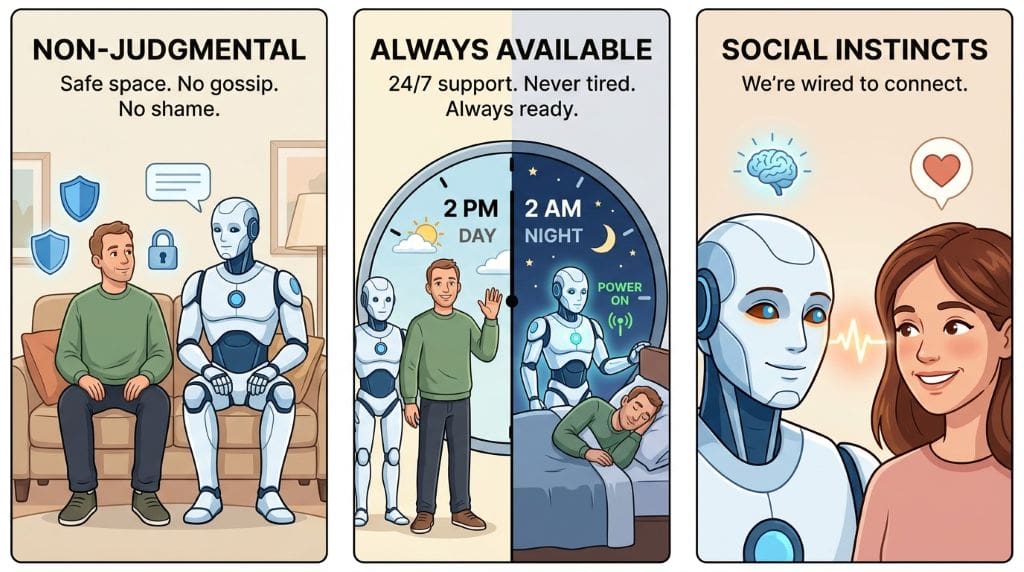
Thirdly, their design can trigger our social instincts. This is known as the “Computers Are Social Actors” (CASA) paradigm (Reeves & Nass, 1996). Our brains are wired to respond to social cues. A robot with a face and voice automatically engages this wiring. We naturally attribute intentions and emotions to it, even if we know it’s not real.
However, with this power comes great responsibility. Ethical questions are paramount.
- Privacy: What happens to the sensitive data shared with the robot?
- Attachment: Is it ethical to let someone bond deeply with a machine?
- Dependence: Could this replace human connection instead of supplementing it?
These are not simple questions. They are central to the work of researchers and ethicists in this field right now.
Your Path to Building the Next Generation of Companions
Are you fascinated by this fusion of tech and empathy? Good news. This field is growing fast. It needs bright, creative minds. Your high school studies are the perfect launchpad. Here is your roadmap.
Core K-12 Subjects to Master
- Computer Science & Programming: This is the foundation. Learn languages like Python. Understand algorithms. You are teaching machines how to think and learn.
- Mathematics (Especially Algebra & Statistics): AI and robotics run on math. Statistics helps you analyze data from human interactions.
- Physics & Engineering Principles: To build a body that moves, you need physics. Understanding forces, motors, and sensors is key.
- Psychology & Social Sciences: You cannot build a good companion without understanding people. Courses in psychology are incredibly valuable.
- English & Communication: You must write clear code and research papers. You also need to design how the robot speaks. Strong communication skills are vital.
Potential Career Paths in Human-Robot Interaction
- Social Robotics Engineer: You design and build the physical robot and its core systems.
- AI/ML Specialist: You develop the “brain”—the algorithms for understanding and responding.
- HRI (Human-Robot Interaction) Researcher: You conduct studies to see how people and robots interact. You improve the design based on science.
- Robotics Psychologist/Ethicist: You focus on the human side. You ensure robots are built and used responsibly and ethically.
Two Exciting Facts About Robots as Companions
- It’s not just about humanoid robots. Companion agents can be on tablets, in virtual reality, or even simple cute devices.
- This technology is already helping in hospitals, schools, and elder care homes today.
The Future is a Partnership with Robots as Companions
The goal of robotic companions is not replacement. It is augmentation. These machines will not take the place of friends, family, or therapists. Instead, they will serve as accessible tools. They can offer immediate support, guide us through helpful exercises. They can provide practice for social skills.
After all, we are at the very beginning of this journey. The robot in the study by Jeong et al. (2022) was an early prototype. Future companions will be more intuitive and adaptive. They will learn our unique patterns. They will offer more personalized support.
The future of robots as companions is being written now. It will be written by people who understand both circuits and emotions. Also, by people who ask tough ethical questions. It will be written by people who see technology as a way to support human flourishing. That person could be you.
References
Jeong, S., Aymerich-Franch, L., Arias, K. et al. Deploying a robotic positive psychology coach to improve college students’ psychological well-being. User Model User-Adap Inter 33, 571–615 (2023). https://doi.org/10.1007/s11257-022-09337-8.
Lucas, G. M., Gratch, J., King, A., & Morency, L.-P. (2014). It’s only a computer: Virtual humans increase willingness to disclose. Computers in Human Behavior, 37, 94–100. https://doi.org/10.1016/j.chb.2014.04.043
Reeves, B., & Nass, C. (1996). The media equation: How people treat computers, television, and new media like real people and places. Cambridge University Press.
Yang, W., & Xie, Y. (2024). Can robots elicit empathy? The effects of social robots’ appearance on emotional contagion. Computers in Human Behavior: Artificial Humans, 2, 100049. https://doi.org/10.1016/j.chbah.2024.100049
- Author
- Latest Posts

Charudatta Pathak was a student at St. Aloysius High School in Bhusawal, established in 1874, making it one of India’s oldest convent institutions. He earned his bachelor’s degree in mechanical engineering from SSVPS College of Engineering, Dhule in 1995, demonstrating exceptional academic achievement. Thereafter, he launched his career as a CNC programmer in a toolroom. He has utilized FANUC, Deckel, Maho, and Mikron controllers to operate 2-axis and 3-axis machines for the fabrication of jigs, fixtures, dies, and molds. He commenced his career as an academic in 1996, when he assumed the role of lecturer at SSVPS College of Engineering, Dhule. Additionally, he earned his post-graduate degree in CAD/CAM from L. D. College of Engineering, Ahmedabad, in 2000, and then acquired a Ph.D. from COEP in 2011 while concurrently engaged in teaching. Until 2023, he occupied many academic roles, including lecturer, assistant professor, professor, dean, principal, director, and vice chancellor at both public and private universities throughout India. From 2008 to 2010, he served as the project lead in the CAE department of a European multinational firm. During his 28-year professional tenure, he identified a need for dependable books targeted at students in grades 8 to 12, particularly for nascent career planning. He founded ENTECH Digital Magazine, a free monthly publication available on entechonline.com and magzter.com. Teens with a strong interest in Science, Technology, Engineering, and Mathematics (STEM) who aspire to pursue careers in these fields may find ENTECH Digital Magazine beneficial.



Great.
Thanks for your comment!
Keep visiting entechonline.com to read the latest news and articles on Science, Technology, Engineering and Mathematics STEM. ENTECH Online is more than just a magazine; it’s a gateway to a world of possibilities for teenagers passionate about Science, Technology, Engineering, and Mathematics (STEM).
Wonderful.
Thanks for your comment!
Keep visiting entechonline.com to read the latest news and articles on Science, Technology, Engineering and Mathematics STEM. ENTECH Online is more than just a magazine; it’s a gateway to a world of possibilities for teenagers passionate about Science, Technology, Engineering, and Mathematics (STEM).
Excellent
Thanks for your comment!
Keep visiting entechonline.com to read the latest news and articles on Science, Technology, Engineering and Mathematics STEM. ENTECH Online is more than just a magazine; it’s a gateway to a world of possibilities for teenagers passionate about Science, Technology, Engineering, and Mathematics (STEM).
Good
Thanks for your comment!
Keep visiting entechonline.com to read the latest news and articles on Science, Technology, Engineering and Mathematics STEM. ENTECH Online is more than just a magazine; it’s a gateway to a world of possibilities for teenagers passionate about Science, Technology, Engineering, and Mathematics (STEM).
Bestest articles
Thanks for your comment!
Keep visiting https://entechonline.com/ to read the latest news and articles on Science, Technology, Engineering and Mathematics STEM. ENTECH Online is more than just a magazine; it’s a gateway to a world of possibilities for teenagers passionate about Science, Technology, Engineering, and Mathematics (STEM).
Nice content.
Thanks for your comment!
Keep visiting https://entechonline.com/ to read the latest news and articles on Science, Technology, Engineering and Mathematics STEM. ENTECH Online is more than just a magazine; it’s a gateway to a world of possibilities for teenagers passionate about Science, Technology, Engineering, and Mathematics (STEM).
Good content 👍
Thanks for your comment, keep visiting entechonline.com for more articles related to your interests.
Robotics is for new generation.
Thanks for your comment, keep visiting entechonline.com for more articles related to your interests.
Amazing article.
Bestest articles👍
Thanks for your comment!
Keep visiting entechonline.com to read the latest news and articles on Science, Technology, Engineering and Mathematics STEM. ENTECH Online is more than just a magazine; it’s a gateway to a world of possibilities for teenagers passionate about Science, Technology, Engineering, and Mathematics (STEM).
Thanks for your comment, keep visiting entechonline.com for more articles related to your interests.
Wow it is amazing and interesting!
Thanks for your comment, keep visiting entechonline.com for more articles related to your interests.