In organic chemistry, Generally hydrocarbons are compounds made only of carbon (C) and hydrogen (H)..
Organic Chemistry Complete Guide for Grades 8–12 | Master Concepts & Reactions
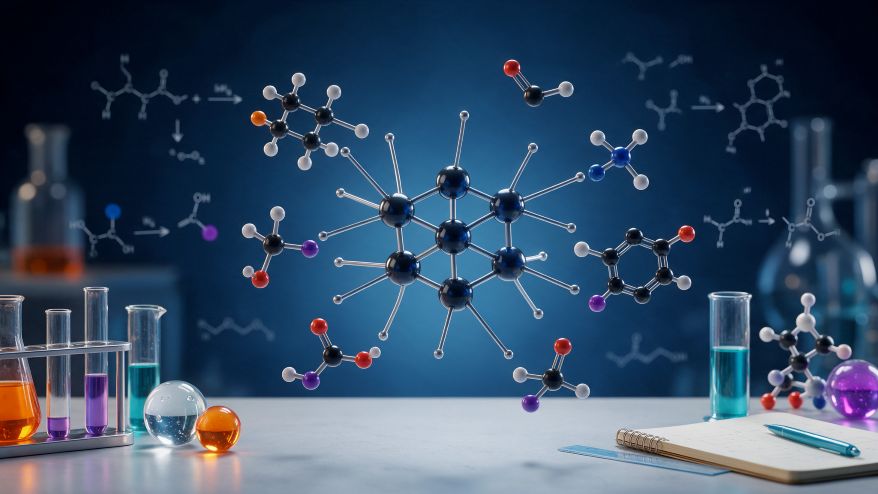
Consider your morning routine. For example, you wash your face with soap, a product of organic reactions. You drink coffee, powered by caffeine, a nitrogen-containing compound. You put on a polyester shirt, which is a long polymer chain. In fact, every step of your day involves organic molecules. These molecules are not just in labs. Instead, they form the fabric of life itself. From the food you eat to the medicines you take, organic chemistry explains it all. Therefore, this Article organic chemistry complete guide will help you master these concepts, starting from the basics of carbon bonding to advanced functional groups. We will, moreover, explore reactions, naming systems, and exam strategies. By the end, you will, ultimately, see the world through a chemist’s eyes.
Key Takeaways: Organic Chemistry Complete Guide
- Carbon’s unique ability to form four bonds creates millions of compounds.
- Functional groups determine a molecule’s reactivity.
- Hybridization explains the shapes of molecules.
- IUPAC naming provides a universal language for chemists.
- Isomerism shows how the same atoms can create different substances.
- Reaction mechanisms explain how bonds break and form.
- Practice is the key to mastering organic chemistry.
What Is Organic Chemistry? A Clear Definition
Organic chemistry is the study of carbon-containing compounds. In general, it explores their structure, properties, composition, reactions, and preparation. An introductory concept, moreover, is that carbon atoms form stable covalent bonds with each other. As a result, this creates chains and rings of almost unlimited length. Historically, the origin of this field dates back to Friedrich Wöhler in 1828. At that time, he accidentally synthesized urea from inorganic ammonium cyanate. This experiment, therefore, disproved the older theory of vitalism, which claimed only living things could produce organic substances.
The Historical Origins: Organic Chemistry Complete Guide
Before 1828, scientists thought organic compounds required a “vital force.” Friedrich Wöhler’s urea synthesis showed otherwise. This discovery transformed chemistry. It proved that organic compounds could be made in a lab. This was a major breakthrough.
Organic vs Inorganic Chemistry
Organic chemistry generally involves carbon, hydrogen, oxygen, nitrogen, and halogens. Inorganic chemistry involves all other elements. Organic molecules often have complex structures. Inorganic molecules tend to be simpler.
Why Carbon Is Unique: Organic Chemistry Complete Guide
Carbon is unique because of its electron configuration. In fact, it has four valence electrons. This, therefore, allows it to form four stable covalent bonds with other atoms. Moreover, no other element forms such stable long chains. This property is called catenation. As a result, this is why millions of organic compounds exist. In my classroom, I often use a “Lego brick” analogy. Carbon, similarly, is like a brick with four connection points. Therefore, you can build towers of any shape or size. This simple hands-on idea, moreover, helps students understand carbon’s versatility.
The Carbon Atom and Covalent Bonding
The carbon atom has six electrons: two in the inner shell and four in the outer shell. In particular, the outer shell holds these valence electrons. To become stable, carbon needs eight electrons in its outer shell. This is known as the octet rule. Therefore, carbon achieves this by sharing electrons with other atoms. This sharing, in turn, forms covalent bonds. A single bond is a pair of shared electrons. Similarly, a double bond shares two pairs. Finally, a triple bond shares three pairs.
Electron Configuration
Carbon’s electron configuration is 1s² 2s² 2p². The four outer electrons are available for bonding. However, This setup is perfect for forming sigma bonds and pi bonds.
Covalent vs Ionic Bonds
Covalent bonds involve sharing electrons. Ionic bonds involve transferring electrons. However, Organic chemistry relies heavily on covalent bonding. For example, methane (CH₄) is a covalently bonded molecule.
Bond Length, Bond Energy, Bond Angle
Bond length is the distance between two bonded nuclei. Meanwhile, bond energy is the energy required to break a bond. A triple bond, moreover, is shorter and stronger than a single bond. Bond angle, in turn, is the angle between two bonds from the same atom. For more details on bonding, read our dedicated guide on hybridization. These parameters, therefore, are critical for understanding molecular shape and reactivity. The American chemist Linus Pauling, furthermore, first explained these concepts in The Nature of the Chemical Bond (1939). This text, ultimately, remains an authoritative source.
Hybridization — sp, sp², sp³ Explained Simply
Hybridization is a concept from quantum mechanics. In fact, it explains how atomic orbitals mix to form new, equivalent hybrid orbitals. More importantly, this concept was first proposed by Linus Pauling in 1931. As a result, these hybrid orbitals help explain the shapes of organic molecules. Furthermore, the theory aligns with the VSEPR theory to predict molecular geometry. Therefore, by understanding hybridization, we can, in turn, better understand molecular shapes and bonding.
sp³ Hybridization (Tetrahedral): Organic Chemistry Complete Guide
In sp³ hybridization, one s orbital mixes with three p orbitals. This forms four sp³ hybrid orbitals. However, Each orbital has equal energy. They point to the corners of a tetrahedron. The bond angle is 109.5°. For Example Methane (CH₄).
sp² Hybridization (Trigonal Planar)
In sp² hybridization, one s orbital mixes with two p orbitals. This forms three sp² hybrid orbitals. They lie in a plane with a bond angle of 120°. The leftover p orbital forms a pi bond. For Example Ethene (C₂H₄)
sp Hybridization (Linear)
In sp hybridization, one s orbital mixes with one p orbital. As a result, This forms two sp hybrid orbitals. They are linear with a bond angle of 180°. The remaining two p orbitals form two pi bonds. For Example, Ethyne (C₂H₂) For a step-by-step breakdown of sp, sp², and sp³ hybridization with diagrams, read our dedicated guide on hybridization. However, Understanding this is essential for mastering the complete guide to organic chemistry.
Classification of Organic Compounds: Organic Chemistry Complete Guide
Organic compounds are, in general, classified into broad families. First and foremost, the main division is between hydrocarbons and functionalized compounds. Hydrocarbons, in contrast, contain only carbon and hydrogen. Functionalized compounds, on the other hand, contain other atoms like oxygen or nitrogen. Moreover, this classification system, therefore, follows IUPAC recommendations.
Hydrocarbons (Alkanes, Alkenes, Alkynes, Aromatics)
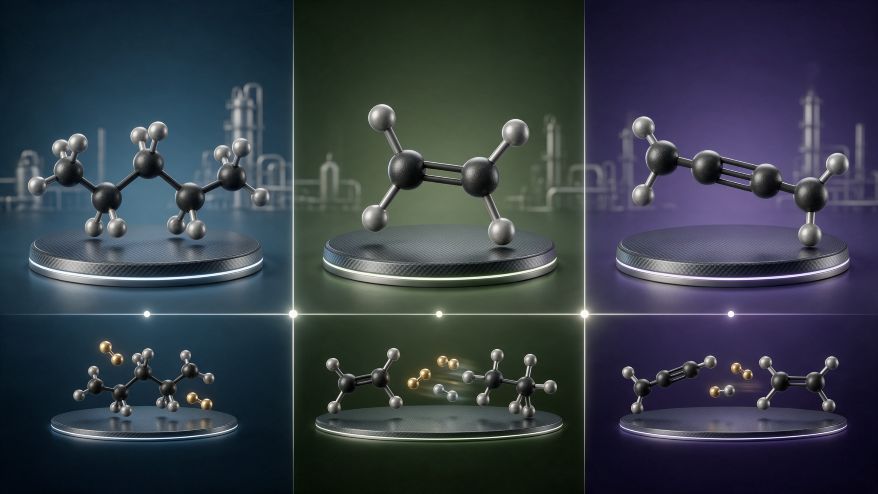
Hydrocarbons are the simplest organic compounds. However, Alkanes have only single bonds (saturated). Alkenes have double bonds. Alkynes have triple bonds. Ultimately, Aromatics contain a special ring structure like benzene.
Functionalized Compounds
These compounds have functional groups. Thus, These groups give the molecule its unique properties. For example, alcohols have an -OH group. Carboxylic acids have a -COOH group.
Homologous Series Concept
A homologous series is a family of compounds with similar properties. Thus, Each member differs from the next by a CH₂ unit. The molecular formula changes by a fixed pattern. For instance, alkanes follow CₙH₂ₙ₊₂.
Functional Groups — The Reactive Heart of Organic Molecules
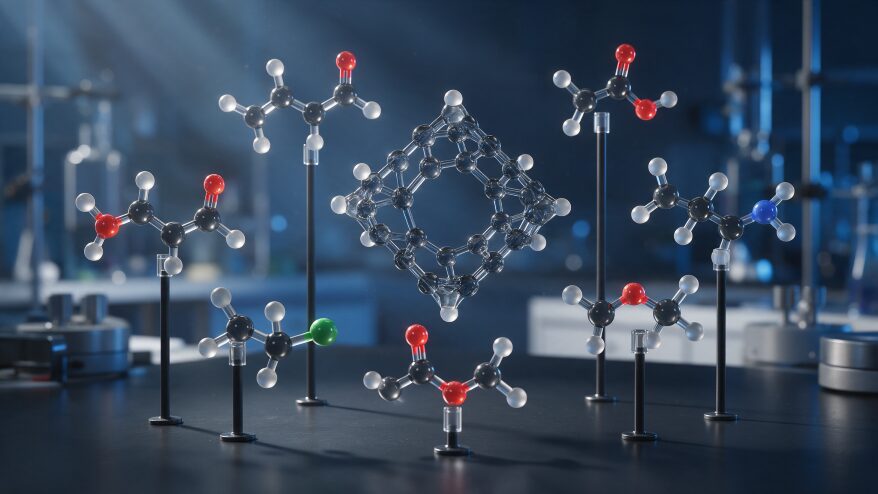
Functional groups are specific atoms or groups of atoms. However, They determine the chemical reactivity of a molecule. They also affect physical properties like boiling point. The IUPAC nomenclature rules prioritize these groups. The group with the highest priority gets the name’s suffix.
Complete Functional Group Table
| Functional Group | General Formula | Example | IUPAC Prefix | IUPAC Suffix |
|---|---|---|---|---|
| Alkane | R-H | Methane | – | -ane |
| Alkene | R₂C=CR₂ | Ethene | – | -ene |
| Alkyne | RC≡CR | Ethyne | – | -yne |
| Alcohol | R-OH | Ethanol | hydroxy- | -ol |
| Aldehyde | R-CHO | Ethanal | oxo- | -al |
| Ketone | R-CO-R | Propanone | oxo- | -one |
| Carboxylic Acid | R-COOH | Ethanoic Acid | carboxy- | -oic acid |
| Amine | R-NH₂ | Ethylamine | amino- | -amine |
| Ester | R-COOR | Ethyl Ethanoate | alkoxycarbonyl- | -oate |
IUPAC Priority Order
When a molecule has multiple groups, the highest priority group determines the suffix. The priority order is: Carboxylic Acid > Aldehyde > Ketone > Alcohol > Amine > Alkene > Alkyne. Explore the complete functional group chart and priority rules in our comprehensive functional groups guide.
How Functional Groups Determine Reactivity
The hydroxyl group, in fact, makes alcohols polar. As a result, this allows them to form hydrogen bonds. The carbonyl group in aldehydes, moreover, is reactive towards nucleophiles. The carboxyl group, on the other hand, is acidic. Therefore, these groups are the reactive heart of organic molecules. In addition, mastering them is crucial for a beginner in organic chemistry.
Electronic Effects: Basics of Organic Chemistry
Electronic effects, in fact, control how electrons move within a molecule. More importantly, they explain why certain reactions happen at specific positions. As a result, they are key to understanding reaction mechanisms. Furthermore, the British chemist Christopher Kelk Ingold formalized these concepts in his work Structure and Mechanism in Organic Chemistry (1953). Therefore, understanding these, in turn, makes you a better problem-solver.
Inductive Effect (+I and –I)
The inductive effect, in fact, is the polarization of a sigma bond. More specifically, an electron-withdrawing group (-I) pulls electron density away. In contrast, an electron-donating group (+I) pushes electron density. As a result, this affects the acidity of molecules. For example, fluorine is a strong -I group. Therefore, its electron-withdrawing nature can significantly influence nearby bonds and atoms.
Resonance Effect (+R and –R)
The resonance effect, in fact, involves the delocalization of pi electrons. More specifically, it applies to conjugated systems. An electron-donating group (+R), moreover, pushes electrons into the system. In contrast, an electron-withdrawing group (-R) pulls them out. As a result, this stabilizes intermediates like carbocations. Furthermore, the greater the delocalization, the greater the stability of the intermediate. Consequently, resonance plays a crucial role in understanding organic reaction mechanisms.
Hyperconjugation
Hyperconjugation, in fact, is the stabilization of a molecule. More specifically, it involves the interaction of sigma bonds with pi orbitals or empty p orbitals. As a result, it explains the stability of some alkenes. It also, moreover, explains the stability of carbocations. In particular, tertiary carbocations are more stable than primary ones partly due to hyperconjugation. Therefore, mastering these effects becomes important for understanding organic chemistry. Finally, master these effects with step-by-step examples in our electronic effects tutorial.
Electromeric Effect
The electromeric effect is a temporary effect. However, It occurs in the presence of an attacking reagent. It involves the complete transfer of a pi electron pair. This is different from the resonance effect, which is permanent.
Types of Organic Reactions — A Systematic Overview
Organic reactions are, in general, classified by how bonds break and form. First, the nucleophile is an electron-rich species. It then attacks an electron-poor electrophile. Meanwhile, the fragment that leaves is a leaving group. Therefore, this systematic approach follows IUPAC recommendations. We will, moreover, look at five major types.
Substitution Reactions
In substitution reactions, one atom or group replaces another. A common example is SN2. In SN2, the nucleophile attacks from the back. The leaving group departs. However, This is common for haloalkanes.
Addition Reactions
In addition reactions, two molecules, in turn, combine to form one. This is, in particular, typical for alkenes and alkynes. During the reaction, the pi bond breaks. As a result, new sigma bonds form. Moreover, Markovnikov’s rule predicts the product for asymmetric alkenes. Therefore, understanding these reactions is essential for mastering organic chemistry. Finally, understand substitution and addition with mechanism previews in our reaction types overview.
Elimination Reactions
In elimination reactions, a molecule loses atoms to form a pi bond. In contrast, this is the reverse of addition. For example, alcohols can undergo dehydration to form alkenes. This process, moreover, uses an acid catalyst. As a result, elimination reactions provide an important pathway for forming unsaturated compounds.
Oxidation & Reduction
Oxidation often involves gaining oxygen or losing hydrogen. Reduction is the opposite. Alcohols can be oxidized to aldehydes and then to carboxylic acids. Potassium dichromate is a common oxidizing agent.
Condensation & Rearrangement
Condensation reactions join two molecules while losing a small one, often water. Rearrangement reactions involve the migration of an atom or group. The carbon skeleton changes.
Isomerism — Same Formula, Different Structures
Isomerism occurs when molecules have the same molecular formula but different structures. This concept has real-world consequences. Chirality was responsible for the thalidomide tragedy of the 1960s. One enantiomer caused birth defects. This shows how important molecular shape is. It’s a crucial part of any organic chemistry complete guide.
Structural Isomerism (Chain, Position, Functional)
Structural isomers have different bonding arrangements. Chain isomers have different carbon skeletons. Position isomers have the functional group at different positions. Functional group isomers have different functional groups. For example, C₂H₆O can be ethanol (an alcohol) or dimethyl ether (an ether).
Stereoisomerism (Geometric & Optical)
Stereoisomers have the same bonding order but different spatial arrangements. Geometric isomers (cis-trans) occur in alkenes. Optical isomers are non-superimposable mirror images. They are called enantiomers. The Cahn-Ingold-Prelog system (CIP rules) is used to name them.
Why Isomerism Matters in Real Life
The thalidomide case is a powerful example. One enantiomer was a safe sedative. The other caused terrible birth defects. This shows the critical importance of understanding stereochemistry. Learn structural and stereoisomerism in detail in our isomerism guide.
IUPAC Nomenclature — How to Name Any Organic Compound
IUPAC nomenclature provides a universal naming system. It was established by the International Union of Pure and Applied Chemistry. All conventions follow the IUPAC Blue Book (2013 edition). This ensures every chemist can understand a name. This is a vital skill for any student studying chemistry for class 11.
The 5-Step IUPAC Naming Process
- Identify the parent chain: Find the longest continuous carbon chain.
- Number the chain: Start from the end closest to the highest priority functional group.
- Identify and name substituents: These are groups attached to the parent chain.
- Assign locants: Use numbers to show where substituents are attached.
- Write the name: List substituents alphabetically, then the parent chain name with the suffix.
Functional Group Priority Ladder
The functional group priority ladder decides the suffix. Remember: Carboxylic Acid is highest. Alkane is lowest. Other groups become prefixes.
Quick-Reference Table with 10 Examples
| Molecular Formula | IUPAC Name | Key Features |
|---|---|---|
| CH₄ | Methane | Simplest alkane |
| C₂H₆ | Ethane | Two-carbon alkane |
| C₂H₄ | Ethene | Double bond |
| C₂H₂ | Ethyne | Triple bond |
| CH₃OH | Methanol | Alcohol (-ol) |
| CH₃CHO | Ethanal | Aldehyde (-al) |
| CH₃COCH₃ | Propanone | Ketone (-one) |
| CH₃CH₂Cl | Chloroethane | Haloalkane |
| CH₃CH₂NH₂ | Ethanamine | Amine (-amine) |
| CH₃CH₂COOH | Propanoic acid | Carboxylic acid |
Hydrocarbons — The Foundation of Organic Chemistry
Hydrocarbons form the backbone of all organic molecules. They are the starting point for CBSE Class 11 organic chemistry. They are divided into saturated (alkanes) and unsaturated (alkenes, alkynes, aromatics). A personal classroom observation: Students often struggle with Markovnikov’s rule. I explain it using a “rich get richer” analogy. The carbon with more hydrogens already gets the new hydrogen. This simple trick helps them remember.
Alkanes: Properties, Preparation & Reactions
Alkanes are relatively unreactive. They undergo substitution reactions with halogens in the presence of light. They are used as fuels. Methane is a primary component of natural gas.
Alkenes: Addition Reactions & Markovnikov’s Rule
Alkenes are more reactive due to the pi bond. They undergo addition reactions. Markovnikov’s rule states that the hydrogen atom adds to the carbon with more hydrogen atoms. This rule is a cornerstone of high school organic chemistry.
Alkynes: Acidity & Addition
Alkynes have a terminal hydrogen that is slightly acidic. This is a unique property. They can form metal acetylides. They also undergo two rounds of addition reactions.
Aromatic Hydrocarbons: Benzene & Hückel’s Rule
Aromatic hydrocarbons are cyclic, planar, and have a ring of delocalized electrons. Benzene is the classic example. Hückel’s rule states that a compound is aromatic if it has (4n+2) pi electrons. This rule applies to flat, cyclic molecules.
Haloalkanes and Haloarenes — Substitution & Beyond
Haloalkanes serve as the gateway to understanding reaction mechanisms. They contain a carbon-halogen bond. This bond is polar. The carbon is electrophilic. This makes it a target for nucleophilic substitution reactions. The environmental impact of haloalkanes is significant. Chlorofluorocarbons (CFCs) deplete the ozone layer.
Classification & Nomenclature
Haloalkanes are classified as primary, secondary, or tertiary. This depends on the carbon attached to the halogen. The IUPAC name uses a prefix like chloro-, bromo-, or iodo-.
Nucleophilic Substitution (SN1 & SN2)
SN1 is a two-step reaction. It involves a carbocation intermediate. It favors tertiary substrates. SN2 is a one-step reaction. It favors primary substrates. The rate depends on the substrate and the nucleophile. Dive deeper into these mechanisms with our haloalkanes and haloarenes guide.
Environmental Impact of Haloalkanes
CFCs, in fact, were used as refrigerants. Moreover, they are very stable. As a result, they rise to the stratosphere. There, UV light releases chlorine atoms. Consequently, these chlorine atoms destroy ozone molecules. Therefore, this depletion allowed more harmful UV radiation to reach Earth. Finally, this is an important real-world application of the topic.
Alcohols, Phenols, and Ethers — Oxygen-Containing Compounds
Alcohols, phenols, and ethers, in general, are oxygen-containing compounds. Moreover, hydrogen bonding gives alcohols their unusually high boiling points. As a result, this explains why ethanol is a liquid at room temperature. Ethers, on the other hand, are more volatile. Therefore, understand how hydrogen bonding gives alcohols their unique properties in our dedicated article on this topic.
Classification & Hydrogen Bonding
Alcohols are classified as primary, secondary, or tertiary. This depends on the carbon attached to the -OH group. Hydrogen bonding occurs between the hydrogen of one alcohol and the oxygen of another. This interaction is strong. It raises the boiling point significantly.
Key Reactions: Organic Chemistry Complete Guide
Dehydration of alcohols, in fact, produces alkenes. Moreover, it requires an acid and heat. Oxidation of primary alcohols, meanwhile, gives aldehydes or carboxylic acids. Therefore, the Lucas test distinguishes between primary, secondary, and tertiary alcohols.
Distinction Tests
The Lucas test, in fact, uses zinc chloride and hydrochloric acid. Moreover, tertiary alcohols react immediately. Secondary alcohols, meanwhile, react in about 5 minutes. In contrast, primary alcohols do not react at room temperature. Therefore, this is a simple way to identify the type of alcohol.
Aldehydes, Ketones, and Carboxylic Acids — The Carbonyl Family
Carbonyl chemistry, in fact, is arguably the most important topic in Class 12 organic chemistry. Moreover, it ties together numerous named reactions. The carbonyl group (C=O), therefore, is highly polar. As a result, this makes the carbon electrophilic. Consequently, it is a prime target for nucleophilic addition reactions. Furthermore, this group is central to any organic chemistry study guide.
Nucleophilic Addition to Carbonyl
The nucleophile, in fact, attacks the electrophilic carbon. As a result, the pi bond breaks. Subsequently, a tetrahedral intermediate forms. Therefore, this is the foundation of many reactions. The Cannizzaro reaction, however, is a special case. In particular, it involves aldehydes without an alpha hydrogen.
Oxidation & Reduction
Aldehydes, in fact, are easily oxidized to carboxylic acids. Moreover, Tollens reagent and Fehling solution are mild oxidizing agents. Ketones, however, resist oxidation. Therefore, this is a key difference between them. Meanwhile, reduction of carbonyls gives alcohols.
Carboxylic Acid Derivatives
Esters and amides are derivatives of carboxylic acids. They are formed by condensation reactions. Esters are often responsible for fruity smells. Amides are key in proteins. These are vital connections for the complete picture.
Amines — Nitrogen-Containing Organic Compounds
Amines are the building blocks of amino acids, proteins, and many pharmaceuticals. They are derived from ammonia (NH₃). One or more hydrogen atoms are replaced by alkyl or aryl groups. Their basicity is a key property. They can act as bases or nucleophiles.
Classification & Basicity
Amines are classified as primary (1°), secondary (2°), or tertiary (3°). This depends on the number of carbon groups attached to the nitrogen. Their basicity depends on the availability of the lone pair on nitrogen. Alkyl groups donate electrons, increasing basicity.
Key Reactions & Diazonium Salts
Diazotization is a key reaction. It converts a primary aromatic amine into a diazonium salt. This salt is a versatile intermediate. It can be replaced by many other groups like -Cl, -Br, or -OH.
Amines in Daily Life
Amines are found in many drugs. Aniline is a precursor to many dyes. Amino acids contain an amine and a carboxylic acid. They form the polymers of life: proteins. The Hinsberg test distinguishes between primary, secondary, and tertiary amines.
Your Organic Chemistry Practice Roadmap: Organic Chemistry Complete Guide
This roadmap was, moreover, developed based on years of curriculum development experience for CBSE and competitive exam students. Ultimately, success in organic chemistry is not about memorization. Instead, it is about problem-solving. Therefore, you must practice constantly. First, start with the basics. Then, build up to complex mechanisms.
How to Use This Guide for Self-Study
Use this pillar page as your organic chemistry complete guide. First, start with Section 1. Most importantly, do not skip around. Instead, read each section thoroughly. As you progress, draw the structures yourself. Then, try to name the compounds. After that, test yourself with the linked practice problems. This active learning, therefore, is crucial.
Topic-Wise Practice Sequence
Follow this sequence for the best results:
- Carbon atom and bonding.
- Hybridization and molecular shapes.
- Functional groups and their properties.
- IUPAC nomenclature (practice at least 20 compounds).
- Isomerism (draw all possible isomers).
- Basic reaction types (substitution, addition).
- Electronic effects (predict product stability).
- Advanced mechanisms (SN1, SN2, E1, E2).
- Named reactions (aldol, Cannizzaro).
- Full-length problem solving.
Connecting Concepts — The Big Picture
Organic chemistry is, in fact, a web of connected ideas. The functional group, therefore, determines the reaction. Meanwhile, the electronic effect influences the rate. The stereochemistry, in turn, determines the product shape. As a result, seeing these connections is the key to mastery. Moreover, keep connecting each new topic back to the basics of the carbon atom and its bonding. In this way, this will build your intuition.
Frequently Asked Questions: Organic Chemistry Complete Guide
1. What is organic chemistry in simple words?
It is the chemistry of carbon compounds. It studies their structure, properties, and reactions.
2. Is organic chemistry very hard?
It can be challenging, but not impossible. You need to understand concepts, not memorize them. Practice is the key.
3. What is the first step to learn organic chemistry?
Start with the carbon atom and its bonding. Understand covalency and the octet rule. This is your foundation.
4. Why is carbon special in organic chemistry?
Carbon forms four strong covalent bonds. It can create long chains and rings. This allows for immense molecular diversity.
5. What is a functional group?
A functional group is a specific atom or group of atoms. It determines how an organic molecule will react.
6. What is IUPAC naming?
It is an international system for naming organic compounds. It gives each molecule a unique, descriptive name.
7. What are hydrocarbons?
They are the simplest organic compounds. They contain only carbon and hydrogen atoms.
8. What is the difference between SN1 and SN2?
SN1 is a two-step reaction with a carbocation intermediate. It favors tertiary carbons. SN2 is a one-step reaction that favors primary carbons.
References
- Cahn, R. S., Ingold, C., & Prelog, V. (1966). Specification of molecular chirality. Angewandte Chemie International Edition in English, 5(4), 385–415. https://doi.org/10.1002/anie.196603851
- Determination of reaction kinetics in three phase CO2 methanation” by Mathias Monning, Asad Asadli, Siegfried Bajohr, Moritz Wolf, and Thomas Kolb is associated withis associated with https://doi.org/10.1039/D5RE00337G
- D. Simatos, I. E. Jacobs, I. Dobryden, M. Nguyen, A. Savva, D. Venkateshvaran, M. Nikolka, J. Charmet, L. J. Spalek, M. Gicevičius, Y. Zhang, G. Schweicher, D. J. Howe, S. Ursel, J. Armitage, I. B. Dimov, U. Kraft, W. Zhang, M. Alsufyani, I. McCulloch, R. M. Owens, P. M. Claesson, T. P. J. Knowles, H. Sirringhaus, Effects of Processing-Induced Contamination on Organic Electronic Devices. Small Methods 2023, 7, 2300476. https://doi.org/10.1002/smtd.202300476
- Author
- Latest Posts

I am an inspirational writer and emerging science blogger with a deep-rooted passion for understanding and sharing the wonders of the world around us. My journey began with a Bachelor of Science in Chemistry from AKI’s Poona College of Arts, Commerce and Science, where I developed not only a strong foundation in scientific principles but also a mindset that values curiosity, observation, and critical thinking. Studying chemistry has taught me to approach problems with logic, to look beyond the obvious, and to see patterns where others might only see complexity. These experiences have shaped the way I perceive life and influence the way I express my thoughts, both scientifically and creatively.
I have always believed that knowledge is only as powerful as the way it is shared. This belief has guided me to create content that bridges the gap between science and everyday life. I aim to simplify complex scientific ideas so they become approachable, relatable, and engaging for everyone—whether someone has a formal background in science or is simply curious about the world. Science, in my view, is not confined to textbooks and laboratories; it is a way of thinking, understanding, and connecting with the world around us. By making science accessible, I hope to inspire curiosity, ignite learning, and encourage people to see the beauty and relevance of scientific discovery in their daily lives.
Alongside my love for science, I am deeply passionate about motivational writing. I believe words carry the power to transform perspectives, encourage self-reflection, and inspire action. By combining analytical thinking with creativity, I create content that is intellectually stimulating yet emotionally resonant. Whether I am breaking down a chemical concept, exploring a scientific phenomenon, or crafting motivational narratives, my goal is to communicate ideas in a way that is clear, meaningful, and impactful.
Through my work, I strive to empower my readers – not just by helping them understand the science around them, but by inspiring them to grow, learn, and realize their full potential. Every article, post, or story I write reflects my commitment to turning knowledge into inspiration. I want to spark curiosity, encourage self-improvement, and show that learning and personal growth are deeply connected. For me, writing is not just a craft; it is a way to touch minds, connect hearts, and make ideas come alive in a way that truly resonates.