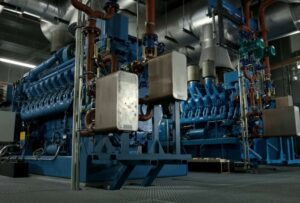
Discover the growing field of Heat Treatment Careers and how they contribute to essential industries like automotive and aerospace.
The Hidden Science Behind Stronger Metals: A Teen’s Guide to Heat Treatment Careers
Estimated reading time: 6 minutes
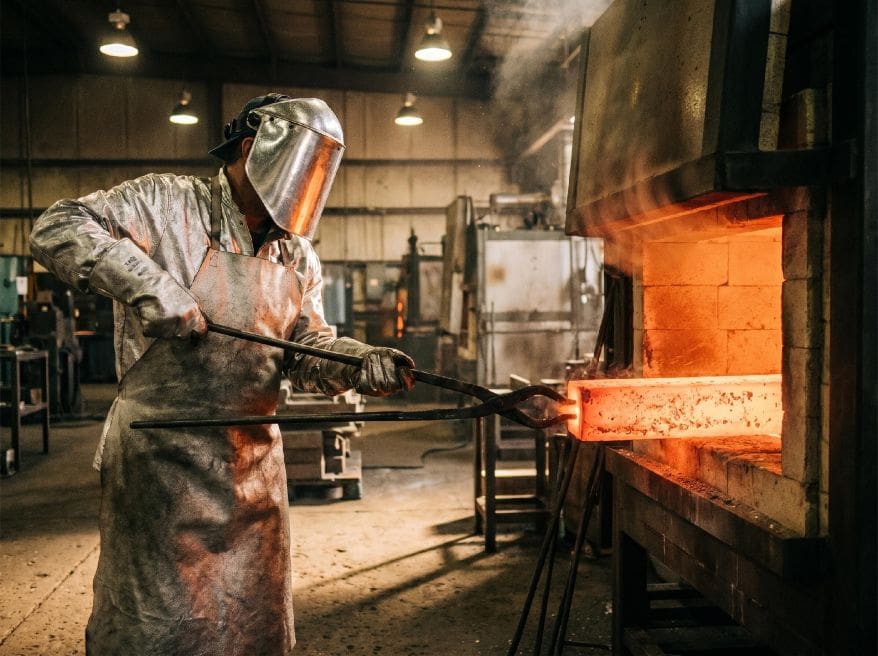
Every car on the road, every plane in the sky, and every surgical tool in an operating room depends on a process most people never notice. Heat treatment uses controlled heating and cooling to change the internal structure of metals. It turns soft steel into hard, durable components that can handle extreme forces and high temperatures year after year. For teens who want a hands-on STEM career that involves real materials and measurable results, this field is worth a closer look.
The heat treatment industry is massive and growing. The Business Research Co. reports in its 2026 Heat Treating Market Report that the global market hit $110.7 billion in 2025 and is projected to reach $142.4 billion by 2030. Yet most people have never heard of the companies and processes behind it. This article covers the basics, profiles the top players in the space, and maps out career paths for students interested in metallurgy and materials science.
What Is Heat Treatment and Why Does It Matter?
Heat treatment covers several specific processes. Annealing softens metal for easier machining. Quenching rapidly cools it to increase hardness. Tempering reduces brittleness after quenching. Case hardening creates a wear-resistant outer layer while keeping the core tough. Each process changes the metal’s microstructure at the atomic level.
Because this work demands specialized furnaces, precise temperature controls, and strict quality testing, most manufacturers don’t invest in their own heat treatment lines. Instead, they work with specialized heat treatment companies that already own the equipment and employ the metallurgists needed to process everything from tiny surgical screws to massive landing-gear components. These companies operate across automotive, aerospace, medical, and energy sectors, making them invisible but essential partners in modern manufacturing.
Top Heat Treatment Companies Powering Global Industry
Source: Bodycote – Bodycote operates over 165 locations across more than 20 countries, making it the largest thermal processing company on the planet.
1. TEAM, Inc.
A global leader in asset integrity, TEAM offers specialized on-site heat treatment services that allow for maintenance and processing directly at the client’s facility. Their Heat360 division provides critical post-weld heat treating (PWHT), stress relieving, and annealing for the energy, power, and manufacturing sectors, enabling repairs and construction to move forward without the need to transport massive components to an off-site furnace.
2. Bluewater Thermal Solutions.
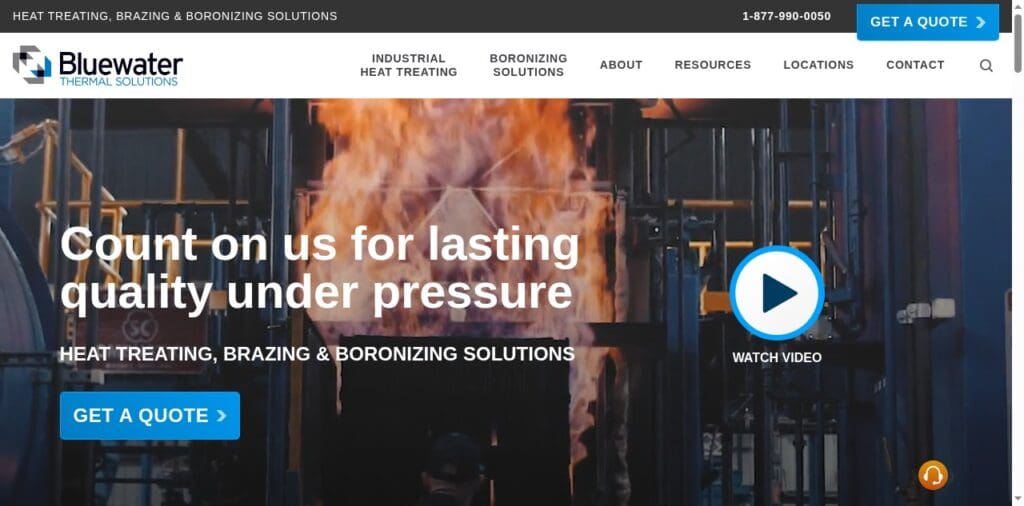
Based in the US, Bluewater is a major North American player with a strong focus on automotive and aerospace clients. It operates dozens of plants across the country and holds multiple NADCAP accreditations, meaning its processes meet the strict quality standards required by aircraft manufacturers.
3. Solar Atmospheres.
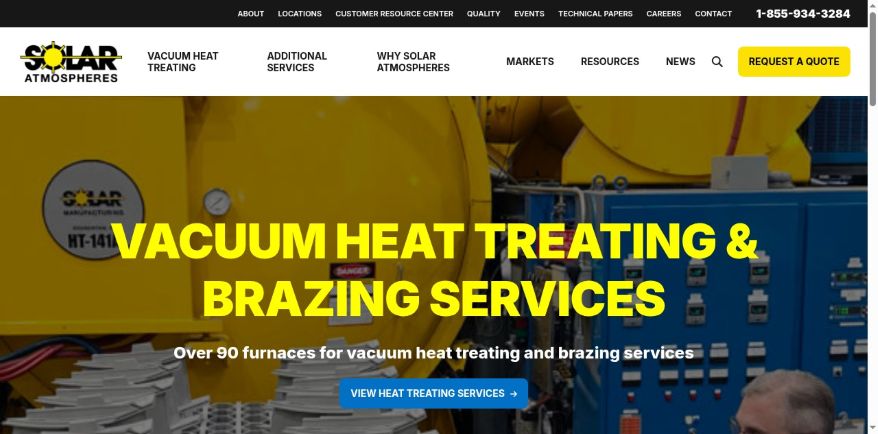
This US company focuses exclusively on vacuum heat treating. Vacuum furnaces remove oxygen during processing, which produces cleaner results with zero surface oxidation. That makes Solar Atmospheres a preferred choice for medical implants, jet engine parts, and other components where perfect surface quality is non-negotiable.
4. Paulo.
Founded in 1943, Paulo is one of the oldest family-owned commercial heat treaters in the United States. It operates facilities in the Midwest and South, serving heavy machinery, automotive, and tool-and-die customers with conventional heat treatment and brazing services.
5. DOWA Thermotech.
Part of the DOWA Holdings group in Japan, DOWA Thermotech is a leading Asian heat treatment provider. It runs facilities across Japan, China, Thailand, and other Southeast Asian markets, with a strong presence in electronics and automotive component processing.
Which Industries Rely on Heat Treatment?

Fortune Business Insights reports in its 2025 Heat Treating Market report that automotive manufacturing drives roughly 30% of all heat treatment demand. Lightweight, durable components are critical for both traditional internal-combustion vehicles and electric cars. Aerospace manufacturers rely on NADCAP-certified heat treatment for landing gear, turbine blades, and structural components. NASA’s research into materials for space exploration depends on advanced heat treatment processes to create alloys that survive launch stresses and temperature extremes.
The Bureau of Labor Statistics reports that heat treating equipment operators earn a median wage of $49,030 per year as of May 2025. Entry-level positions typically require only a high school diploma and moderate on-the-job training. For teens who want to avoid four-year college debt, this is a viable route into skilled technical work.
Our deep-dive on a new method that doubles fatigue resistance in high-strength steel shows how new materials changing engineering directly connects to heat treatment technology.
How Teens Can Start a Career in Heat Treatment
Several paths lead into this field. Technical colleges offer one- to two-year certificate programs in materials processing and metallurgical technology. Apprenticeships with commercial heat treatment companies let you earn while you learn, often leading to full-time operator or technician roles. The ASM Heat Treating Society offers student resources and certificate programs for anyone exploring the field.
A degree in metallurgy or materials engineering opens doors to higher-level roles in process development, quality engineering, and research. Our overview of careers in metallurgy and materials covers the full range of opportunities in this area. For students curious about emerging technologies, our article on smart materials and heat management shows how heat treatment connects to innovations like shape-memory alloys and thermal management materials.
The Takeaway
Heat treatment doesn’t get the spotlight, but it makes modern manufacturing possible. The companies profiled here represent a global industry that keeps planes flying, cars running, and medical devices functioning safely. For teens interested in a stable, well-paying career that involves real science and hands-on work, this field offers options at every education level.
The demand for skilled heat treatment technicians and metallurgists is only going to grow alongside the industries that depend on them. If you’re curious about how things are built to last, there’s no better place to start.
- Author
- Latest Posts

Charudatta Pathak was a student at St. Aloysius High School in Bhusawal, established in 1874, making it one of India’s oldest convent institutions. He earned his bachelor’s degree in mechanical engineering from SSVPS College of Engineering, Dhule in 1995, demonstrating exceptional academic achievement. Thereafter, he launched his career as a CNC programmer in a toolroom. He has utilized FANUC, Deckel, Maho, and Mikron controllers to operate 2-axis and 3-axis machines for the fabrication of jigs, fixtures, dies, and molds. He commenced his career as an academic in 1996, when he assumed the role of lecturer at SSVPS College of Engineering, Dhule. Additionally, he earned his post-graduate degree in CAD/CAM from L. D. College of Engineering, Ahmedabad, in 2000, and then acquired a Ph.D. from COEP in 2011 while concurrently engaged in teaching. Until 2023, he occupied many academic roles, including lecturer, assistant professor, professor, dean, principal, director, and vice chancellor at both public and private universities throughout India. From 2008 to 2010, he served as the project lead in the CAE department of a European multinational firm. During his 28-year professional tenure, he identified a need for dependable books targeted at students in grades 8 to 12, particularly for nascent career planning. He founded ENTECH Digital Magazine, a free monthly publication available on entechonline.com and magzter.com. Teens with a strong interest in Science, Technology, Engineering, and Mathematics (STEM) who aspire to pursue careers in these fields may find ENTECH Digital Magazine beneficial.