Discover how ALPR parking technology eliminates queues, enhances security with real-time alerts, and minimizes citation errors.
ALPR Parking Technology: 4 Ways it is Modernizing Parking
Estimated reading time: 3 minutes
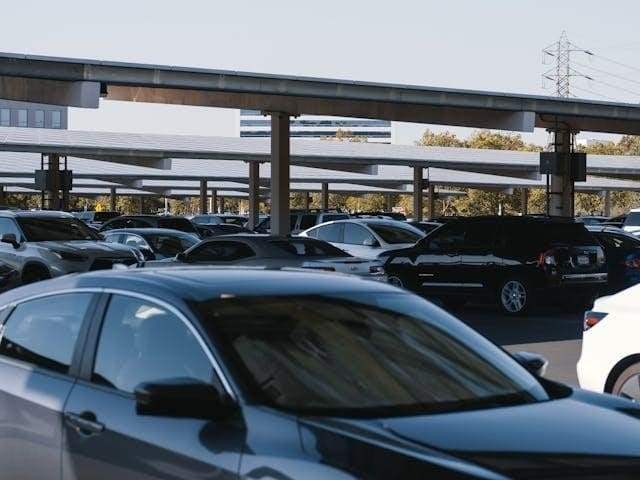
Image Source: Pexels – CC0 Licence
There are nearly 300 million cars on the US roads, and that doesn’t just impact the experience of driving on the roads. Parking is affected, too. We’ve seen in recent years that the historic, typically manual method for managing parking is increasingly inadequate for ensuring a smoother parking experience.
This is where ALPR — Automatic License Plate Recognition — technology comes in. This increasingly utilized tool allows parking attendants to work better, drivers to park more quickly, and results in fewer errors. What’s more, it can be deployed in parking lots of all types, including airports, sporting venues, campuses, and commercial outlets.
In this post, we’ll outline some of the key ways that ALPR is transforming parking and leading to a better experience for all stakeholders.
Reducing Queues
Traditional parking lots use the entry/exit barrier system, which often creates major bottlenecks during peak hours. In some cases, the queues created by having each driver manually click a button and wait for a barrier to go up and then down meant delays that caused attendees to miss the start of an event.
ALPR removes the need for a barrier at all. An ALPR camera can automatically read and log a license plate number, even when the vehicle is in motion, allowing for a much smoother flow of traffic. The result? Happier drivers, who spend less time waiting, and more productive staff, who can spend their time doing other value-adding tasks during the busiest periods.
Post-Parking Payment
Historically, drivers would have to pay for parking at the beginning or end of their stay. With ALPR, they can pay at a time that suits them. The camera automatically logs their license plate on arrival and exit, allowing for an accurate data trail of how long each vehicle used the parking services. From there, it’s possible for drivers to pay for their parking via a smartphone app. That means less time finding and queuing to pay at a kiosk, and a smoother flow of traffic at the exit, since no parking booths are required.
Real-Time Alerts
ALPR cameras aren’t just making it faster and easier for drivers to park. It’s also keeping them safer. The technology can cross-reference license plates to automatically detect any violations, which helps to speed identification and enforcement.
In addition to making a parking facility safer, these alerts also enhance staff productivity. It’s not realistic to think that an employee can be aware of every vehicle in a facility. With ALPR, they’re automatically alerted to issues even if they’re on the other side of the building. This can provide peace of mind that there’s always a set of eyes monitoring the space, even if those “eyes” are a camera.
Minimized Citation Errors
No one wants to receive a parking ticket — and they especially don’t want to receive one that was issued incorrectly. Highly accurate ALPR cameras have been shown to significantly reduce citation errors. Instead of relying on paper trails, citations are issued based on timestamped, photographic evidence that ensures that enforcement is reliable and consistent.
- Author
- Latest Posts

Charudatta Pathak was a student at St. Aloysius High School in Bhusawal, established in 1874, making it one of India’s oldest convent institutions. He earned his bachelor’s degree in mechanical engineering from SSVPS College of Engineering, Dhule in 1995, demonstrating exceptional academic achievement. Thereafter, he launched his career as a CNC programmer in a toolroom. He has utilized FANUC, Deckel, Maho, and Mikron controllers to operate 2-axis and 3-axis machines for the fabrication of jigs, fixtures, dies, and molds. He commenced his career as an academic in 1996, when he assumed the role of lecturer at SSVPS College of Engineering, Dhule. Additionally, he earned his post-graduate degree in CAD/CAM from L. D. College of Engineering, Ahmedabad, in 2000, and then acquired a Ph.D. from COEP in 2011 while concurrently engaged in teaching. Until 2023, he occupied many academic roles, including lecturer, assistant professor, professor, dean, principal, director, and vice chancellor at both public and private universities throughout India. From 2008 to 2010, he served as the project lead in the CAE department of a European multinational firm. During his 28-year professional tenure, he identified a need for dependable books targeted at students in grades 8 to 12, particularly for nascent career planning. He founded ENTECH Digital Magazine, a free monthly publication available on entechonline.com and magzter.com. Teens with a strong interest in Science, Technology, Engineering, and Mathematics (STEM) who aspire to pursue careers in these fields may find ENTECH Digital Magazine beneficial.