Understand the significance of automotive manufacturing in modern design, material selection, and engineering practices.
How Precision Manufacturing Is Driving the Next Generation of Automotive Engineering?
Estimated reading time: 5 minutes
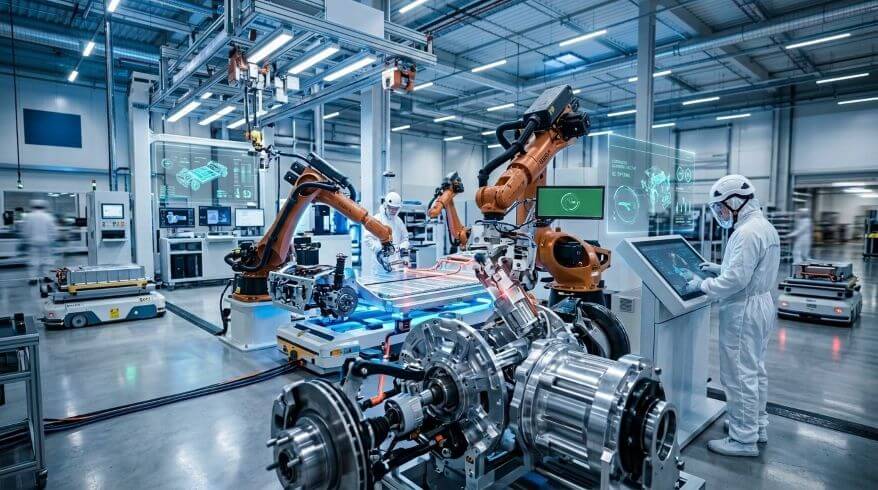
Automotive engineering has always pushed manufacturing to its limits. Engines that survive millions of combustion cycles, suspension systems that absorb thousands of impacts without failure, and brake components that perform reliably under extreme heat all depend on parts being made correctly, to tight tolerances, from the right materials. As vehicles become more complex, the manufacturing disciplines behind them have had to keep pace.
Engineering students should learn about modern automotive parts and their manufacturing to see where the field is going. Knowing these methods helps them choose the right materials and create better plans. It also shows how a designer’s vision fits with what factories can build.
The Shift Toward Tighter Tolerances
Older manufacturing methods could tolerate a reasonable degree of variation between parts. Workers built engines by hand, picking parts that fit together well. They did this because old machines could not make every piece exactly the same.
Modern CNC-based manufacturing changed that. Computer-controlled machines follow the same programmed toolpath on every part, producing components that are dimensionally consistent within fractions of a millimetre. For automotive applications this matters because tighter tolerances mean better sealing, lower friction, reduced wear, and longer service life.
These gains compound across an engine or drivetrain. When every mating surface fits as intended, the assembly performs closer to its designed specification, which translates directly into efficiency, reliability, and emissions performance.
Automotive Manufacturing: Materials Science and Automotive Production
The materials used in automotive manufacturing have changed considerably over the past two decades. Aluminium has displaced cast iron in many engine and structural applications because it offers a better strength-to-weight ratio, which reduces vehicle mass and improves fuel economy or electric range.
Automotive manufactures use high-strength steels in safety-critical structural areas where energy absorption in a collision is important. Titanium appears in performance and motorsport applications where weight reduction justifies the higher material cost. Carbon fibre composite components are increasingly found in premium and electric vehicles.
Each of these materials presents different manufacturing challenges. Aluminum requires different cutting speeds and tooling compared to steel. Titanium is difficult to machine and generates significant heat at the cutting zone. Carbon fibre needs specialist tooling to avoid delamination. Manufacturers with genuine automotive manufacturing expertise understand these material-specific requirements and build their processes around them rather than applying a one-size-fits-all approach.
Electric Vehicles and New Manufacturing Demands
The transition to electric vehicles has introduced manufacturing requirements that did not exist in traditional powertrain production. Battery housings need to be structurally rigid, thermally managed, and sealed to a high standard. Electric motor casings require precision bores and surface finishes to support high-speed rotating assemblies. Thermal management components, including cooling plates and heat exchangers, demand complex internal geometries that are difficult to produce.
These components require the same level of precision as traditional engine parts, but the geometries are often more complex and the material requirements more specific. Multi-axis machines can work on a piece from many angles at once. This method fits this task well. It uses fewer steps and helps prevent small mistakes from adding up.
For engineering students studying EV systems, this connection between design intent and manufacturing process is worth understanding early. If you design a part without thinking about the build process, it might cost too much to make or fail to work properly.
The Role of Prototyping in Automotive Development
Before any automotive component enters production, it goes through a prototyping and validation phase. This is where manufacturing precision becomes especially important. If you build a test model differently than the final product, it will act differently during trials. This can cause designers to make wrong choices.
Car makers often use CNC machines to build early models. This method makes small groups of parts out of the real materials needed for the final product. It follows exact designs, without the need for the costly molds that other metal-shaping ways require. This allows engineering teams to test real parts in real conditions before committing to full production investment.
Quality Control and the Supply Chain in Automotive Manufacturing
Automotive manufacturers operate under strict quality systems. Parts supplied into the OEM supply chain must meet dimensional and material specifications consistently. Also, suppliers have to demonstrate process control through documented measurement and inspection.
This is not just a bureaucratic requirement. Dimensional measurement data across a production run tells engineers whether a process is stable and whether variation is trending in a direction that could cause problems. For students studying quality engineering or manufacturing systems, automotive supply chains are a good case study in how statistical process control and measurement systems are used to manage risk at scale.
Connecting Theory to Practice
Engineering schools often struggle to connect classroom lessons with real-world jobs. Automotive manufacturing is a useful domain for closing that gap because the problems are concrete, the performance consequences are measurable, and the range of engineering disciplines involved is wide.
Materials science, thermodynamics, fluid mechanics, structural analysis, and manufacturing engineering all intersect in the production of a single engine or drivetrain assembly. Following a component from design through machining, assembly, and testing gives a clear picture of how these disciplines interact in practice.
Additionally, to stay updated with the latest developments in STEM research, visit ENTECH Online. Basically, this is our digital magazine for science, technology, engineering, and mathematics. Further, at ENTECH Online, you’ll find a wealth of information.
- Author
- Latest Posts

Charudatta Pathak was a student at St. Aloysius High School in Bhusawal, established in 1874, making it one of India’s oldest convent institutions. He earned his bachelor’s degree in mechanical engineering from SSVPS College of Engineering, Dhule in 1995, demonstrating exceptional academic achievement. Thereafter, he launched his career as a CNC programmer in a toolroom. He has utilized FANUC, Deckel, Maho, and Mikron controllers to operate 2-axis and 3-axis machines for the fabrication of jigs, fixtures, dies, and molds. He commenced his career as an academic in 1996, when he assumed the role of lecturer at SSVPS College of Engineering, Dhule. Additionally, he earned his post-graduate degree in CAD/CAM from L. D. College of Engineering, Ahmedabad, in 2000, and then acquired a Ph.D. from COEP in 2011 while concurrently engaged in teaching. Until 2023, he occupied many academic roles, including lecturer, assistant professor, professor, dean, principal, director, and vice chancellor at both public and private universities throughout India. From 2008 to 2010, he served as the project lead in the CAE department of a European multinational firm. During his 28-year professional tenure, he identified a need for dependable books targeted at students in grades 8 to 12, particularly for nascent career planning. He founded ENTECH Digital Magazine, a free monthly publication available on entechonline.com and magzter.com. Teens with a strong interest in Science, Technology, Engineering, and Mathematics (STEM) who aspire to pursue careers in these fields may find ENTECH Digital Magazine beneficial.