How a fuzzy PID controller for column electric power steering makes autonomous vehicles safer, smoother, and more precise.
Precision Steering for Self-Driving Cars
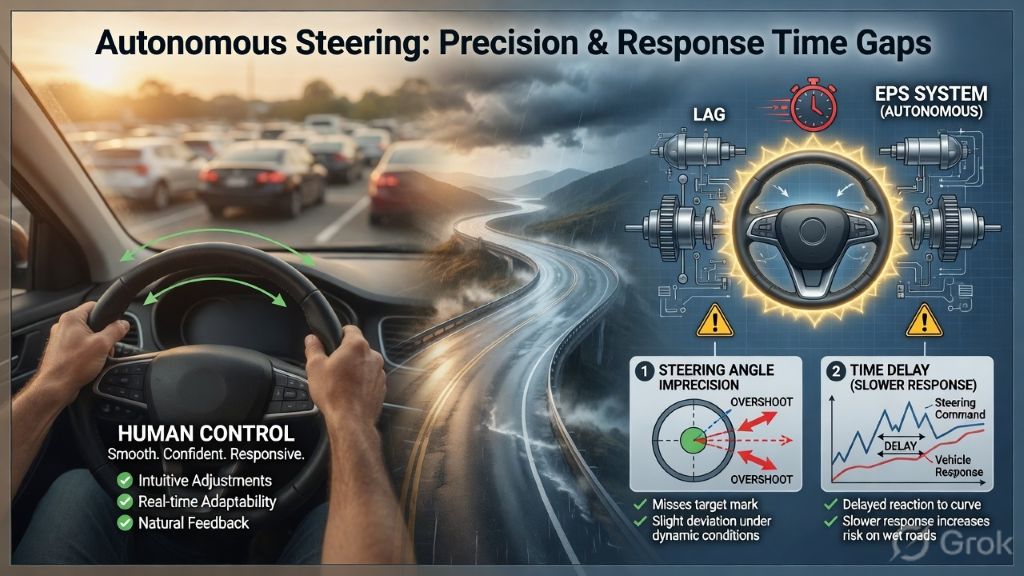
Self-driving cars are rapidly becoming a reality on our roads. However, one critical challenge has been holding them back: the steering system’s accuracy and response time. A pioneering study published on June 22, 2026, in Frontiers in Mechanical Engineering introduces a solution that could revolutionize the operation of autonomous vehicle steering on the road.
Replicating the effortless precision of a human driver has been one of the toughest problems in autonomous vehicle engineering. A new fuzzy PID controller for column electric power steering (C-EPS) delivers 98.98% angular accuracy, settles in just 0.18 seconds, and does it with zero overshoot — closing one of the last gaps between driverless research and road-ready reality.
Key results at a glance
| 0.18 s | 0% | 98.98% | 0.2° |
| Stability time | Overshoot | Angle control accuracy | Lateral deflection @ 25 km/h |
The Steering Challenge in Autonomous Vehicles
The last time you drove through a crowded parking lot, your hands were making dozens of tiny, unconscious corrections — the steering wheel was running its own micro-loop of feedback before you even noticed. For self-driving cars, replicating this precision has proven remarkably difficult.
Most autonomous vehicles rely on electric power steering (EPS) systems, and they struggle with two problems in particular: they do not steer to the exact angle required, and they respond too slowly when road conditions change. Either issue on its own might be manageable; together, at highway speed, even a small overshoot of a few degrees can turn a routine maneuver into a dangerous one.
Earlier attempts to solve these problems fell short. Some methods improved accuracy but sacrificed response speed; others failed to handle the complex interactions among the steering wheel, the assist motor, and the mechanical linkage. What was missing was a control approach that could adapt to real-world conditions instead of relying on rigid mathematical assumptions.
Researcher Xiaohua Li, of Neijiang Vocational & Technical College in China, recognized that small cars — the most common vehicles on the road — needed a solution tailored to their steering system architecture. That insight set the stage for the new approach.
How the New Fuzzy PID Controller Works
The innovation at the heart of this discovery combines Column Electric Power Steering (C-EPS) technology with fuzzy control theory. Fuzzy control is a way of reasoning with approximations rather than absolutes. You would not say “I’m exactly 73.4% hungry”; you would say “I’m somewhat hungry” or “I’m very hungry.” Fuzzy logic applies the same graded, approximate reasoning to the messy, unpredictable situations cars face on real roads.
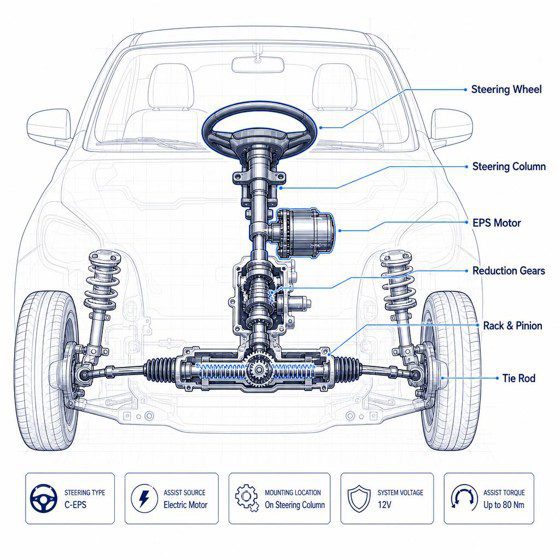
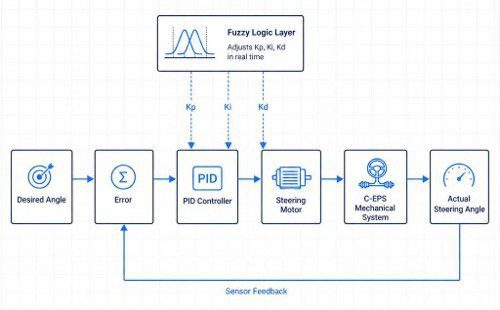
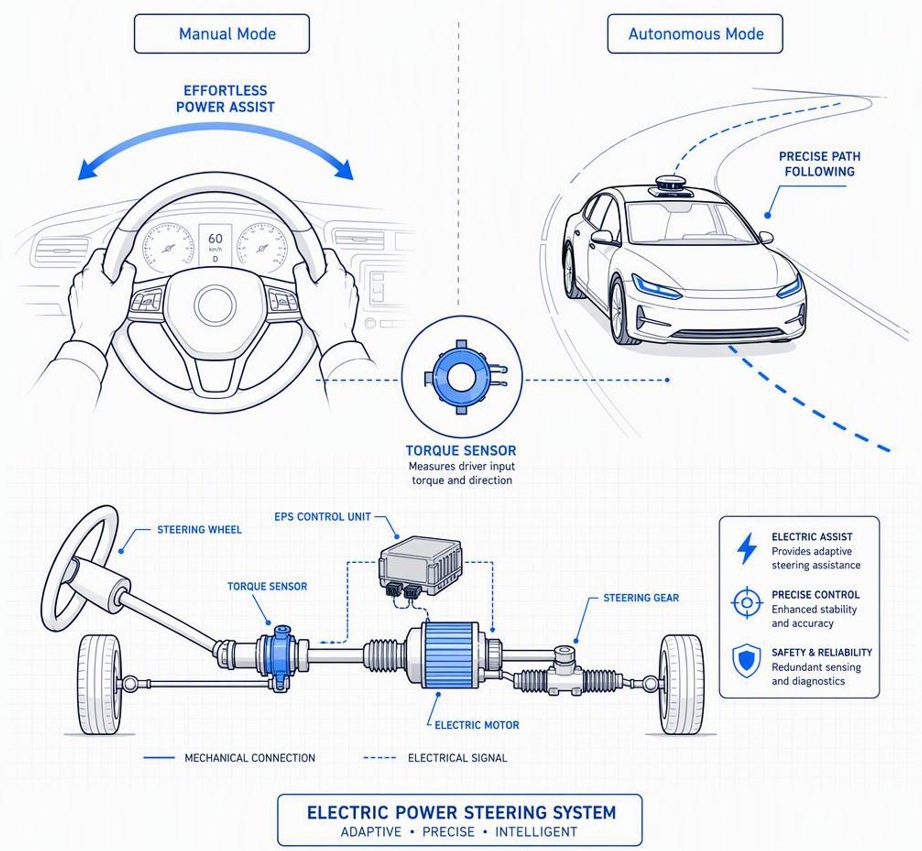
Underneath the fuzzy layer sits a proportional-integral-derivative (PID) controller — a mathematical formula that continuously adjusts the steering motor based on three factors: the difference between the wheel’s current and target positions, and the speed at which it is closing that gap. What makes the system revolutionary is the fuzzy layer on top, which tunes those three PID factors in real time according to driving conditions. The controller also builds a complete model of how every component interacts: the steering wheel, the column, the reduction gears, the assist motor, and even the road-surface forces pushing back through the tires. Figure 2 shows the resulting control architecture — a closed loop in which sensor feedback constantly informs the fuzzy layer’s adjustments.
Two modes, one seamless system
One particularly clever feature lets the system switch between two operating modes without a hitch. When a human driver takes the wheel, it provides smooth, natural-feeling power assistance that makes steering effortless. When the autonomous driving system takes over, it switches to precise angle control to follow the planned path. A torque sensor continuously monitors whether the driver’s hands are on the wheel and triggers the change instantly — no jarring transition, no hesitation.
Performance That Speaks for Itself
The numbers tell the story. The fuzzy PID controller reached stability in just 0.18 seconds — faster than the blink of an eye — with absolutely zero overshoot. A traditional PID controller, by contrast, took 0.89 seconds to settle and overshot its target by 13.2%, swinging the wheel past the target before correcting. At speed, overshoot like that reads as wobble, and a car that constantly micro-corrects does not inspire confidence when you are trusting it with your life.
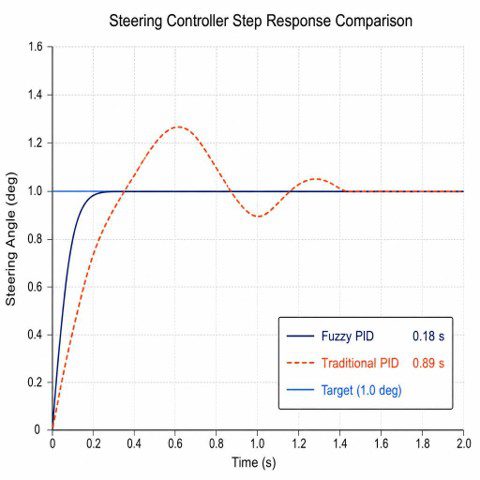
Table 1: Comparative performance of steering control methods
| Control Method | Current Control Accuracy | Angle Control Accuracy | Steady-State Error |
| Fuzzy PID (Proposed) | 97.89% | 98.98% | 0.14% |
| Sliding Mode Control | 93.26% | 94.35% | 0.29% |
| GA-PID | 92.13% | 95.21% | 0.32% |
| Traditional PID | 90.06% | 93.88% | 0.57% |
When tested on an actual vehicle traveling at 25 km/h (about 15.5 mph—typical for navigating a residential neighborhood), the fuzzy PID controller maintained a lateral centroid deflection angle of only 0.2 degrees. This technical term measures how much the vehicle’s rear end swings out during a turn. The smaller this number, the more stable and predictable the vehicle’s handling, which directly translates to passenger comfort and safety.
Real-World Impact and Future Applications
This matters as autonomous vehicles move from research labs to public roads. The system requires no extensive manual calibration when installed in a new vehicle: the fuzzy logic automatically adapts to variations in motor characteristics, steering geometry, and road conditions. Manufacturers can deploy the same controller across an entire vehicle lineup without redesigning it for each model, significantly reducing development time and cost.
Precision like this shows up in everyday scenarios. Merging onto a highway calls for smooth, confident steering adjustments; parallel parking demands millimeter-level accuracy; emergency obstacle avoidance requires an instantaneous response with no overshoot. The fuzzy PID controller excels at all three because it pairs the fast response of conventional control methods with intelligent, real-time adaptation to changing conditions.
Conclusion: Autonomous Vehicle Steering Toward a Safer Future
This June 2026 breakthrough represents more than an incremental improvement—it’s a fundamental reimagining of how autonomous vehicles interact with the road. By achieving 0% overshoot, sub-0.2-second response times, and 98.98% angular accuracy, the fuzzy PID controller for C-EPS systems solves problems that have plagued autonomous vehicle development for years. As self-driving technology continues to evolve from highway pilot systems to fully autonomous vehicles, innovations like this form the critical foundation for building safer, more reliable transportation systems. The road ahead for autonomous vehicles just got considerably smoother.
Reference
Li X (2026) Steering technology of autonomous vehicle based on C-EPS and fuzzy control theory. Front. Mech. Eng. 12:1837376. doi: 10.3389/fmech.2026.1837376
- Author
- Latest Posts

Charudatta Pathak was a student at St. Aloysius High School in Bhusawal, established in 1874, making it one of India’s oldest convent institutions. He earned his bachelor’s degree in mechanical engineering from SSVPS College of Engineering, Dhule in 1995, demonstrating exceptional academic achievement. Thereafter, he launched his career as a CNC programmer in a toolroom. He has utilized FANUC, Deckel, Maho, and Mikron controllers to operate 2-axis and 3-axis machines for the fabrication of jigs, fixtures, dies, and molds. He commenced his career as an academic in 1996, when he assumed the role of lecturer at SSVPS College of Engineering, Dhule. Additionally, he earned his post-graduate degree in CAD/CAM from L. D. College of Engineering, Ahmedabad, in 2000, and then acquired a Ph.D. from COEP in 2011 while concurrently engaged in teaching. Until 2023, he occupied many academic roles, including lecturer, assistant professor, professor, dean, principal, director, and vice chancellor at both public and private universities throughout India. From 2008 to 2010, he served as the project lead in the CAE department of a European multinational firm. During his 28-year professional tenure, he identified a need for dependable books targeted at students in grades 8 to 12, particularly for nascent career planning. He founded ENTECH Digital Magazine, a free monthly publication available on entechonline.com and magzter.com. Teens with a strong interest in Science, Technology, Engineering, and Mathematics (STEM) who aspire to pursue careers in these fields may find ENTECH Digital Magazine beneficial.