The bright yellow worm known as Paralvinella hessleri is making headlines for its remarkable ability to survive in extreme conditions of the Pacific Ocean.
Deep-Sea Worm and the Science of Opiment Formation
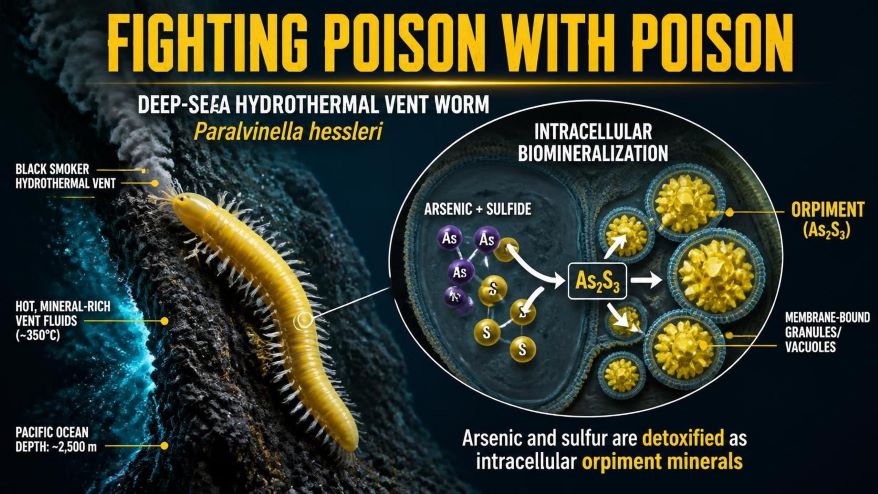
Life thrives in some of the most extreme environments on Earth. Deep-sea hydrothermal vents release scalding, mineral-rich water into the cold ocean. However, one remarkable creature survives in this harsh environment: a deep-sea worm that manages toxic arsenic and sulphur by turning them into stable mineral crystals. First, the worm creates a mineral called orpiment (As₂S₃) inside its own body. Historically, people used orpiment as an artistic pigment and as a poisonous substance. However, this mineral serves a very different biological purpose in the worm. The worm builds orpiment crystals inside its cells and uses this process to contain arsenic and sulphur.
Key Takeaways
- A deep-sea worm lives at hydrothermal vents. It uses biomineralisation to create opiment crystals.
- The worm detoxifies arsenic and sulphur inside its body. These elements are lethal to most life forms.
- This process is a novel detoxification mechanism. No other animal is known to use this method.
- The worm produces a specific protein to control crystal growth. It directs where and how the crystals form.
- This discovery could inspire new ways to handle pollution or develop biomaterials
The Discovery: Deep-Sea Worm Facts and the Orpiment Formation
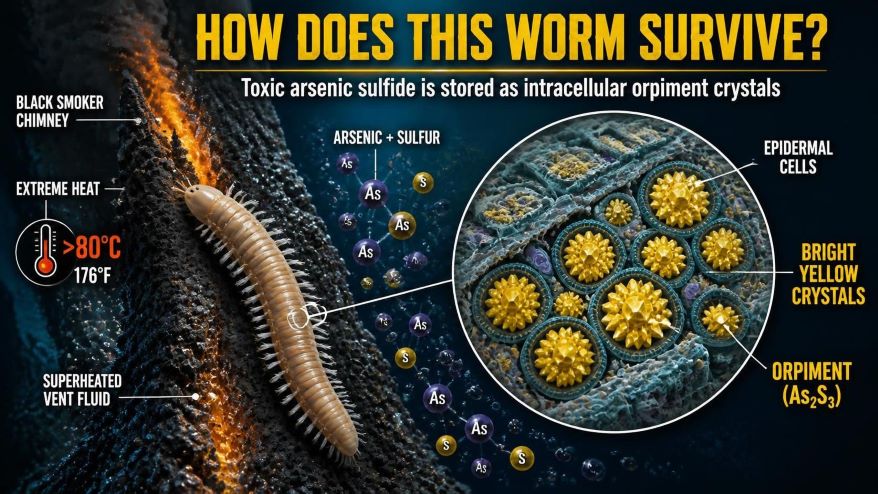
Researchers collected specimens of the deep-sea worm Alvinella pompejana from hydrothermal vents, where this remarkable organism lives under extreme environmental conditions. First, the worm inhabits the walls of black smoker chimneys, where temperatures can exceed 80°C (176°F). Moreover, the surrounding water contains high concentrations of arsenic and sulphur, which can interfere with essential cellular processes and damage vital proteins. To investigate how the worm survives these conditions, the research team used advanced microscopy techniques to examine its tissues. Interestingly, they discovered unusual crystals within the worm’s epidermal cells. Furthermore, chemical analysis showed that these crystals consisted of orpiment (As₂S₃), a bright yellow arsenic sulphide mineral. Historically, people have used orpiment as a pigment and depilatory agent; however, the compound is also highly toxic because of its arsenic content.
How the Worm Detoxifies Arsenic: The Biological Mechanism
The study identifies the molecular machinery that enables the deep-sea worm to safely store toxic arsenic compounds. First, the deep-sea worm produces a specialised protein that plays an important role in this process. Interestingly, this protein contains high levels of cysteine and histidine residues. Because these amino acids can bind strongly to arsenic and sulphur, they help the protein interact with these elements inside the cell. Furthermore, the protein acts as a molecular template that brings arsenic and sulphur together within a defined cellular space. In this way, it concentrates the elements and creates conditions that favour mineral formation. Next, the protein helps direct the crystallisation of orpiment. As a result, arsenic and sulphur become incorporated into stable orpiment crystals rather than remaining freely available to interact with cellular components.
Moreover, the crystals form inside specialised, membrane-bound vesicles within the cell. Therefore, these vesicles provide a controlled compartment where mineral formation can occur. Importantly, this compartmentalisation may further reduce the exposure of vital cellular machinery to free arsenic. Overall, the protein, its cysteine- and histidine-rich structure, and the membrane-bound vesicles work together to support orpiment formation. Ultimately, this molecular mechanism helps explain how Alvinella pompejana can tolerate and manage high levels of toxic elements in its extreme hydrothermal-vent environment.
Biomineralisation: A Rare Strategy for Heavy Metal Detoxification
Biomineralisation occurs when living organisms produce minerals through biological processes. For example, humans and other animals form minerals that contribute to bones and teeth, while many marine organisms produce minerals that make up seashells. Similarly, some bacteria can precipitate minerals as part of their normal activities. However, very few animals use biomineralisation as a strategy to manage toxic substances. Remarkably, this deep-sea worm represents a rare example of such an adaptation. Instead of producing a mineral primarily for structural protection, the worm actively forms a toxic mineral and stores it within its cells. Furthermore, this process differs from the way animals build protective shells or other mineralised structures. In this case, the worm uses biomineralisation as a form of poison containment.
Potential Applications: From Chemistry to Cleanup
This discovery has several practical applications for environmental science and biotechnology. First, scientists study natural detoxification mechanisms to develop useful solutions for human and environmental problems. In this context, the deep-sea worm provides a valuable biological model for understanding how organisms manage toxic elements. Furthermore, engineers can study the worm’s biomineralisation process to develop new technologies. For example, they could potentially design synthetic systems that capture and immobilise arsenic from contaminated water. In addition, researchers could use insights from this natural process to explore more efficient approaches to arsenic removal.
Environmental Significance: Life at Hydrothermal Vents
Hydrothermal vents form extreme ecosystems in the deep ocean, particularly where tectonic plates spread apart. First, seawater enters cracks in the Earth’s crust and moves deep underground. As it travels downward, the water absorbs heat from surrounding rocks and dissolves minerals. Then, the heated fluid rises and erupts through openings in the ocean floor. Remarkably, hydrothermal vent fluids can reach temperatures of about 400°C (752°F). Moreover, these fluids contain high concentrations of hydrogen sulphide, arsenic, and various heavy metals. Therefore, these environments create conditions that challenge the survival of most organisms.
Frequently Asked Questions
How does the worm survive high levels of arsenic?
The deep-sea worm uses intracellular biomineralization to manage toxic elements. It produces a specialized protein that binds arsenic and sulfur inside its cells. Then, this protein helps organize these elements and promotes the formation of orpiment crystals within the cellular environment. As a result, the crystals remain contained inside the cells and reduce the availability of free arsenic to interact with essential cellular components.
Is orpiment dangerous to humans?
Yes. Orpiment is an arsenic sulphide mineral, and exposure through ingestion or inhalation can harm the body. Historically, people used orpiment as a pigment and, in some contexts, as a poisonous substance.
Are there other animals that use this detox method?
No. Scientists have identified this deep-sea worm as the first known animal to use orpiment biomineralisation as a detoxification strategy. In contrast, some bacteria can precipitate arsenic-containing minerals as part of their biological processes. However, this worm uses a distinct mechanism that scientists have not previously documented among animals.
Reference
- Wang, H., Cao, L., Zhang, H., Zhong, Z., Zhou, L., Lian, C., Wang, X., Chen, H., Wang, M., Zhang, X., & Li, C. (2025). A deep-sea hydrothermal vent worm detoxifies arsenic and sulfur by intracellular biomineralization of orpiment (As2S3). PLoS Biology, 23(8), e3003291. https://doi.org/10.1371/journal.pbio.3003291
Additionally, to stay updated with the latest developments in STEM research, visit ENTECH Online. Basically, this is our digital magazine for science, technology, engineering, and mathematics. Furthermore, at ENTECH Online, you’ll find a wealth of information.
- Author
- Latest Posts

Neha Adikane holds a Master’s degree in Environmental Science from Pune University, bringing a unique blend of scientific expertise and creative writing skills to her craft. She specializes in creating engaging, insightful, and impactful content across various niches. With a passion for translating complex ideas into simple, relatable narratives, she excels at crafting blogs, articles, website content, and social media posts that captivate readers and drive engagement. Neha’s background in environmental science adds depth to her writing, allowing her to effectively cover topics related to sustainability, eco-awareness, and scientific innovations.
- Author
- Latest Posts

I completed my Master of Science from the University of Allahabad in 2017 with a strong academic background in life sciences and chemistry. My specialization included Molecular Biology, Microbiology, Genetics, Plant Breeding, Phycology, Paleobotany, and Bioinformatics, along with Organic Chemistry, Inorganic Chemistry, and Physical Chemistry. This multidisciplinary training provided me with a comprehensive understanding of biological systems and analytical scientific approaches.
After completing my postgraduate studies, I gained valuable professional experience in both the education and social development sectors. I worked at A.M. Oxford Public School, where I was actively involved in guiding students toward academic excellence. In this role, I focused on creating an engaging learning environment, encouraging critical thinking, and nurturing students’ curiosity for scientific learning. My experience as an educator strengthened my communication, mentoring, and classroom management skills.
In addition to my teaching experience, I worked with Jeevan Jagriti Foundation, where I contributed to community-based initiatives aimed at improving educational access and awareness among underprivileged sections of society. Through this work, I participated in programs designed to support social development and promote the value of education in marginalized communities.
These professional experiences helped me develop strong interpersonal, leadership, and organizational skills while reinforcing my commitment to education and community service.