Plastic-Eating Bacteria: Advancing Sustainable Plastic Management
Plastic-Eating Bacteria: Transforming Plastic Waste Management
Estimated reading time: 6 minutes
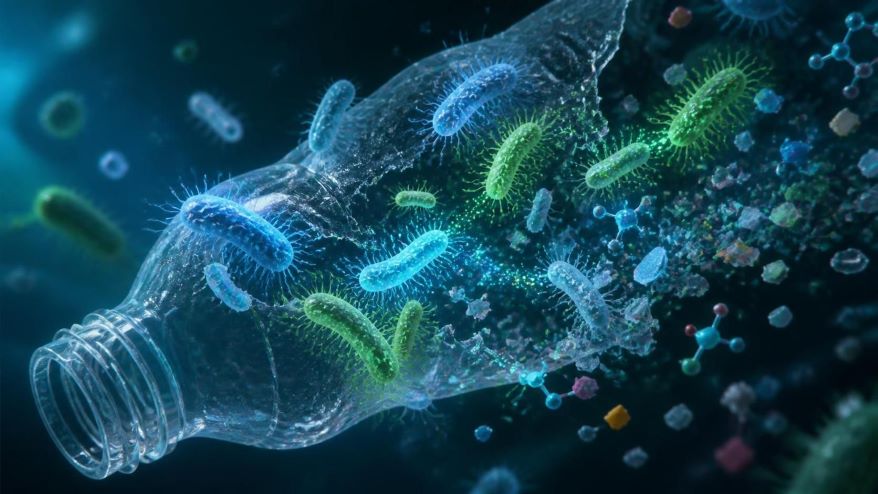
Plastic pollution remains one of the most serious environmental challenges today. In particular, polyethylene terephthalate (PET), a common plastic used in bottles and packaging, continues to accumulate in oceans around the world. However, recent scientific discoveries offer new possibilities for addressing this problem. One promising area of research involves plastic-eating bacteria. First, researchers have found that bacteria capable of breaking down PET occur widely across global oceans. Importantly, these microorganisms produce enzymes known as PETases, which can help degrade PET. Furthermore, a specific functional motif enables these enzymes to interact with and break down plastic more effectively. As a result, scientists are investigating how these natural microbial systems could contribute to plastic degradation.
Key Takeaways: Plastic-Eating Bacteria
- Plastic-eating bacteria are present in oceans across the globe
- PETase enzymes contain a functional motif essential for plastic degradation
- These microorganisms can break down PET into simpler compounds
- Environmental factors influence enzyme activity in marine settings
- Bioremediation applications using these bacteria show promise for waste management
- Future research aims to enhance enzyme efficiency for industrial use
The Discovery of Widespread PET-Degrading Plastic-Eating Bacteria in Oceans
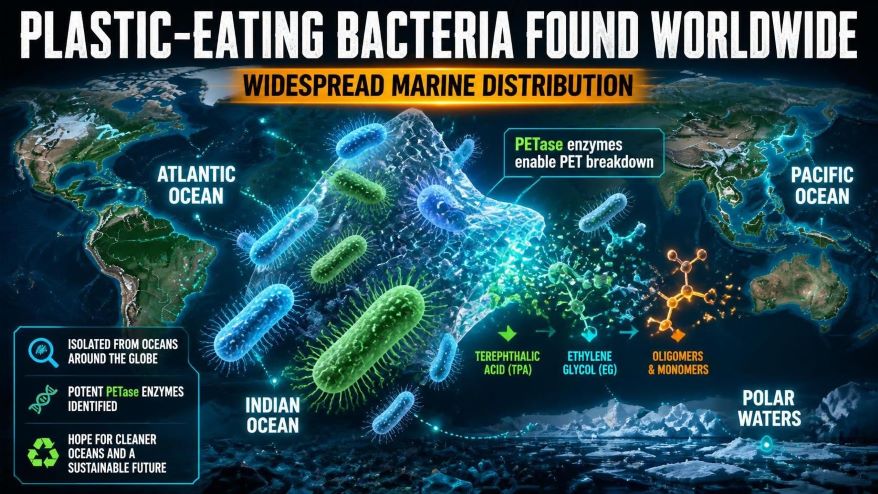
A groundbreaking study published in The ISME Journal reports striking findings about bacteria that can degrade plastic. First, researchers analysed metagenomic data collected during sampling expeditions across the world’s oceans. Through this analysis, they identified bacteria that carry PETase enzymes with a functional motif needed for PET breakdown. Importantly, these microorganisms do not appear only in specific regions. Instead, researchers found them across a wide range of marine environments. For example, scientists detected these bacteria in samples from the Atlantic Ocean. Similarly, they found them in the Pacific and Indian Oceans. Furthermore, researchers detected plastic-degrading microbes even in remote polar waters. As a result, their widespread distribution suggests that these microorganisms can occupy diverse marine environments and may interact with plastic pollution in different regions.
Understanding the Functional Motif in Plastic-Eating Bacteria
The functional motif represents a specific sequence of amino acids within the PETase enzyme. First, this sequence plays an important role in determining how effectively the enzyme can degrade PET. In particular, researchers identified a conserved motif that occurs across different bacterial species. Importantly, this motif appears essential for catalytic activity. Without it, the enzyme may lose its ability to break down PET efficiently.
| Ocean Region | PETase-Positive Bacteria | Water Depth | Average Temperature |
|---|---|---|---|
| North Atlantic | High abundance | 0-200 m | 15-25°C |
| South Pacific | Moderate abundance | 200-1000 m | 5-15°C |
| Indian Ocean | High abundance | 0-100 m | 20-30°C |
| Arctic Waters | Low abundance | 0-500 m | -2 to 5°C |
How Plastic-Eating Bacteria Function in Marine Environments
Plastic-degrading bacteria use several strategies to break down PET. First, the main mechanism involves secreting enzymes into the surrounding water. Once released, these enzymes move through the water until they encounter plastic particles. Next, PETase attaches to the plastic surface. Then, the enzyme hydrolyses the polymer chains and releases smaller, soluble breakdown products. As a result, bacteria can absorb these compounds through their cell membranes and use them as sources of carbon and energy for growth. Meanwhile, marine conditions can strongly influence enzyme activity. For example, salinity can affect protein stability, while changes in pH can alter catalytic activity. Similarly, temperature influences molecular movement and reaction rates. Therefore, environmental conditions can determine how efficiently bacteria and their enzymes degrade plastic.
Global Distribution Patterns and Ecological Implications
The study mapped PETase-containing plastic-eating bacteria across the global oceans and revealed clear patterns in their distribution. First, environmental gradients strongly influence where these plastic-degrading bacteria occur. In particular, temperature emerges as an important factor. For example, warmer waters generally support higher bacterial abundance and activity. As a result, tropical regions contain relatively high levels of plastic-degrading microbes. In contrast, temperate regions show moderate bacterial abundance, while polar waters generally contain lower levels. Furthermore, pollution levels appear to influence the distribution of PETase-containing bacteria. Specifically, areas with higher plastic contamination often show greater representation of PETase genes. Therefore, these patterns may indicate that some bacterial communities respond to local plastic pollution. However, environmental conditions can influence this relationship in different ways.
Applications for Bioremediation and Waste Management
Plastic-degrading bacteria offer promising approaches for addressing plastic pollution. First, scientists can use these microorganisms in bioremediation strategies to help remove or reduce plastic contamination at affected sites. Furthermore, engineered systems can provide controlled conditions that support efficient microbial degradation. For example, closed bioreactors can maintain suitable temperature and pH levels while also supplying nutrients required for bacterial growth.
In addition, marine bacteria often require specific culture conditions because they naturally live in seawater environments. Therefore, salt concentrations in laboratory systems should closely match the conditions that support their growth. Similarly, growth media should provide appropriate trace elements and other nutrients. However, bacterial species differ considerably in their ability to grow under laboratory conditions. For instance, some species grow rapidly, whereas others are more difficult to cultivate. Meanwhile, researchers continue to isolate and characterise important plastic-degrading bacterial species. Moreover, they investigate optimal growth conditions, enzyme activity, and nutrient requirements. As a result, this information can guide the development and design of efficient bioreactors.
Furthermore, pilot projects allow scientists to test these systems under more realistic, real-world conditions. Early studies have reported promising degradation rates, although further research is needed to determine how effectively these systems can operate at larger scales.
Frequently Asked Questions: Plastic-Eating Bacteria
How do plastic-eating bacteria work?
These bacteria produce enzymes called PETases. These enzymes break chemical bonds in PET plastic. The bacteria then absorb the resulting compounds and use them as food sources. This process converts solid plastic into digestible nutrients.
Are engineered bacteria safe for the environment?
Scientists follow strict safety protocols when developing engineered organisms. Containment measures prevent unintended release. Kill switches can stop organism growth if needed. Regulatory oversight ensures responsible development. Risk assessment accompanies all field applications.
What is the functional motif in PETase?
It is a specific amino acid sequence essential for enzyme activity. This motif allows the enzyme to bind and break down PET plastic. Without it, degradation cannot occur. The motif is conserved across many bacterial species.
Reference:
- Alam, I., Marasco, R., Momin, A. A., Aalismail, N., Laiolo, E., Martin, C., Sanz-Sáez, I., Foix, B. B., Sá, E. L., Kamau, A., Guzmán-Vega, F. J., Jamil, T., Acinas, S. G., Gasol, J. M., Gojobori, T., Agusti, S., Daffonchio, D., Arold, S. T., & Duarte, C. M. (2025). Widespread distribution of bacteria containing PETases with a functional motif across global oceans. The ISME Journal, 19(1). https://doi.org/10.1093/ismejo/wraf121
- Author
- Latest Posts

Deven Nandapurkar is a Software Engineer, Project Lead; working at the strategic intersection of software engineering, productivity science, and emerging technologies. Driven by a core philosophy of “building things worth building,” he leads cross-functional teams and drives end-to-end technical strategy—from early-stage conceptualization through production-grade deployment.
A Computer Engineering graduate from Pune University, Deven brings a sharp systems-thinking approach to technical leadership, honed by years of managing high-stakes engineering projects and leading teams to top placements in national and international hackathons, including the NASA Space Apps Challenge and the Peerlist GenAI Hackathon.
Deven explores how human cognition and emerging technology converge. He regularly writes about cognitive performance optimization, attention management, AI integration, and the evolving dynamics of the modern workforce – offering actionable frameworks for professionals seeking to maximize their productivity and thrive alongside intelligent systems.
- Author
- Latest Posts

I completed my Master of Science from the University of Allahabad in 2017 with a strong academic background in life sciences and chemistry. My specialization included Molecular Biology, Microbiology, Genetics, Plant Breeding, Phycology, Paleobotany, and Bioinformatics, along with Organic Chemistry, Inorganic Chemistry, and Physical Chemistry. This multidisciplinary training provided me with a comprehensive understanding of biological systems and analytical scientific approaches.
After completing my postgraduate studies, I gained valuable professional experience in both the education and social development sectors. I worked at A.M. Oxford Public School, where I was actively involved in guiding students toward academic excellence. In this role, I focused on creating an engaging learning environment, encouraging critical thinking, and nurturing students’ curiosity for scientific learning. My experience as an educator strengthened my communication, mentoring, and classroom management skills.
In addition to my teaching experience, I worked with Jeevan Jagriti Foundation, where I contributed to community-based initiatives aimed at improving educational access and awareness among underprivileged sections of society. Through this work, I participated in programs designed to support social development and promote the value of education in marginalized communities.
These professional experiences helped me develop strong interpersonal, leadership, and organizational skills while reinforcing my commitment to education and community service.