Learn about Filtration Engineering and its impact on fluid mechanics and systems reliability in power generation operations.
Filtration Engineering in Power Plants: Why Clean Fluids Are Critical to Plant Performance
Estimated reading time: 6 minutes
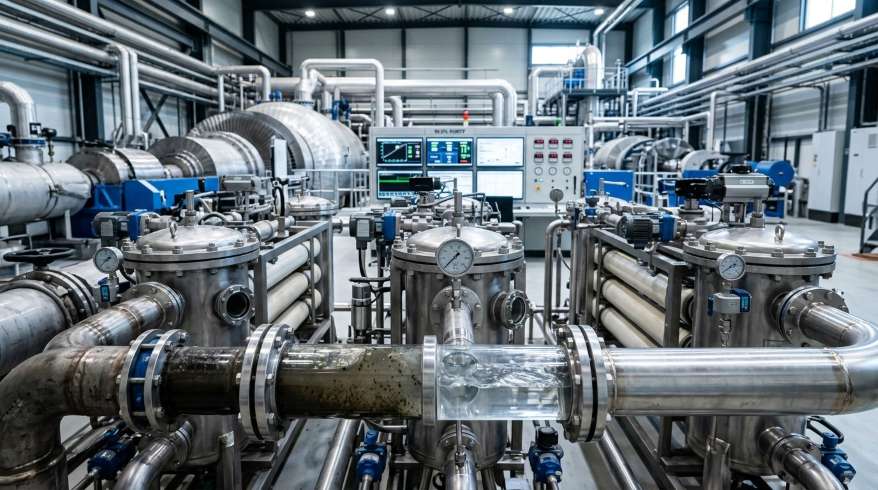
Power generation equipment undeniably operates under demanding conditions. Turbines spin at thousands of revolutions per minute. Heat exchangers transfer energy across thin metal surfaces. Cooling circuits carry water through kilometres of pipework. In every one of these systems, contamination is a constant threat. Particles, dissolved solids, biological growth, as well as chemical byproducts all degrade performance, accelerate wear, and in serious cases cause failures that take a plant offline for days or weeks.
Filtration engineering particularly sits at the centre of managing this risk. For engineering students studying power systems, thermodynamics, or mechanical engineering, understanding how filtration works across different plant types connects fluid mechanics, materials science, and systems reliability in a practical context.
Filtration Engineering: Why Contamination Is a Fundamental Problem?
Fluid contamination in power generation takes several forms. Particulate contamination includes solid material that enters or forms within a system, ranging from rust particles shed by ageing pipework to fine debris carried in from external water sources. Dissolved contamination includes chemical compounds that affect corrosion rates, scaling on heat transfer surfaces, or chemical reactions within the fluid itself. Biological contamination, particularly relevant in cooling water systems, includes bacteria and algae that can form biofilms and cause both blockages and microbiologically influenced corrosion.
Each contamination type has a different mechanism of harm and also requires a different filtration or treatment approach. A filtration system designed for one problem may have no effect on another, which is why power plant fluid management involves multiple treatment stages rather than a single filter.
Steam Turbine Systems
Steam turbines are found in coal, gas, nuclear, as well as concentrating solar power plants. They convert thermal energy carried in high-pressure steam into mechanical rotation, which in reality drives a generator. The steam and condensate systems in these plants carry water through boilers, turbines, condensers, and feedwater heaters in a closed loop.
Maintaining the purity of this water is unquestionably critical. Dissolved oxygen causes corrosion in boiler tubes and pipework. Dissolved salts deposit on turbine blades as the steam expands and cools, reducing efficiency and eventually causing blade damage. Iron and copper oxides shed from system surfaces accumulate in the boiler and form deposits that reduce heat transfer and can cause localised overheating.
Filtration and water treatment in steam cycle systems typically includes mechanical filtration to remove particulates, ion exchange to remove dissolved minerals, and chemical dosing to control pH and dissolved oxygen levels. The combination of these treatments keeps water chemistry within the tight limits that high-performance boilers and turbines require.
Gas Turbine Inlet Filtration
Gas turbines used in combined cycle power plants and open cycle peaker plants draw large volumes of air through the inlet system. This air carries dust, pollen, salt, insects, and industrial particulates depending on the plant location and climate. If this material reaches the compressor and combustion sections of the turbine, it causes blade erosion, fouling of cooling passages, and in corrosive environments, accelerated degradation of high-temperature alloys.
Inlet air filtration systems use multi-stage filter arrangements to remove particles progressively. Pre-filters capture coarse material and protect the main filter elements from premature loading. High-efficiency filter stages remove fine particulates that would otherwise pass through. In coastal or offshore environments, additional coalescers remove salt aerosols from the airstream.
The pressure drop across the filter system matters as much as its efficiency. Higher filtration efficiency typically means more resistance to airflow, which reduces the mass flow through the turbine and lowers output. Selecting the right filter specification involves balancing contamination removal against performance penalty, which is a genuine engineering trade-off.
Cooling Water Systems
Most thermal power plants use large volumes of water for cooling. Once-through systems draw water from a river, lake, or ocean, pass it through condensers to absorb heat, and return it to the source. Closed-circuit systems circulate cooling water through cooling towers where heat is rejected to the atmosphere.
Both types require filtration and water treatment, but the specific requirements differ. Once-through systems need screening and straining to remove debris, fish, and biological material from the incoming water before it enters heat exchangers. Cooling tower systems need treatment to control scaling, corrosion, and biological growth in the recirculating water, which concentrates as it evaporates.
Strainer systems on cooling water intakes are often self-cleaning, using rotating screens or backwash cycles to remove accumulated debris without manual intervention. The reliability of these systems directly affects plant availability because a blocked cooling water inlet can force a load reduction or shutdown.
Hydraulic and Lubrication Systems
Beyond the main fluid circuits, power plants rely on hydraulic systems to operate valves, dampers, and control actuators, and on lubrication systems to protect turbine bearings and gearboxes. These systems use oil as the working fluid, and maintaining oil cleanliness is as important as maintaining water quality in the primary circuits.
Particulate contamination in hydraulic oil causes wear in pumps, valves, and actuators. Water contamination reduces lubrication film strength and promotes oxidation of the oil itself. Dedicated filtration systems on hydraulic and lube oil circuits remove particles to specified cleanliness levels, typically defined according to ISO 4406 cleanliness codes, and water removal systems handle moisture ingress.
Specialist suppliers offering power plant filtration cover this full range of applications, from cooling water strainers through to high-precision lube oil filtration systems.
Renewable Energy Applications
Filtration requirements are not limited to fossil fuel and nuclear plants. Wind turbines use gearbox lubrication systems that require clean oil to protect high-load gear contacts. Hydroelectric plants manage sediment-laden water that would otherwise cause rapid erosion of turbine runners and seals. Biomass and waste-to-energy plants handle flue gases and process fluids that carry high particulate loads.
As the energy mix shifts toward a higher proportion of renewable generation, filtration engineering adapts to new plant types and operating profiles. The underlying principles remain consistent: identify contamination sources, select the appropriate removal mechanism, and maintain system cleanliness within the limits that the equipment requires.
Filtration Engineering: Connecting Theory to Plant Performance
For engineering students, power plant filtration is a useful case study in how fluid mechanics, materials degradation, and systems reliability interact. A filter is not simply a component that removes dirt. It is part of a contamination management strategy that determines how long equipment lasts, how efficiently it operates, and how often it requires maintenance. Understanding the relationship between fluid cleanliness, component wear rates, and plant availability gives students a practical lens for applying theoretical knowledge about fluid flow, surface phenomena, and failure mechanisms to real engineering systems.
Additionally, to stay updated with the latest developments in STEM research, visit ENTECH Online. Basically, this is our digital magazine for science, technology, engineering, and mathematics. Further, at ENTECH Online, you’ll find a wealth of information.
- Author
- Latest Posts

Charudatta Pathak was a student at St. Aloysius High School in Bhusawal, established in 1874, making it one of India’s oldest convent institutions. He earned his bachelor’s degree in mechanical engineering from SSVPS College of Engineering, Dhule in 1995, demonstrating exceptional academic achievement. Thereafter, he launched his career as a CNC programmer in a toolroom. He has utilized FANUC, Deckel, Maho, and Mikron controllers to operate 2-axis and 3-axis machines for the fabrication of jigs, fixtures, dies, and molds. He commenced his career as an academic in 1996, when he assumed the role of lecturer at SSVPS College of Engineering, Dhule. Additionally, he earned his post-graduate degree in CAD/CAM from L. D. College of Engineering, Ahmedabad, in 2000, and then acquired a Ph.D. from COEP in 2011 while concurrently engaged in teaching. Until 2023, he occupied many academic roles, including lecturer, assistant professor, professor, dean, principal, director, and vice chancellor at both public and private universities throughout India. From 2008 to 2010, he served as the project lead in the CAE department of a European multinational firm. During his 28-year professional tenure, he identified a need for dependable books targeted at students in grades 8 to 12, particularly for nascent career planning. He founded ENTECH Digital Magazine, a free monthly publication available on entechonline.com and magzter.com. Teens with a strong interest in Science, Technology, Engineering, and Mathematics (STEM) who aspire to pursue careers in these fields may find ENTECH Digital Magazine beneficial.