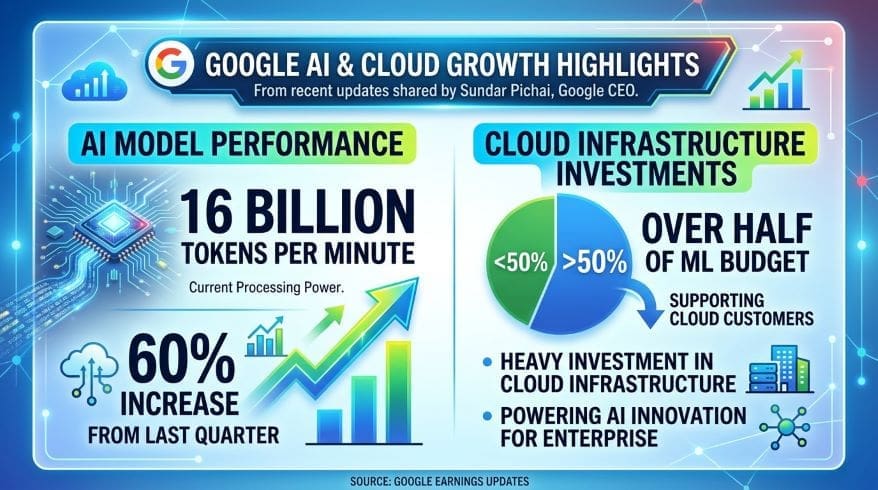
Sundar Pichai, Google's CEO, shared impressive growth numbers. In short, the company's AI models now process 16 billion tokens per minute.
This Google Event can Change Your Career Forever – Here’s How
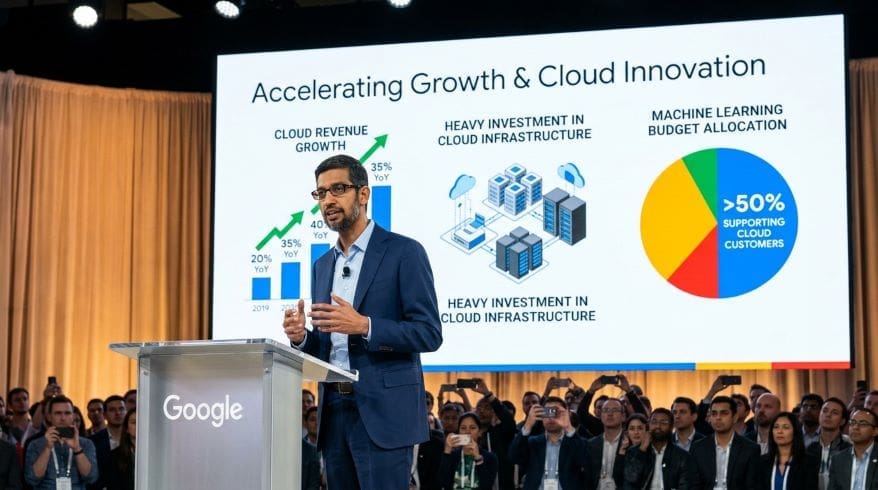
Google just unveiled groundbreaking technology at Cloud Next 2026. As has been noted, the event showcased how artificial intelligence is transforming business operations. As a result, companies can now manage thousands of AI agents simultaneously.
Key Takeaways
- Google processes over 16 billion AI tokens per minute for customers
- 75% of new Google code is now AI-generated and approved
- Eighth-generation TPUs handle massive AI workloads efficiently
- AI agents reduce security threat response time by 90%
- Students can prepare through math, computer science, and physics courses
What Happened at Cloud Next 2026?
Sundar Pichai, Google’s CEO, shared impressive growth numbers. In short, the company’s AI models now process 16 billion tokens per minute. To clarify, this represents a 60% increase from last quarter. Above all, Google is investing heavily in cloud infrastructure. In fact, over half of their machine learning budget now supports cloud customers.
The Rise of AI Agents
AI agents are software programs that complete tasks independently. Additionally, they can write code, detect threats, and solve problems. In light of this capability, businesses are rapidly adopting agent technology. Surprisingly, Google reported 40% growth in paid users quarter-over-quarter.
The new Gemini Enterprise Agent Platform helps organizations manage these agents. Actually, it provides security, governance, and optimization tools. As an illustration, companies can now coordinate thousands of agents efficiently.
Career Opportunities in Cloud Computing and AI
This technology boom creates exciting career paths for students. The field needs talented individuals who understand both hardware and software. At the present time, demand far exceeds supply.
High-Demand Job Roles
| Job Title | Average Salary | Growth Rate |
|---|---|---|
| Cloud Architect | $120,000-180,000 | 22% annually |
| AI Engineer | $110,000-160,000 | 35% annually |
| Security Specialist | $95,000-145,000 | 28% annually |
| Data Scientist | $100,000-150,000 | 31% annually |
Essential Skills to Develop
Programming knowledge forms the foundation of these careers. Students should learn Python, Java, and SQL early. Moreover, understanding cloud platforms like Google Cloud is crucial.
Critical thinking skills matter just as much as technical knowledge. Also, AI engineers must solve complex problems creatively. To enumerate the key abilities needed:
- Algorithm design and optimization
- Data analysis and interpretation
- System architecture planning
- Cloud infrastructure management
- Cybersecurity best practices
K-12 Subjects for Success
Your academic foundation starts now with specific course selections. At this point, choosing the right subjects matters significantly.
Core Mathematics Courses
Take advanced math courses throughout high school. Calculus and statistics are particularly important. Linear algebra helps students understand AI algorithms better.
Probability theory becomes essential for machine learning work. As a matter of fact, these mathematical concepts power modern AI systems.
Computer Science Foundation
Start coding as early as possible. Many schools offer programming classes for beginners. To illustrate, AP Computer Science teaches fundamental programming concepts.
Take courses in:
- Introduction to Programming
- Data Structures and Algorithms
- Web Development
- Database Management
Science Requirements
Physics helps students understand hardware operations. Additionally, chemistry knowledge applies to semiconductor manufacturing. Also, Biology becomes relevant for AI applications in healthcare.
At length, a strong science background provides versatility. So, students can apply AI knowledge across multiple industries.
Google’s Revolutionary TPU Technology
The eighth-generation TPUs represent a major hardware advancement. These processors handle demanding AI workloads more efficiently. As can be seen, Google developed two specialized chip versions.
TPU 8t optimizes training operations for AI models. It delivers three times more processing power than previous generations. On the other hand, TPU 8i focuses on inference tasks. This chip runs millions of agents simultaneously with low latency.
Real-World Impact
Google uses these technologies internally with impressive results. To point out, 75% of their new code is AI-generated. Engineers now work six times faster on complex migrations.
Security operations improved dramatically as well. AI agents automatically triage tens of thousands of threat reports monthly. This automation reduces mitigation time by over 90%.
Preparing for Your Future Career
Start building your skills today through hands-on projects. Many free resources exist online for learning programming. To this end, platforms like Coursera and edX offer excellent courses.
Join coding clubs at your school or community center. Participate in hackathons to gain practical experience. At the same time, build a portfolio of personal projects.
Consider internship opportunities during summer breaks. Tech companies often hire high school students for entry-level positions. These experiences provide invaluable industry exposure.
The Future Is Here
Cloud computing and AI offer tremendous career potential. Also, the field grows rapidly with new opportunities emerging constantly. With attention to, proper preparation now leads to success later.
Students who master these subjects will shape tomorrow’s technology. To sum up, your education choices today determine future possibilities. In conclusion, start preparing now for this exciting and rewarding career path.
References
Pichai, S. (2026, April 22). Cloud Next ’26: Momentum and innovation at Google scale. Google Cloud Blog. https://blog.google/innovation-and-ai/infrastructure-and-cloud/google-cloud/cloud-next-2026-sundar-pichai/
U.S. Bureau of Labor Statistics. (2026). Occupational outlook handbook: Computer and information technology occupations. https://www.bls.gov/ooh/computer-and-information-technology/home.htm
- Author
- Latest Posts

Charudatta Pathak was a student at St. Aloysius High School in Bhusawal, established in 1874, making it one of India’s oldest convent institutions. He earned his bachelor’s degree in mechanical engineering from SSVPS College of Engineering, Dhule in 1995, demonstrating exceptional academic achievement. Thereafter, he launched his career as a CNC programmer in a toolroom. He has utilized FANUC, Deckel, Maho, and Mikron controllers to operate 2-axis and 3-axis machines for the fabrication of jigs, fixtures, dies, and molds. He commenced his career as an academic in 1996, when he assumed the role of lecturer at SSVPS College of Engineering, Dhule. Additionally, he earned his post-graduate degree in CAD/CAM from L. D. College of Engineering, Ahmedabad, in 2000, and then acquired a Ph.D. from COEP in 2011 while concurrently engaged in teaching. Until 2023, he occupied many academic roles, including lecturer, assistant professor, professor, dean, principal, director, and vice chancellor at both public and private universities throughout India. From 2008 to 2010, he served as the project lead in the CAE department of a European multinational firm. During his 28-year professional tenure, he identified a need for dependable books targeted at students in grades 8 to 12, particularly for nascent career planning. He founded ENTECH Digital Magazine, a free monthly publication available on entechonline.com and magzter.com. Teens with a strong interest in Science, Technology, Engineering, and Mathematics (STEM) who aspire to pursue careers in these fields may find ENTECH Digital Magazine beneficial.


