Understand how interlocking brick machines function and their role in creating sustainable building materials for a greener future.
How Interlocking Brick Machines Work and Why They Matter for Sustainable Construction?
Estimated reading time: 5 minutes
Construction is one of the most resource-intensive industries on the planet. Cement production alone accounts for a significant share of global CO2 emissions, and conventional building methods in many parts of the world still rely on fired clay bricks, which consume large amounts of fuel and produce considerable waste. Against this backdrop, compressed earth block technology and the machines that produce it have attracted serious attention from engineers, development organisations, and construction researchers.
For engineering students with an interest in civil engineering, materials science, or sustainable development, understanding how interlocking brick machines work and what makes them useful connects manufacturing principles to some of the more pressing infrastructure challenges of the coming decades.
What Is an Interlocking Brick?
A conventional brick is a rectangular block bonded to its neighbours using mortar. The mortar layer fills gaps, levels surfaces, and provides adhesion between courses. It also adds cost, requires a skilled tradesperson to apply correctly, and takes time to cure before the wall can bear load.
An interlocking brick is designed differently. The block has a geometry, typically including projections and recesses on its top and bottom faces, that allows it to lock mechanically to the bricks above and below it. This mechanical interlock means mortar is either used in reduced quantities or eliminated entirely in many applications. Walls go up faster, require less skill to lay, and in some configurations can be dismantled and rebuilt.
The structural principle is not new. Dry-stone walling, masonry arch construction, and various traditional building systems have always relied on geometry and compression rather than adhesive bonding. Interlocking brick systems formalise this approach using precisely manufactured blocks that fit together consistently.
How the Machine Produces the Block
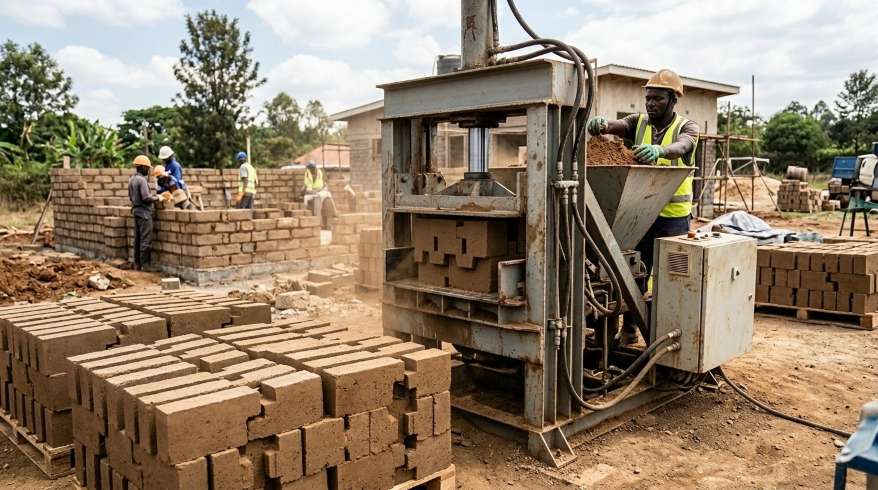
An interlocking brick machine compresses a mixture of soil, cement, and sometimes sand or gravel into a mould under high pressure. The compression consolidates the material and forces it to conform to the mould geometry, producing a dense block with defined dimensions and surface detail.
The mix ratio determines the strength and durability of the finished block. Higher cement content increases compressive strength but raises material cost. Well-graded soil with the right clay content can produce good blocks with relatively low cement addition, typically between 5 and 10 percent by weight. Getting the mix right for local soil conditions is part of the engineering challenge in deploying this technology in a new location.
Machines range from manually operated lever-press designs producing a few dozen blocks per hour, through to hydraulic or electric-powered machines capable of several hundred blocks per hour. The mould determines the block geometry, and manufacturers typically offer interchangeable moulds to produce different block profiles from the same machine frame.
After pressing, blocks are stacked and allowed to cure for several days. Unlike fired bricks, which require a kiln, compressed earth blocks cure through a chemical reaction between the cement binder and the compressed earth, similar in principle to how poured concrete gains strength over time.
Engineering Advantages Over Conventional Masonry
The engineering case for interlocking compressed earth blocks rests on several factors. The elimination or reduction of mortar reduces construction time and labour cost. The mechanical interlock improves resistance to lateral loads, which is relevant in seismic zones where conventional mortared masonry performs poorly. The use of local soil as the primary raw material reduces transportation costs and makes the technology accessible in areas with limited infrastructure.
Thermal mass is another consideration. Compressed earth blocks have higher thermal mass than hollow concrete blocks, which means walls built from them absorb heat during the day and release it slowly at night. In climates with significant day-night temperature variation, this characteristic reduces the need for active heating and cooling.
The blocks are also dimensionally consistent in a way that hand-formed or kiln-fired bricks often are not. Because each block is produced in the same mould under the same pressure, the variation between blocks is small, which makes it easier to build walls with consistent coursing and level surfaces.
Interlocking Brick Machines: Limitations and Engineering Challenges
Honest engineering assessment also requires looking at the limitations. Compressed earth blocks have lower compressive strength than fired bricks or dense concrete blocks in most mix configurations, which limits their application in high-load structural elements without reinforcement. They are vulnerable to erosion if exposed to sustained water contact, which means protected wall bases, adequate roof overhangs, and appropriate surface treatment are important design considerations in wet climates.
Soil variability is a practical challenge. The same machine and the same mix ratio will produce blocks of different strength depending on the clay content, particle size distribution, and moisture content of the local soil. Engineers deploying this technology in a new location need to test local soil, adjust the mix, and produce sample blocks for testing before committing to a construction programme.
Applications in Development and Low-Cost Housing
The technology has found wide application in affordable housing programmes, rural infrastructure projects, and self-build construction across Sub-Saharan Africa, South and Southeast Asia, and Latin America. Organisations including UN-Habitat and various development banks have supported compressed earth block programmes as part of wider efforts to improve housing quality using locally available materials.
In these contexts, the ability to train local operators to run the machine and produce blocks without importing materials or specialist skills is as important as the technical performance of the blocks themselves. The technology transfers well because the core principles are straightforward, the machines are mechanically simple relative to industrial construction equipment, and the raw material is almost universally available.
Why Engineering Students Should Pay Attention to Interlocking Brick Machines
Infrastructure deficits in developing economies represent one of the larger engineering challenges of the coming decades. Billions of people live in housing that does not meet basic standards of safety, durability, or thermal comfort. Solving this at scale requires technologies that are affordable, locally operable, and adaptable to varied conditions. Compressed earth block technology and the machines that produce it sit at the intersection of materials engineering, structural design, manufacturing, and development practice. For students looking for engineering problems with real-world scale and direct human impact, this is a field worth exploring in depth.
Additionally, to stay updated with the latest developments in STEM research, visit ENTECH Online. Basically, this is our digital magazine for science, technology, engineering, and mathematics. Further, at ENTECH Online, you’ll find a wealth of information.
- Author
- Latest Posts

Charudatta Pathak was a student at St. Aloysius High School in Bhusawal, established in 1874, making it one of India’s oldest convent institutions. He earned his bachelor’s degree in mechanical engineering from SSVPS College of Engineering, Dhule in 1995, demonstrating exceptional academic achievement. Thereafter, he launched his career as a CNC programmer in a toolroom. He has utilized FANUC, Deckel, Maho, and Mikron controllers to operate 2-axis and 3-axis machines for the fabrication of jigs, fixtures, dies, and molds. He commenced his career as an academic in 1996, when he assumed the role of lecturer at SSVPS College of Engineering, Dhule. Additionally, he earned his post-graduate degree in CAD/CAM from L. D. College of Engineering, Ahmedabad, in 2000, and then acquired a Ph.D. from COEP in 2011 while concurrently engaged in teaching. Until 2023, he occupied many academic roles, including lecturer, assistant professor, professor, dean, principal, director, and vice chancellor at both public and private universities throughout India. From 2008 to 2010, he served as the project lead in the CAE department of a European multinational firm. During his 28-year professional tenure, he identified a need for dependable books targeted at students in grades 8 to 12, particularly for nascent career planning. He founded ENTECH Digital Magazine, a free monthly publication available on entechonline.com and magzter.com. Teens with a strong interest in Science, Technology, Engineering, and Mathematics (STEM) who aspire to pursue careers in these fields may find ENTECH Digital Magazine beneficial.