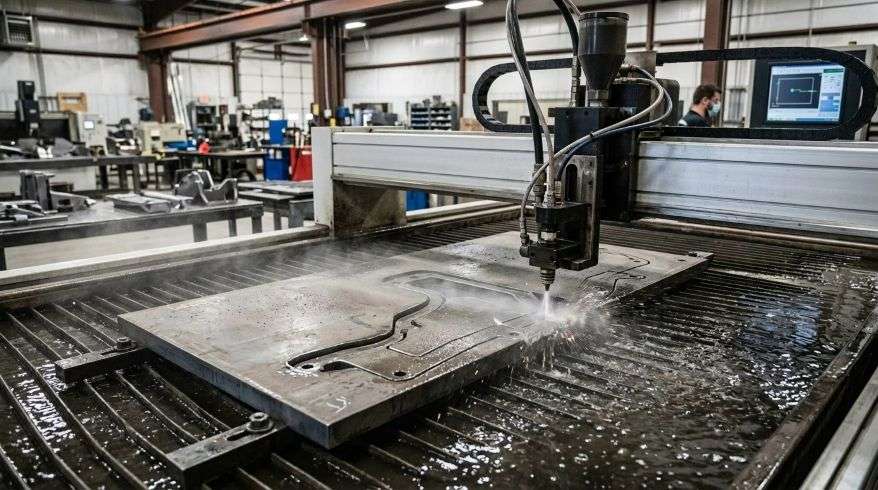
Understand waterjet cutting and its remarkable ability to cut thick materials like steel without warping or generating heat damage.
How Waterjet Cutting Works and Why Engineers Use It?
Estimated reading time: 4 minutes
When engineers need to cut through thick steel, glass, stone, or composite materials without warping the surface or creating heat damage, waterjet cutting is often the method they reach for. It is one of the more impressive manufacturing processes in use today, and understanding how it works gives you a useful window into modern precision engineering.
The Basic Principle behind Waterjet Cutting
Waterjet cutting uses a high-pressure stream of water to erode material along a programmed path. The water is pressurised to anywhere between 30,000 and 90,000 PSI and forced through a tiny nozzle opening, typically less than 1mm in diameter. At that pressure, the stream moves fast enough to cut through a wide range of materials cleanly and accurately.
For softer materials like rubber, foam, or food products, pure water is sufficient. For harder materials such as metals, ceramics, and stone, an abrasive powder, we usually add garnet to the stream. This variant is called abrasive waterjet cutting and is the method used most often in industrial manufacturing.
Why Temperature Matters
One of the most important advantages of waterjet cutting is that it is a cold-cutting process. Unlike laser cutting, plasma cutting, or electrical discharge machining, waterjet does not generate significant heat at the cut zone. This means there is no heat-affected zone, no thermal distortion, and no change to the material’s internal structure.
For engineers working with heat-sensitive materials, or components where surface integrity cannot be compromised, this is a significant benefit. Titanium alloys, hardened tool steels, and certain composites are good examples of materials where avoiding heat damage is a priority.
Accuracy and Tolerances
Modern waterjet cutting machines operate under CNC control, following digital designs with a high degree of accuracy. Tolerances of plus or minus 0.1mm are achievable in most applications, and tighter tolerances are possible with optimised cutting parameters and fixturing.
The kerf width, which is the width of material removed during cutting, is narrow and predictable. This allows engineers to nest parts efficiently on a sheet, minimising material waste. For anyone working in a field like aerospace, automotive, or architecture where raw material costs are significant, this efficiency matters.
What Materials Can Be Cut using Waterjet Cutting?
The range of materials that waterjet cutting handles is one of its strongest points. Metals including mild steel, stainless steel, aluminium, copper, and titanium are all compatible. Beyond metals, the process works on glass, granite, marble, carbon fibre composites, rubber, plastics, and even layered sandwich materials.
This versatility means a single waterjet cutting machine can serve multiple industries and production requirements without the need to switch between different cutting technologies.
Applications of Waterjet Cutting Across Engineering Disciplines
Waterjet cutting appears across a broad range of engineering sectors. In mechanical and structural engineering, it is used to produce precision-cut brackets, flanges, and frames. In aerospace, it processes lightweight composite panels and titanium structural parts. Architecture and interior design use it to cut decorative stone and glass elements. The defence and energy sectors rely on it for cutting thick steel plate and specialised alloys.
For engineering students looking to understand how design intent translates into physical parts, waterjet cutting is a good process to study because it connects CNC programming, material science, and manufacturing tolerances in a practical way. You can find more info on waterjet cutting including how the process works across different materials and thicknesses.
Limitations to Consider
No manufacturing process is without trade-offs. Waterjet cutting is slower than laser cutting for thin sheet metal, and the equipment and operating costs are higher than some alternatives. Very deep cuts in thick material also require slower feed rates, which affects cycle time.
For engineering projects where speed is the priority and heat tolerance is not a concern, laser or plasma cutting may be more practical. Waterjet cutting earns its place when material integrity and versatility are the deciding factors.
A Process Worth Understanding
Whether you are studying mechanical engineering, materials science, or manufacturing technology, waterjet cutting is one of those processes that bridges theory and application clearly. It demonstrates how physical principles, pressure, velocity, and abrasion, can be engineered into a precise and controllable industrial tool. As manufacturing continues to work with a wider range of materials and tighter tolerances, this process will remain a core part of how parts are made.
Additionally, to stay updated with the latest developments in STEM research, visit ENTECH Online. Basically, this is our digital magazine for science, technology, engineering, and mathematics. Further, at ENTECH Online, you’ll find a wealth of information.
- Author
- Latest Posts

Charudatta Pathak was a student at St. Aloysius High School in Bhusawal, established in 1874, making it one of India’s oldest convent institutions. He earned his bachelor’s degree in mechanical engineering from SSVPS College of Engineering, Dhule in 1995, demonstrating exceptional academic achievement. Thereafter, he launched his career as a CNC programmer in a toolroom. He has utilized FANUC, Deckel, Maho, and Mikron controllers to operate 2-axis and 3-axis machines for the fabrication of jigs, fixtures, dies, and molds. He commenced his career as an academic in 1996, when he assumed the role of lecturer at SSVPS College of Engineering, Dhule. Additionally, he earned his post-graduate degree in CAD/CAM from L. D. College of Engineering, Ahmedabad, in 2000, and then acquired a Ph.D. from COEP in 2011 while concurrently engaged in teaching. Until 2023, he occupied many academic roles, including lecturer, assistant professor, professor, dean, principal, director, and vice chancellor at both public and private universities throughout India. From 2008 to 2010, he served as the project lead in the CAE department of a European multinational firm. During his 28-year professional tenure, he identified a need for dependable books targeted at students in grades 8 to 12, particularly for nascent career planning. He founded ENTECH Digital Magazine, a free monthly publication available on entechonline.com and magzter.com. Teens with a strong interest in Science, Technology, Engineering, and Mathematics (STEM) who aspire to pursue careers in these fields may find ENTECH Digital Magazine beneficial.