Engineered polyketide synthases produce monomers for fully recyclable PDK plastics.
Plastic That Unzips on Command: Engineered Enzymes Enable Tunable Recyclable Polymers
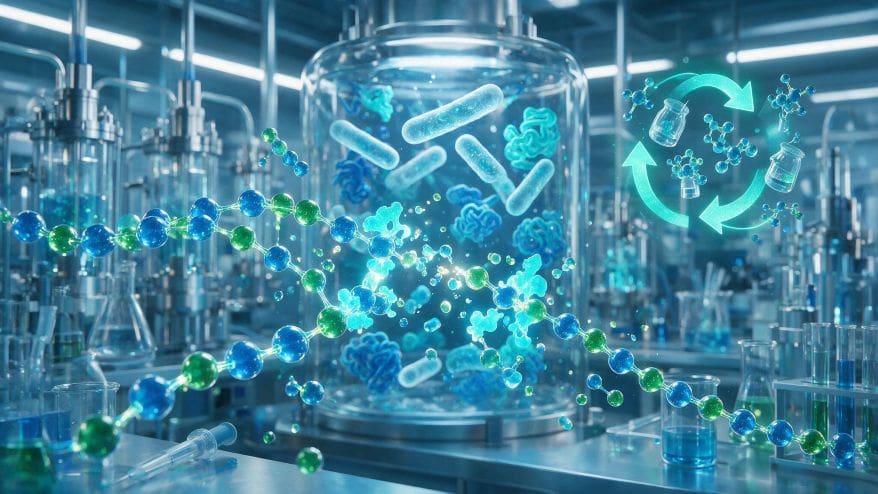
Most plastics never truly recycle—they simply become lower-quality materials before ending up in landfills or oceans. Crosslinked thermosets used in electronics and construction are especially problematic because they cannot be remelt. Now, researchers have engineered bacteria to produce building blocks for a new class of fully recyclable plastics called polydiketoenamines (PDKs). By controlling monomer chemistry through biosynthetic enzymes, they achieved programmable depolymerization across a 20–60°C range. This breakthrough matters because it offers a path toward plastics that can be recycle indefinitely without losing quality.
ENTECH STEM Magazine has included this research in its list of Top 10 STEM Discoveries and Innovations of July 2026.
Key Takeaways: Recyclable PDK plastics
- Engineered polyketide synthases produce monomers for fully recyclable PDK plastics.
- Additionally, Computational screening identified solvation free energy as the key predictor of depolymerization temperature.
- Moreover, Monomer stereochemistry and substituents govern thermal, mechanical, and optical properties.
- Corn-stover feedstocks can outperform petrochemical routes on cost and emissions.
- Current titers of 1.84 g/L require further scale-up for industrial viability.
- Furthermore, True chemical recycling enables infinite reuse without quality loss.
- This approach replaces fossil-derived dimedone with renewable, tunable alternatives.
Importance of Recyclable PDK plastics
Traditional plastics are made from fossil fuels and design to be durable. Unfortunately, this durability makes them nearly impossible to break down. Crosslinked thermosets—plastics that harden irreversibly—are uses in circuit boards, adhesives, and composites. They cannot be melt or reshape, so they almost always end up as waste.
Polydiketoenamines (PDKs) represent a different approach. These polymers can be depolymerizes back into their original monomers using acid, allowing true chemical recycling. However, earlier PDKs relied on a monomer called dimedone, which comes from petroleum. Moreover, dimedone offers limited flexibility for tuning material properties.
Also Read: Targeted Protein Degradation
How It Works: Step-by-Step
Think of a PDK plastic like a necklace made of identical beads. Recycling involves unthreading the necklace to recover the beads whole. This research focuses on designing better beads.
Step 1: Computational Screening of Recyclable PDK plastics
The team modeled 144 beta-keto-delta-lactones (BKDLs)—the potential monomer candidates. They calculated properties like solvation free energy, which predicts how easily the polymer will break down. This screening identified monomers with depolymerization temperatures spanning 20 to 60 degrees Celsius.
Step 2: Engineering Bacterial Factories
Next, researchers engineered hybrid type I polyketide synthases (PKSs). These are enzyme complexes that naturally produce complex molecules in bacteria. By modifying them, the team programmed Escherichia coli and Streptomyces bacteria to produce BKDLs with specific substituents and stereochemistry—meaning the monomers had precise three-dimensional shapes.
Step 3: Fermentation and Scale-Up
The engineered bacteria were grown in bioreactors, reaching production titers of 1.84 grams per liter. This is a significant yield for a synthetic biology process.
Step 4: Polymerization and Testing
Researchers chemically synthesized BKDLs identical to those produced by the bacteria. They then polymerized these monomers into PDK plastics. The resulting materials showed tunable glass transition temperatures ranging from 53 to 98 degrees Celsius. More importantly, different monomers enables temperature–gated depolymerization—meaning the plastic can be programmed to unzip at a specific temperature.
Step 5: Property Characterization
The team measured thermal, mechanical, solvent-resistance, and optical properties. They found that both the chemical substituents and the chirality (handedness) of the monomers influenced these characteristics.
Real-World Applications
Engineered PDK plastics have the potential to transform multiple industries. For example, in electronics, they can be uses to manufacture recyclable circuit boards and encapsulants that depolymerize for easy component recovery. Similarly, in construction, adhesives and coatings can be removes cleanly during building renovations. Moreover, carbon fiber-reinforced composites can enable efficient fiber recovery at the end of their lifecycle. In the automotive sector, interior components can be chemically recycled into new parts, while in packaging, high-performance containers for industrial chemicals can be designed to degrade on command. Additionally, PDK plastics can serve as support materials in 3D printing that dissolve under specific conditions. Finally, in the medical field, they could be uses to develop temporary implants or drug delivery systems that degrade safely at body temperature.
Benefits of Recyclable PDK plastics
True chemical recyclability enables monomers to be recovered intact, allowing infinite reuse without losing quality. Additionally, tunable monomer chemistry controls the material’s strength, flexibility, and degradation temperature. Moreover, renewable feedstocks such as corn stover (agricultural waste) can replace petroleum, making the process more sustainable. As a result, life-cycle analysis shows lower greenhouse gas emissions compared to conventional dimedone. Furthermore, technoeconomic modeling predicts that the process can remain cost-competitive at scale. Finally, programmable degradation allows designers to set the exact temperature for depolymerization, providing greater control over recycling and end-of-life management.
Challenges and Limitations
Production scale is currently limited. Bioreactor titers of 1.84 g/L are promising but far below industrial requirements. Further metabolic engineering and process optimization are needed. Monomer diversity remains constrained. While 144 candidates were screened computationally, only a subset has been produces biosynthetically. Expanding the toolkit requires additional enzyme engineering.
Cost of fermentation can be high compares to petrochemical routes. Although corn stover is cheap, purification costs may offset savings depending on the monomer. Property trade-offs exist. Monomers that depolymerize at lower temperatures may have reduced thermal stability in end use. Balancing recyclability with performance requires careful design. End-of-life infrastructure does not yet exist for PDKs. Chemical recycling requires collection, sorting, and processing systems that are not widely available.
Also Read: Heme-Derived Carbon Electrocatalyst: Transforming Energy Conversion Technology
Future Scope and Emerging Trends
Expanded monomer libraries will be generated through directed evolution of PKS enzymes. Additionally, machine learning can predict which enzyme modifications yield desirable monomers, thereby accelerating the discovery process. Furthermore, consolidated bioprocessing combines monomer production and polymerization in a single organism or reactor system, reducing both costs and complexity. Moreover, hybrid materials incorporating PDKs with other biopolymers could create composites with tailored degradation profiles, offering greater flexibility for future applications.
Carbon-negative plastics are theoretically possible if feedstocks come from atmospheric CO₂ captured by plants, combined with renewable energy for fermentation. Regulatory frameworks for chemically recyclable plastics are emerging. Early adopters may benefit from extended producer responsibility policies. Open-source design tools for predicting depolymerization behavior will democratize this technology for smaller companies and research groups.
Frequently Asked Questions
What are polydiketoenamine plastics?
They are a class of polymers that can be chemically recycle back into their original monomers. Unlike conventional plastics, PDKs do not degrade in quality during recycling, enabling infinite reuse cycles.
How do engineered bacteria produce plastic monomers?
Researchers modified polyketide synthase enzymes in E. coli and Streptomyces to produce beta-keto-delta-lactones. These monomers are the building blocks for PDK plastics with tunable properties.
Can these plastics be recycle at room temperature?
Depolymerization temperature is programmable between 20 and 60°C depending on monomer chemistry. This allows designers to choose conditions that match their recycling infrastructure.
Is this technology commercially available?
Not yet. The research demonstrates proof of concept at laboratory scale. Further development in metabolic engineering, fermentation, and purification is needed before commercial production.
Reference
Wang, Z., Cheong, S., Wang, H. et al. Engineered polyketide synthases enable a microbial chassis for recyclable plastics with tunable properties. Nat Biotechnol (2026). https://doi.org/10.1038/s41587-026-03229-7
- Author
- Latest Posts

I am an inspirational writer and emerging science blogger with a deep-rooted passion for understanding and sharing the wonders of the world around us. My journey began with a Bachelor of Science in Chemistry from AKI’s Poona College of Arts, Commerce and Science, where I developed not only a strong foundation in scientific principles but also a mindset that values curiosity, observation, and critical thinking. Studying chemistry has taught me to approach problems with logic, to look beyond the obvious, and to see patterns where others might only see complexity. These experiences have shaped the way I perceive life and influence the way I express my thoughts, both scientifically and creatively.
I have always believed that knowledge is only as powerful as the way it is shared. This belief has guided me to create content that bridges the gap between science and everyday life. I aim to simplify complex scientific ideas so they become approachable, relatable, and engaging for everyone—whether someone has a formal background in science or is simply curious about the world. Science, in my view, is not confined to textbooks and laboratories; it is a way of thinking, understanding, and connecting with the world around us. By making science accessible, I hope to inspire curiosity, ignite learning, and encourage people to see the beauty and relevance of scientific discovery in their daily lives.
Alongside my love for science, I am deeply passionate about motivational writing. I believe words carry the power to transform perspectives, encourage self-reflection, and inspire action. By combining analytical thinking with creativity, I create content that is intellectually stimulating yet emotionally resonant. Whether I am breaking down a chemical concept, exploring a scientific phenomenon, or crafting motivational narratives, my goal is to communicate ideas in a way that is clear, meaningful, and impactful.
Through my work, I strive to empower my readers – not just by helping them understand the science around them, but by inspiring them to grow, learn, and realize their full potential. Every article, post, or story I write reflects my commitment to turning knowledge into inspiration. I want to spark curiosity, encourage self-improvement, and show that learning and personal growth are deeply connected. For me, writing is not just a craft; it is a way to touch minds, connect hearts, and make ideas come alive in a way that truly resonates.