Doctors used heart rate variability (HRV) to monitor the diver’s autonomic nervous system.
Decompression Sickness: Causes, Symptoms, and Prevention
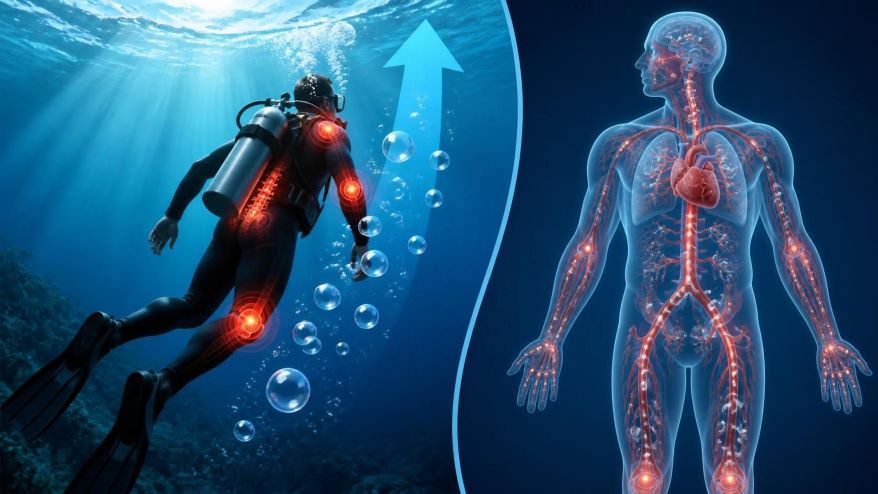
Imagine descending into the deep blue ocean. The pressure around you increases with every meter. Your body feels normal, but a silent process is already underway. Gases like nitrogen dissolve into your blood and tissues. This process is harmless—until you ascend too quickly. Then, those dissolved gases form bubbles. These bubbles cause joint pain, dizziness, and nerve damage. This condition is decompression sickness. It is also called “the bends.” It affects divers, aviators, and even astronauts. For medical professionals and outdoor enthusiasts, accurate knowledge can save lives. As a botanist, I explain these risks using simple analogies. Think of a soda bottle. Shake it, open it fast, and bubbles explode. The same physics applies to your body. Understanding this pressure-biology link is vital.
Key Takeaways:
- Decompression sickness happens when dissolved nitrogen forms bubbles during rapid ascent.
- Pressure changes during diving force nitrogen into your blood and tissues.
- Symptoms range from joint pain to paralysis and require immediate medical care.
- Prevention relies on slow ascents, safety stops, and following dive tables.
- Proper hydration and avoiding alcohol reduce your risk significantly.
How Nitrogen Dissolves in Your Blood and Tissues
The story of decompression sickness begins with Henry’s Law. This law states that the amount of gas dissolved in a liquid is proportional to the partial pressure of that gas above the liquid. In simple terms, when you are underwater, the pressure around you increases. Your lungs deliver air at ambient pressure. That air contains about 78% nitrogen. Nitrogen is inert, meaning your body does not use it. Nevertheless, it dissolves in your blood plasma and then in your tissues.
Pressure Changes During Diving: The Physics of Ascents and Descents
Diving introduces your body to significant pressure gradients. With every 10 meters of salt water, pressure increases by 1 atmosphere. The human body consists mostly of water, which is incompressible. But the gas spaces in your body—sinuses, lungs, and middle ear—are compressible. As you descend, these gas spaces shrink. As you ascend, they expand. This change is governed by Boyle’s Law, which states that the volume of a gas is inversely proportional to its pressure.
Bubble Formation: The Mechanical Trigger of Symptoms
When you ascend too quickly, nitrogen bubbles form directly in your blood and tissues. These bubbles act like foreign objects. They can block blood vessels, causing embolisms. They can compress nerves, causing pain or paralysis. Bubbles can also trigger inflammation and clotting. The location of bubbles determines the type of symptoms you will experience.
Recognizing the Symptoms of Decompression Sickness
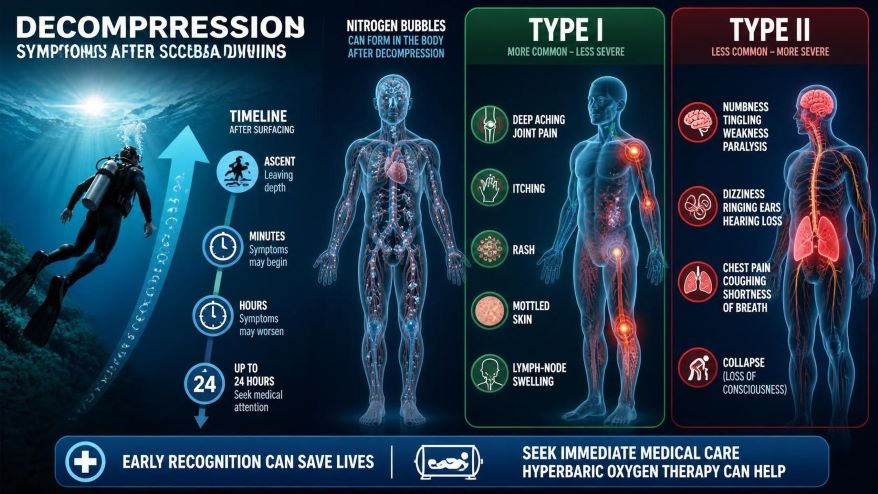
Symptoms of decompression sickness usually appear within minutes to hours after surfacing. They can start during ascent or up to 24 hours later. Early recognition is crucial for successful treatment. Symptoms are divided into two main categories: Type I and Type II.
Type I decompression sickness affects the musculoskeletal system and skin. The most common symptom is pain in one or more joints. The pain is deep, aching. At times, it is described as a “bone-crushing” sensation. It may start gradually. Thereafter, it can become severe. Skin symptoms include itching and rashes. A mottled appearance called “cutis marmorata” also occurs. Swelling of the lymph nodes may occur. To illustrate, these symptoms are uncomfortable. After all, they are rarely life-threatening.
Type II decompression sickness affects the nervous system, lungs, and inner ear. This type is more serious. Neurological symptoms include numbness and tingling. Weakness or paralysis is also possible. What’s more, dizziness and ringing in the ears occur. Hearing loss indicates inner ear involvement. Pulmonary symptoms include chest pain and coughing. Shortness of breath is common too. In severe cases, collapse can happen. In summary, any neurological symptom requires immediate evaluation. Any respiratory symptom after a dive demands medical attention.
Prevention Strategies for Safe Diving
Preventing decompression sickness starts with careful dive planning. Divers must limit their depth and bottom time. Dive computers or tables calculate the maximum allowable time at each depth. These tables account for the rate of nitrogen absorption. Safety stops are mandatory for any dive deeper than 10 meters. A three- to five-minute stop at 3 to 5 meters allows excess nitrogen to leave the body slowly.
Frequently Asked Questions
Can decompression sickness occur after flying or diving?
Yes. Flying soon after diving increases your risk. The reduced cabin pressure in an airplane accelerates bubble formation. Most agencies recommend waiting 12 to 24 hours after a single dive before flying. For multiple dives, a 24-hour surface interval is safer.
Is decompression sickness the same as air embolism?
No, these are different conditions. Arterial gas embolism occurs when a bubble enters an artery and blocks blood flow to the brain or heart. This usually results from lung overexpansion. Decompression sickness is caused by bubbles forming from dissolved gas. Both require hyperbaric treatment, but they have different causes and onset times.
Can I treat decompression sickness with oxygen at home?
No. First aid includes giving 100% oxygen. To begin with, keep the person lying flat. Provided that this is done, it helps stabilize them. However, definitive treatment requires a hyperbaric chamber. The chamber applies pressure. As a result, it shrinks the bubbles. In addition, it increases oxygen delivery. At the same time, this restores blood flow. Above all, time is critical here. Delaying treatment can lead to permanent disability. After all, the longer bubbles remain, the more damage occurs. So as to avoid this, seek help immediately. In conclusion, do not wait to see if symptoms improve. All things considered, oxygen is a bridge, not a cure.
References
Mitchell S. J. (2024). Decompression illness: a comprehensive overview. Diving and hyperbaric medicine, 54(1Suppl), 1–53. https://doi.org/10.28920/dhm54.1.suppl.1-53
Sánchez-Villalobos, J. M., Fortuna-Alcaraz, M. L., Serrano-Velasco, L., Pujante-Escudero, Á., Garnés-Sánchez, C. M., Pérez-Garcilazo, J. E., Olea-González, A., & Pérez-Vicente, J. A. (2022). Breath-Hold Diving-Related Decompression Sickness with Brain Involvement: From Neuroimaging to Pathophysiology. Tomography, 8(3), 1172-1183. https://doi.org/10.3390/tomography8030096
- Author
- Latest Posts

Charudatta Pathak was a student at St. Aloysius High School in Bhusawal, established in 1874, making it one of India’s oldest convent institutions. He earned his bachelor’s degree in mechanical engineering from SSVPS College of Engineering, Dhule in 1995, demonstrating exceptional academic achievement. Thereafter, he launched his career as a CNC programmer in a toolroom. He has utilized FANUC, Deckel, Maho, and Mikron controllers to operate 2-axis and 3-axis machines for the fabrication of jigs, fixtures, dies, and molds. He commenced his career as an academic in 1996, when he assumed the role of lecturer at SSVPS College of Engineering, Dhule. Additionally, he earned his post-graduate degree in CAD/CAM from L. D. College of Engineering, Ahmedabad, in 2000, and then acquired a Ph.D. from COEP in 2011 while concurrently engaged in teaching. Until 2023, he occupied many academic roles, including lecturer, assistant professor, professor, dean, principal, director, and vice chancellor at both public and private universities throughout India. From 2008 to 2010, he served as the project lead in the CAE department of a European multinational firm. During his 28-year professional tenure, he identified a need for dependable books targeted at students in grades 8 to 12, particularly for nascent career planning. He founded ENTECH Digital Magazine, a free monthly publication available on entechonline.com and magzter.com. Teens with a strong interest in Science, Technology, Engineering, and Mathematics (STEM) who aspire to pursue careers in these fields may find ENTECH Digital Magazine beneficial.