Technology keeps getting better and more advanced. This means people need to stay updated and knowledgeable. One of the newest changes in the tech world is edge computing.
Edge Computing Explained in 5 Easy Steps
Estimated reading time: 9 minutes
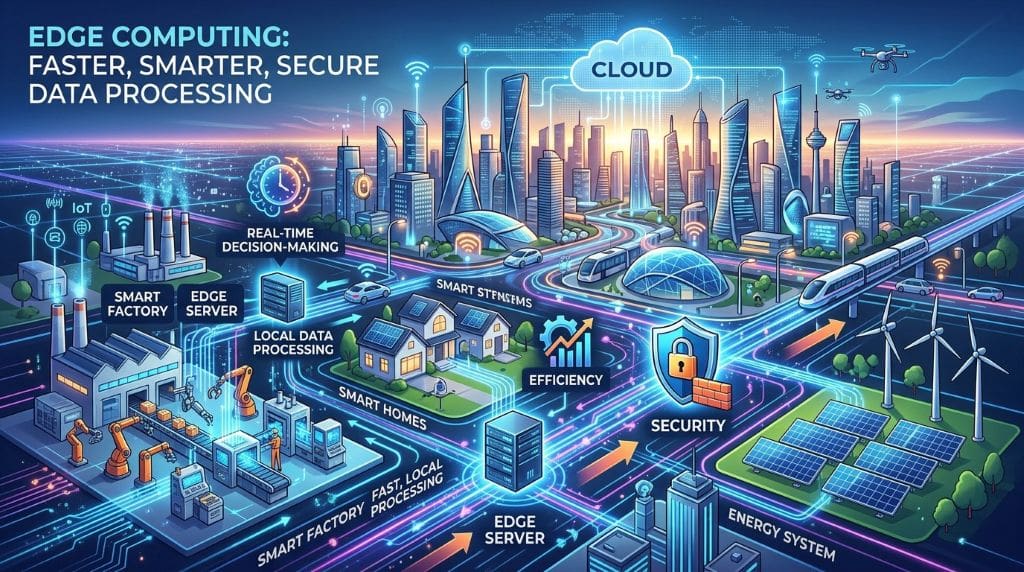
Edge computing is changing how we use data. It brings processing closer to users, making everything faster and smarter. In fact, this technology is vital for IoT, smart manufacturing, and energy systems. Particularly, security and efficiency are at the core of its benefits. Thus, it is shaping the future of digital transformation.
Important Points to Remember
- Processing closer to data sources.
- Reduces latency and conserves network bandwidth.
- Powers IoT and smart devices.
- Improves security by limiting data exposure.
- Enables real-time decision-making.
- Supports smart manufacturing and energy systems.
Edge Computing Explained in 5 Easy Steps
Step 1: What Is Edge Computing?
Edge computing is a distributed approach to data processing. At present, it means handling data near its source. For example, this could be a sensor, a camera, or a smart device. Thus, it reduces the need to send everything to the cloud. As a result, it saves time and bandwidth. In short, it is about local action and fast results. For a detailed edge computing tutorial, see the Oriental Journal of Computer Science and Technology.
To point out, it is not just for tech giants. In fact, it is used in homes, factories, and cities. It is also the foundation of the Internet of Things (IoT). For more on IoT basics, see ENTECH Magazine’s guide.
Key Fact: It is a distributed model that processes data at or near the source, rather than solely in the cloud.
Step 2: How Does Edge Computing Work?
To explain, edge computing uses a three-layer architecture. The first layer is the device layer. This includes sensors, cameras, and IoT devices. The second layer is the edge node. These are local servers or gateways that process data nearby. The third layer is the cloud, which handles long-term storage and big analytics.
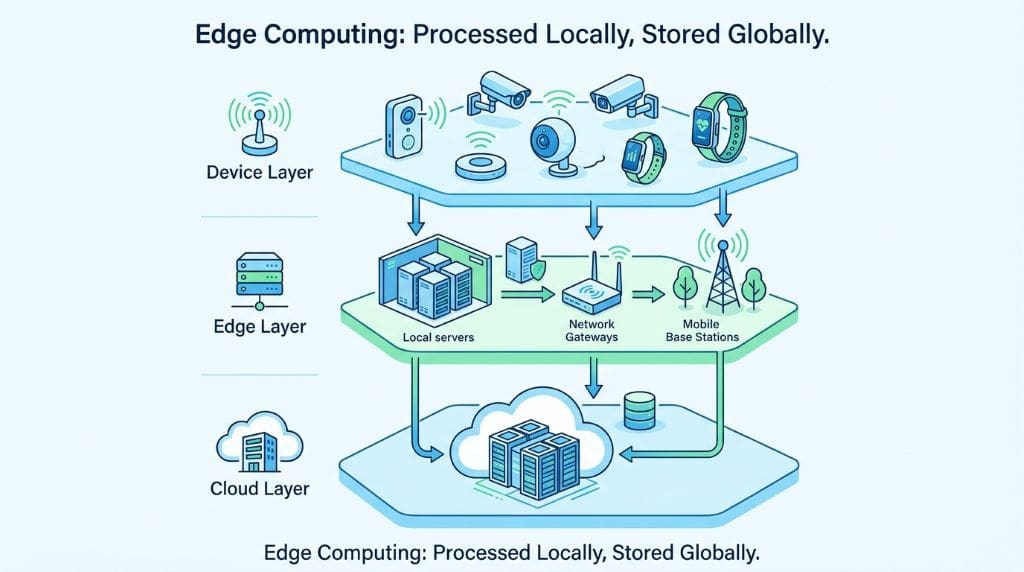
Also, it can use different technologies. Mobile Edge Computing (MEC) places computing power in mobile base stations. Cloudlets are small data centers near users. Fog computing extends cloud services to the edge. Each approach brings processing closer to where data is generated.
Edge Computing Architecture: Three Layers
| Layer | Description | Example Devices |
| Device Layer | Data generation and initial processing | Sensors, cameras, IoT |
| Edge Layer | Local processing and analytics | Gateways, edge servers |
| Cloud Layer | Centralized storage and advanced analytics | Cloud data centers |
Key Fact: Edge computing architectures include end devices, edge nodes, and cloud servers, with data processed across multiple layers.
Step 3: Why Does Edge Computing Matter?
Edge computing offers major benefits for modern technology. At present, it reduces latency, resulting in faster responses for users. It also saves bandwidth by processing data locally. Thus, it improves privacy, as sensitive data stays close to its source. In short, it makes systems more reliable and efficient.
To illustrate how it is vital for real-time applications. Consider autonomous vehicles or smart factories. These systems require instant decisions. It delivers that speed. For more on cloud vs edge computing, see ENTECH Magazine’s comparison.
5 Key Benefits of Edge Computing
- Reduced Latency: Data is processed closer to the source, resulting in faster responses.
- Lower Bandwidth Use: Less data is sent to the cloud, conserving network resources.
- Improved Privacy: Sensitive information stays local, reducing exposure risks.
- Enhanced Reliability: Local processing means fewer disruptions when the network fails.
- Real-Time Decisions: Edge computing enables instant actions for critical systems.
All in all, these benefits make edge computing ideal for modern applications. At the same time, it supports the growing number of connected devices. In short, it is the backbone of smart technology. With this in mind, businesses are adopting it to improve performance.
Step 4: Where Is Edge Computing Used?
Edge computing is used in many real-world applications. For example, it powers smart grids and energy systems. In these systems, edge nodes process data from sensors and meters, enabling real-time monitoring and control. For example, in smart manufacturing, it helps factories make quick decisions. Machines and sensors process data on-site, leading to higher efficiency and less downtime. Healthcare uses it for patient monitoring. Devices process data locally, ensuring fast alerts and privacy. Smart cities use it for traffic control and public safety. For more on smart manufacturing, see the International Journal of Engineering and Computer Science.
4 Ways Edge Computing Transforms Manufacturing
- Faster Decisions: Machines react instantly to sensor data.
- Improved Efficiency: Processes are optimized in real time.
- Greater Flexibility: Systems adapt quickly to changes in demand.
- Enhanced Reliability: Local processing reduces the risk of network failures.
In effect, it is the key to smart factories. At length, it supports automation and predictive maintenance. With this in mind, manufacturers can reduce costs and boost productivity. In sum, it is driving the future of industry.
Step 5: What Are the Challenges and Future of Edge Computing?
While edge computing offers many benefits, it also presents challenges. Security is a top concern. More devices mean more entry points for attackers. Standardization is another issue. Different systems need to work together seamlessly. Resource management is also important. Edge devices have limited power and storage, so efficient task scheduling is needed. At the same time, privacy must be protected at every level. The future of edge computing is bright. AI and 5G will make edge devices even smarter. Digital twins and smart cities will rely on it for real-time insights. In sum, it is set to drive the next wave of innovation. For more on cybersecurity, see Entech Magazine’s introduction.
Real-World Use Cases
Edge computing is not just a theory. It is used in practice every day. For example, smart grids use edge nodes for real-time monitoring, helping balance energy supply and demand. In healthcare, edge devices monitor patients and send alerts, saving lives by providing instant feedback. Smart cities use it for traffic lights and surveillance, where these systems need fast, local decisions.
Why Edge Computing Is the Upgrade Your Devices Need
At this moment, your devices are generating more data than ever. Above all, edge computing is the technology that keeps everything running smoothly. It processes information right where it is created. This means less waiting and more doing. In fact, it is the reason your smart home feels smart. In short, it is the backbone of modern technology. With this in mind, let’s see how it works in five easy steps.
3 Real-World Examples
- Smart Grids: Edge nodes manage energy flow in real time.
- Healthcare: Devices process patient data for instant alerts.
- Smart Cities: Traffic and safety systems use edge analytics.
It powers the systems we rely on every day. Its impact is growing quickly.
IoT: A Perfect Match
Edge computing and IoT are closely linked. IoT devices generate large amounts of data. Sending all this data to the cloud is slow and costly. Conversely, it processes data locally, making devices smarter and faster. Actually, in smart homes, factories, and cities, IoT and edge computing work together. This partnership enables real-time decisions and efficient operations. For more on IoT and edge computing, see Mao et al. (2017).
Smart Manufacturing
Smart manufacturing uses edge computing for real-time control. Machines and sensors process data on-site. This leads to faster decisions and less downtime. It supports automation and predictive maintenance. In fact, it helps factories adapt quickly to changes. In sum, it is essential for Industry 4.0. For more on smart manufacturing, see the International Journal of Engineering and Computer Science.
Energy Systems
Edge computing is transforming energy systems. Smart grids use edge nodes for real-time monitoring and control, improving efficiency and reliability. For example, it helps balance energy supply and demand and supports the integration of renewable energy. In short, it is vital for modern power networks. For more on power IoT, see Liu et al. (2022).
Security Concerns
Security is a major concern in edge computing. More devices mean more entry points for attackers. Also, protecting data at every level is essential. Additionally, it can improve privacy by keeping data local. However, strong security measures are still needed. In sum, security is both a challenge and a benefit of it. For more on cybersecurity, see ENTECH Magazine’s introduction.
The Future of Edge Computing Explained
At present, it is evolving alongside AI and 5G. As a result, these technologies make edge devices smarter and faster. Also, digital twins and smart cities will rely on it for real-time insights. To sum up, it is set to drive the next wave of innovation. It will support sustainable, energy-efficient systems. In short, the future of technology is at the edge.
Key Finding: It is not just a trend. It is the backbone of tomorrow’s digital world. Also, it brings speed, security, and intelligence to every device and system. In fact, it is here to stay — and changing everything.
Check out ENTECH magazine at entechonline.com for articles by experienced professionals, innovators, and researchers.
Frequently Asked Questions (FAQ)
What is edge computing in simple terms?
It is a distributed model that brings processing closer to data sources. Thus, it avoids sending all data to distant cloud servers. This speeds responses and saves bandwidth. In short, it is about local data handling.
How does edge computing help IoT devices?
It enables IoT devices to process information locally. This reduces latency and improves performance. As a result, smart devices can make real-time decisions. It is essential for modern IoT systems.
What are the main benefits of edge computing?
It offers lower latency and better privacy. In fact, it conserves bandwidth and enables real-time actions. It also improves reliability by reducing dependence on the cloud. These benefits are vital for smart technology.
Is edge computing secure?
While it may introduce security risks, it also protects data. Local processing limits exposure to external threats. However, more devices mean more entry points. Particularly, strong security measures are needed at every level.
Where is edge computing used today?
It is used in smart cities and factories. Also, it powers energy grids, healthcare, and autonomous vehicles. It is also vital for IoT and real-time analytics.
What is the future of edge computing?
Edge computing will grow alongside AI and 5G. In fact, it will support digital twins, smart cities, and sustainable systems. For sure, it is poised to drive the next wave of innovation.
References
Liu, Y., Wang, Y., Wang, Y., Wang, Y., & Wei, Z. (2022). Edge computing application, architecture, and challenges in ubiquitous power Internet of Things. Frontiers in Energy Research, 10, Article 850252. https://doi.org/10.3389/fenrg.2022.850252
Mao, Y., You, C., Zhang, J., Huang, K., & Letaief, K. B. (2017). Edge computing technologies for Internet of Things: a primer. Digital Communications and Networks, 4(2), 113–120. https://doi.org/10.1016/j.dcan.2017.07.001
An edge computing tutorial. (2019). Oriental Journal of Computer Science and Technology, 12(2). http://dx.doi.org/10.13005/ojcst12.02.04
Hamdan, S., Ayyash, M., & Almajali, S. (2020). Edge-computing architectures for Internet of Things applications: A survey. Sensors, 20(22), 6441. https://doi.org/10.3390/s20226441
IoT and edge computing for smart manufacturing: Architecture and future trends. (2024). International Journal of Engineering and Computer Science, 13(10). https://doi.org/10.18535/ijecs/v13i10.4922
- Author
- Latest Posts

Charudatta Pathak was a student at St. Aloysius High School in Bhusawal, established in 1874, making it one of India’s oldest convent institutions. He earned his bachelor’s degree in mechanical engineering from SSVPS College of Engineering, Dhule in 1995, demonstrating exceptional academic achievement. Thereafter, he launched his career as a CNC programmer in a toolroom. He has utilized FANUC, Deckel, Maho, and Mikron controllers to operate 2-axis and 3-axis machines for the fabrication of jigs, fixtures, dies, and molds. He commenced his career as an academic in 1996, when he assumed the role of lecturer at SSVPS College of Engineering, Dhule. Additionally, he earned his post-graduate degree in CAD/CAM from L. D. College of Engineering, Ahmedabad, in 2000, and then acquired a Ph.D. from COEP in 2011 while concurrently engaged in teaching. Until 2023, he occupied many academic roles, including lecturer, assistant professor, professor, dean, principal, director, and vice chancellor at both public and private universities throughout India. From 2008 to 2010, he served as the project lead in the CAE department of a European multinational firm. During his 28-year professional tenure, he identified a need for dependable books targeted at students in grades 8 to 12, particularly for nascent career planning. He founded ENTECH Digital Magazine, a free monthly publication available on entechonline.com and magzter.com. Teens with a strong interest in Science, Technology, Engineering, and Mathematics (STEM) who aspire to pursue careers in these fields may find ENTECH Digital Magazine beneficial.